Bloody Christmas Fighting in Fiume
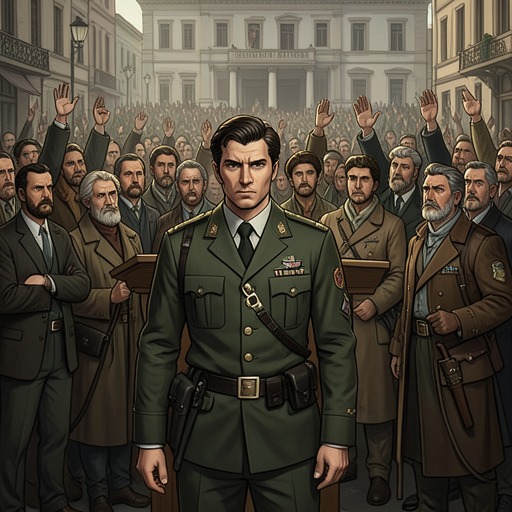
M: Son of the CenturyThe Bloody Christmas Fighting in Fiume was the armed confrontation that ended Gabriele D’Annunzio’s attempt to hold the city against the Italian government and the settlement imposed by the Treaty of Rapallo. It began with ultimatums and a blockade, became a fight between Italian forces on both sides, and concluded with D’Annunzio relinquishing his authority and the legionnaires agreeing to leave. Its bitter contrast was between the language of national brotherhood and a conflict in which the state used force against men who claimed to be defending Italy’s honor.
Ultimatums and a narrowing choice
In early December 1920, General Enrico Caviglia, commanding the contingent sent from Rome to enforce the Treaty of Rapallo, ordered D’Annunzio to evacuate the towns of Veglia and Arbe, which his forces had occupied in defiance of the treaty. On December 20, Caviglia issued a further ultimatum: within forty-eight hours, the legionnaires were to return inside the borders of the Fiume territory recognized by the treaty. At the same time, the government imposed a blockade by land and sea. The pressure made the dispute immediate: D’Annunzio could accept the limits established by the agreement or resist the state’s effort to enforce them.
D’Annunzio answered with three proclamations in twenty-four hours. In appeals to sailors and soldiers, he urged resistance and invoked the bond between Italians, even as he warned of the possibility of death. The language made the crisis a test of loyalty: the troops ordered to besiege Fiume were being addressed as brothers by the people they had been sent to confront. In Milan, Benito Mussolini publicly opposed the blockade and argued that the Fiume Regency should be recognized, presenting recognition as a way to end the dispute without annexation. Yet at a secret meeting of the fasci central committee on December 24, he described Fiume as a secondary issue and said that the movement’s future lay in domestic rather than foreign policy. His position exposed the difference between public solidarity with D’Annunzio and the priorities of an organization trying to establish its political direction.
The attack and the defense
Italian regular troops began their attack at five o’clock on the afternoon of December 24, after the committee meeting in Milan had ended. In Fiume, news of the offensive reached the command room around six. D’Annunzio did not immediately issue an order to fire; it took Major Vagliasindi, a legionnaire inspector, about an hour to obtain one. By then, the first legionnaire garrisons near Cantrida had been surrounded and captured by troops of the Italian Royal Army. The delay placed the Commander’s earlier declarations of readiness to die beside the practical difficulty of directing the defense once the attack arrived.
The first assault was rapid, but it did not settle the battle. Legionnaires had been ordered not to engage and fell back toward the last defensive line around the city. Appeals to the advancing troops to stop short and avoid a grave disaster were ignored. After D’Annunzio’s order came, the defenders reinforced breaches in the line and counterattacked. By nightfall on December 24, they had re-established the line around Fiume. On Christmas Day, Caviglia held the attack in a truce until dawn on December 26, while the army commander, General Ferrario, had ordered that artillery be used more heavily when operations resumed.
At 6:50 a.m. on December 26, regular troops attacked again, concentrating on the central sector. The assault failed; the legionnaires held their positions, counterattacked, captured a cannon, and took prisoners. By midday, the prospect of entering the city had become a question of whether doing so would require a massacre. Caviglia then ordered Admiral Simonetti, commanding the battleship Andrea Doria off the port, to fire on military targets in the city.
Bombardment, surrender, and demobilization
After drafting a proclamation, D’Annunzio appeared withdrawn again and went out onto the balcony of the command building. The ship’s gunner could see him through a telescope from about 800 yards offshore. Shortly after D’Annunzio returned inside, two shells struck the building’s facade; one hit near the study window. The blast injured him slightly and led officers to carry him out of the room. The attack ended any remaining expectation that the confrontation could be settled without force reaching the city itself.
D’Annunzio’s response turned from apparent detachment to anger. He ordered an attack on the battleship Dante Alighieri, which was in Fiume’s port, but that order was not carried out. Rumors spread that he had been killed; he was alive, and issued a proclamation rejecting the idea that he would continue offering his life for a country that had not risen in Fiume’s defense. The episode brought his public pose of sacrifice into conflict with a more immediate question: whether continued resistance would expose the city and its inhabitants to still greater danger.
Bombardment continued over the following forty-eight hours, though it was not heavy. One civilian was killed and several were wounded. On the morning of December 28, Ferrario refused to negotiate surrender terms and threatened to intensify the bombing. Fiume’s citizen representatives appealed to D’Annunzio to give up his powers. He did so, transferring the authority granted to him on September 12 to the mayor and the people of Fiume. During the week of fighting, he had rarely left his study and had not joined the legionnaires on the firing line. The Commander who had repeatedly invoked heroic death ended the confrontation by acknowledging that he could not impose ruin and death on the city.
At 4:30 p.m. on December 31, an agreement was signed in Abbazia providing for the legionnaires’ total demobilization from Fiume. The fighting had not produced the national uprising D’Annunzio had sought: appeals to Italian solidarity did not prevent Italian troops from attacking, and support elsewhere was limited. The episode thus marked both the end of his armed defiance and the limits of its political reach.
The meaning of a failed spectacle
The conflict closed a year that D’Annunzio had described to his legionnaires as one of passion, associating Fiume with youth, life, and a future carried forward by the dead and the unborn. That rhetoric made the city an emblem of renewal against what he portrayed as the weakness and compromise of postwar Europe. The outcome was more constrained: a blockade, military attack, civilian casualties, surrender of authority, and demobilization. The distance between the promise of a new beginning and the actual end of the regime is central to the event’s significance.
The book also places Fiume’s defeat against the broader political use of mass ritual and national symbols. The Unknown Soldier’s burial in November 1921 would turn an unidentified fallen soldier into a public focus for collective mourning, while fascist leaders gathered at the tomb in a scene presented as political religion. That later ceremony does not undo the Christmas fighting; it sharpens the contrast between honoring the dead through national ritual and the earlier failure to prevent Italians from fighting one another. At Fiume, the language of brotherhood could not reconcile D’Annunzio’s claim to represent Italy with the authority of the Italian state.