Carnaro Charter
M: Son of the CenturyThe Carnaro Charter was a proposed constitution for Fiume that sought to make political freedom inseparable from social provision and shared cultural life. Drafted by Alceste De Ambris and received by Gabriele D’Annunzio in March 1920, it imagined a republic in which citizens’ lives would be not merely protected but made worthy and beautiful. Its expansive account of rights and labor stood in tension with the city’s siege conditions and, especially, with the economic order its property provisions challenged.
Draft and setting
On March 18, 1920, D’Annunzio received a constitutional draft from De Ambris, a syndicalist of direct action whom he had called to serve as head of his cabinet at the beginning of the year. The book presents the text as revolutionary: it drew on radical socialism and libertarian principles to propose a democracy grounded in the rights of workers and individuals. It was a program for the projected Republic of Carnaro, not an account of rights already secured in the daily life of the city.
That distinction mattered in Fiume. The city had been awaiting annexation to Italy since September 1919 and had endured months of restricted supplies. Rome could regulate provisions, leaving the city dependent on an external government for necessities. In January, hundreds of poor children were sent from the port to Italian families in what the account calls a children’s crusade; food was rationed, fuel oil was scarce, and the city was cold and dark. Against these conditions, the Charter’s promises of minimum wages and assistance for illness, disability, unemployment, and old age read as a direct answer to material insecurity, though the evidence does not show those guarantees taking effect.
Citizenship, rights, and public life
The Charter placed collective sovereignty in all citizens without distinction of sex, race, language, class, or religion. Its guarantees extended beyond political participation: freedom of the press, speech, thought, religion, and sexual liberty were paired with elementary schooling, physical education, minimum wages, and social assistance. The design therefore treated civil liberties and material support as parts of the same constitutional project rather than separate concessions.
Its definition of citizenship also emphasized contribution to common life. The text describes full citizens as assiduous producers of common wealth and creators of common strength, joining individual standing to participation in a functioning collective. Religious faiths could be practiced and establish temples, but religious observance could not exempt citizens from duties imposed by law. The arrangement both protected plural belief and placed a common civic obligation above any claim to avoid public rules.
The Charter gave workers’ associations a role in shaping the culture of the republic. Each association was to develop insignia, emblems, music, songs, prayers, ceremonies, and rites, and to contribute to shared festivals, anniversaries, and land and sea sports. Associations were also to honor the dead, elders, and heroes. Construction workers, for example, were expected to encourage folk art even in the humblest homes. Music was conceived as a social institution, not simply private recreation or official ornament. The proposed civic order thus made collective expression part of the structure of citizenship.
Work, dignity, and beauty
The Charter aimed to transform labor rather than merely regulate its terms. Work, including the humblest work, was to cease being brutal and backbreaking toil and become an activity capable of aspiring to beauty and beautifying the world. Its ideal of effort without effort gave this aspiration a concise form: labor would remain effort, but should no longer be defined only by exhaustion and compulsion.
D’Annunzio’s revisions made aesthetic language central to this account of political dignity. As he reworked De Ambris’ text, he added a formulation in which a person renewed by liberty could live magnificently while remaining worthy. The Charter’s promise was consequently more ambitious than a minimum standard of welfare. Education, physical development, creative work, social recognition, and liberty belonged together in its picture of a complete life. The political community was expected not only to distribute protections but to make room for citizens to create, celebrate, and take part in shared forms of meaning.
Property and the economic limit
The Charter’s most consequential economic provision linked private property to its social utility. Property could not simply be reserved to one individual as though ownership were absolute; an owner could not leave land fallow or dispose of it in a way that excluded everyone else. The principle aimed to prevent ownership from becoming a license to withhold productive resources from the community.
That clause also revealed a limit within the project. Maffeo Pantaleoni, D’Annunzio’s former minister of finance, observed that the provision made the Charter incompatible with modern capitalist economic and commercial activity. The tension was not incidental: the document combined extensive individual liberties with a social claim on property that could constrain an owner’s control. Its social protections and democratic language therefore did not simply supplement the existing economic order; the land provision challenged one of that order’s central assumptions.
D’Annunzio’s handling and significance
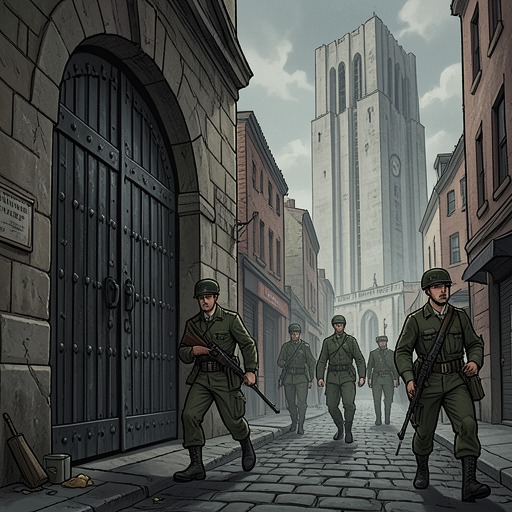
D’Annunzio kept the Charter close and did not reject it, but he also did not present it as a settled constitution put into practice. He guarded the document and rewrote it privately each day in his own elevated, oracular style, while leaving its substance unchanged. This work of revision continued alongside a sharply different public routine: at dawn he led troops on marches into the valleys around Fiume, setting out after three trumpet blasts from Piazza Roma and returning with the legionnaires before noon. The contrast places the proposed civic order beside the martial spectacle through which the Commander maintained his authority.
The Charter’s importance in the narrative lies in the range of life it tried to bring within constitutional design. It joined sovereignty and civil liberty to social guarantees, organized labor, artistic expression, public ceremony, and a critique of property without resolving the conflict between its egalitarian ambitions and the economic system that conflict implicated. Fiume’s shortages make the distance between promise and circumstance visible; D’Annunzio’s private, stylistic revision makes the document at once a political proposal and an object of personal authorship. The evidence establishes its ambitious design and its guarded treatment, but not its implementation as the governing reality of the city.