Crisis and collapse of the Italian liberal state
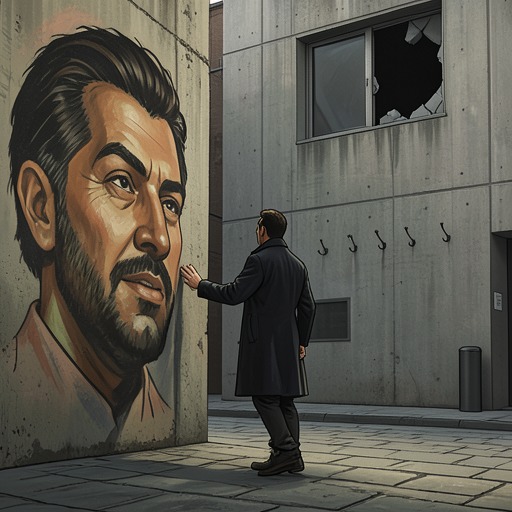
M: Son of the CenturyThe crisis and collapse of the Italian liberal state unfolded through a widening gap between the formal operation of institutions and their declining capacity to command events. Governments, elections, parliamentary debates, and emergency orders continued, yet political violence went unchecked, factions obstructed one another, and officials turned to Fascist organizations for assistance. The resulting collapse was neither instantaneous nor complete: it was a process in which the state’s own responses helped strengthen forces that challenged its authority.
Postwar exhaustion and a weakening state
The crisis took shape in a society marked by the First World War’s enormous human cost and the return of millions of soldiers. The postwar political landscape is presented as a stage emptied of its old leaders, while five million veterans press back into public life. The surviving political class appears unable to address the scale of change; the prospect of further conflict, rather than a settled peace, remains central to the account. This vision of exhaustion matters because the liberal state’s difficulty is not represented as a temporary failure of one ministry. It is a broader loss of confidence in the institutions and political habits that had governed Italy before the war.
The competing symbols of the postwar moment sharpen that loss. Gabriele D’Annunzio casts Fiume as youthful, vital, and oriented toward a future, in contrast to the exhausted diplomacy of Versailles. His rhetoric is not itself proof that the state has collapsed, but it illustrates how alternative political projects could claim to embody renewal while the established order appeared hesitant and spent. Later, Fascist language likewise presents national rebirth as an answer to decline. Such claims gave the crisis an ideological dimension: institutional weakness could be described not simply as administrative failure, but as evidence that a new political order was needed.
The state’s reliance on Fascist force
A decisive contradiction emerges when the liberal state seeks Fascist cooperation to contain its revolutionary opponents. In Milan, Michele Bianchi had already arranged for Fascist groups to assist the prefect in maintaining public order. A confidential government circular then urged Fascist collaboration in suppressing revolutionary attempts, including through violence, on the condition that the groups accept official command. The state was not merely facing an external challenge. In trying to counter one threat, it made use of a movement whose armed capacity and political ambitions would further erode its authority.
The consequences are visible in the response to deaths during a confrontation in the countryside. After eight people were killed and roughly thirty injured, the Chamber of Labor called a province-wide general strike lasting seventy-two hours. The suspension of public and private services deepened the sense that ordinary administration could not contain conflict. In response, farmers, manufacturers, merchants, professionals, public employees, and homeowners organized the Bolognese Association of Social Defense. Its delegation told Prime Minister Francesco Saverio Nitti that the state had abdicated in the face of socialist violence and offered to replace it in the name of self-defense. The episode shows how fear of disorder could produce new organizations claiming powers the state was perceived to have abandoned.
Fascist influence also grew through local alliances and resources. In Ferrara, new sections formed rapidly after the Castello Estense slaughter, and Fascist inspector Marinoni found that many lacked political or ideological content beyond opposition to the socialists. The agrarians supplied material support; their leading figures joined as supporting members and registered their children as squad members. By December 20, they had paid 20,000 lire into Fascist funds. Benito Mussolini attempted to resist the appearance that rural Fascism had become dependent on large landowners, promoting a plan to distribute uncultivated land in small plots to those who worked it. Yet the contrast between that public program and the movement’s financial reliance on agrarian supporters reveals how the state’s weakening monopoly on order intersected with private patronage and local power.
Parliamentary participation and political paralysis
Fascist advance did not occur outside the parliamentary system alone. In 1921, the acceptance of Fascists into the national blocs marked their passage from the violence of the trenches and streets into the parliamentary arena. The insistence that the party ticket was not open to discussion and that a vote would settle the matter captures the discipline with which this new position was asserted. The election campaign remained violent: on election day, clashes in nine cities left twenty-nine dead and 104 wounded. Yet the election also brought Fascist representatives into a Parliament whose divisions were already severe. Giovanni Giolitti had sought to use the Fascists against the socialists and strengthen his government; instead, the result was an ungovernable assembly, fragmented into hostile groups and factions.
The account describes this as the acute phase of the crisis of democracy. The young Fascist Party began its parliamentary life in the XXVI legislature, while the next legislature was anticipated as the first Fascist one. Mussolini’s own electoral success, with 197,000 votes in Milan and 173,000 in Bologna, made the shift especially visible: a movement associated with coercion had secured a substantial electoral platform. Parliamentary procedures persisted, but their continuation did not mean that political competition remained secure or that the institutions could control the forces they had admitted.
By early 1922, ministerial instability and economic scandal intensified the paralysis. The bankruptcy of the Banca di Sconto, whose owners had used savers’ deposits to finance their businesses, ruined thousands of small account holders and helped precipitate a crisis that left the country nearly a month without a government. The groups that had supported Ivanoe Bonomi’s liberal majority split and recombined in an effort to bring him down. Catholic forces were themselves divided, while the socialists were approaching a three-way split. A proposal by the socialist deputy Celli to strengthen public order unintentionally contributed to Bonomi’s fall. Mussolini supported that proposal despite its apparent opposition to him, thereby avoiding isolation and helping prevent the formation of an anti-Fascist government. Parliamentary maneuver continued, but factional vetoes and personal rivalries made it an instrument of instability as much as government.
Failed containment and the approach of insurrection
The failure of state authority became explicit in the conflict over armed Fascist organization. On December 15, 1921, Bonomi issued a prefectural circular treating truncheons as weapons requiring a license and including Fascist paramilitary groups among illegal formations. Within forty-eight hours, Michele Bianchi, newly elected secretary general of the National Fascist Party, issued a directive declaring party sections and combat squads inseparable. The directive was published in Il Popolo d’Italia. The government did not arrest the party secretary for asserting that the party maintained an armed militia. Bonomi instead issued another circular complaining that prefects had failed to enforce his public-order instructions, including the prohibition on citizens routinely carrying spiked clubs and maces on Sunday promenades. The sequence exposes the distance between issuing a rule and possessing the power to make it effective.
The parliamentary crisis of 1922 made the stakes of that weakness plain. Mussolini publicly described a choice between becoming a party of government and remaining a party of insurrection, while continuing to negotiate with liberals, nationalists, democrats, Catholics, and socialists. His tactical flexibility contrasted with the squadristi’s appetite for immediate violence, but the account emphasizes that his strategy depended on waiting until the liberal order had already become politically untenable. When the possibility arose that Filippo Turati and the socialists might enter a government with Catholic support, Mussolini waited in his Milan office, aware that either a socialist government or a return by Giolitti could threaten Fascist power. The state’s crisis was thus intensified by the movement’s ability to present itself as both a potential governing partner and an insurrectionary force.
In October 1922, the government prepared to use the state of siege against the march on Rome. At 6:00 a.m., Luigi Facta sent written defense orders to General Emanuele Pugliese; half an hour later, arrest orders for those responsible for sedition went to the prefects. At 7:50, a telegram announcing the state of siege was drafted, and at 8:30 the manifesto was posted in Rome. These precise steps show that the state still possessed legal procedures and officials capable of preparing a response. They also make the political fragility of that response central: its authority depended on decisions at the highest level, while Fascist forces were already challenging the government in the streets. The episode marks the difference between the existence of emergency powers on paper and the state’s ability to deploy them decisively.
Institutions after the collapse
The account does not treat the collapse as the disappearance of every institution. On November 16, 1922, the Chamber of Deputies was packed with spectators, diplomats, senators, and former deputies as Mussolini entered with his ministers. Deputies, except those of the left, rose to applaud, and the public galleries joined them. Only fifteen days had passed since the march on Rome, yet the event was already being recast in competing terms, from a bloodless revolution to a farce. The chamber remained a place of public ceremony, but its crowded welcome signaled the new government’s ability to turn a crisis of authority into a spectacle of popular recognition.
Mussolini’s political language reinforced that transformation. He described Fascism as the force that would nationalize Italians, restore the state, and direct the masses; its claims joined order to national renewal. In later public imagery, he appeared as the new man set against the old politicians, while a Fascist rally portrayed the movement’s growth from a few followers to legions as a people becoming a nation and a nation becoming a state. These representations made the liberal state’s failure part of the justification for its replacement. Yet the narrative’s contrast is pointed: the promised restoration of order arose through a movement that had helped make violence a condition of political life.
The continuing presence of Parliament did not settle the question of whether it could still check power. On May 30, 1924, Alfredo Rocco gave Giacomo Matteotti the floor in the Chamber of Deputies. The scene presents Matteotti as an isolated figure, accompanied by audible hostility even before he began to speak. His appearance establishes that parliamentary dissent still occurred, but also that it took place in an atmosphere of exclusion and pressure. Across these episodes, the crisis is therefore measured not only by governments lost or emergency decrees prepared, but by the narrowing space in which institutions could act independently. The liberal state’s collapse was a hollowing-out: its formal settings survived, while the capacity to govern violence, sustain political competition, and command obedience passed increasingly beyond its control.