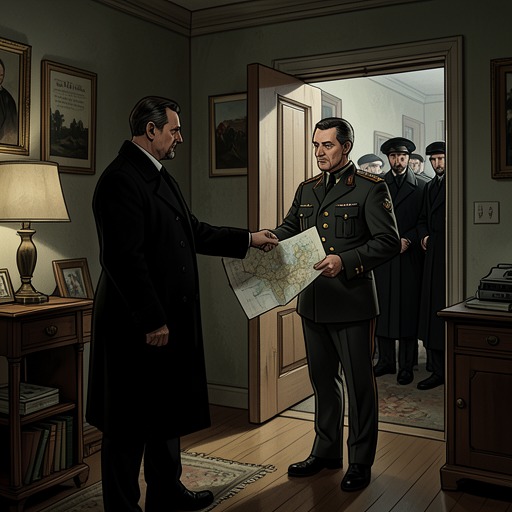
Enzo Galbiati
M: Son of the CenturyEnzo Galbiati was an orphan, accounting student, former Ardito, and Fiume legionnaire who rose to lead Fascist squads in Brianza. He later became consul commander of the militia’s 25th “Iron” Legion and helped lead a delegation of militia consuls that confronted Benito Mussolini. His trajectory joined the movement’s street-level armed organization to its attempt to bring that same force under centralized control.
Background and Rise
Galbiati’s early life is sketched briefly: he was fatherless, studied accounting, served as an Ardito, and became a legionnaire in Fiume. The account identifies him as a leader of the Brianza Fascist squads, placing him among the provincial organizers whose authority rested on local armed formations.
That local role continued into the march on Rome. Galbiati commanded the Monza squad and the militia’s 25th “Iron” Legion; he had also been assigned to defend Il Popolo d’Italia during the march. These positions connected his earlier squad leadership with the emerging national militia.
From Squads to Militia
The militia was designed to absorb and discipline the squadristi rather than leave them under independent provincial leaders. Under the proposed arrangement, the squads would be dissolved, Fascists wishing to remain in the movement would join the militia, and its oath would bind members to Italy and, above all, to the prime minister. The new force was thus presented as an instrument for defending the Fascist revolution and maintaining public order, while also giving Mussolini a means to restrain local armed groups.
Galbiati’s appointment as commander of the 25th “Iron” Legion placed him within this institutional structure without erasing his origins in the squads. He was at once a product of provincial Fascist power and an officer in the organization meant to centralize it. That dual position helps explain why the militia could serve both as a tool of government and as a channel through which its armed leaders could make demands.
The Consuls’ Confrontation
In a New Year confrontation, Galbiati and Aldo Tarabella led a delegation of thirty-three militia consuls who had arrived separately and incognito from across Italy. They lodged at a militia barracks and gathered in small groups at Galleria Colonna, opposite Palazzo Chigi, before entering the prime minister’s rooms. The assembled consuls crowded around Mussolini’s desk; their appearance turned an internal dispute into a direct encounter between the head of government and the officers of his armed organization.
Galbiati’s fellow leader Tarabella told Mussolini that the consuls were tired of waiting, that Fascists filled the prisons, and that they would assume responsibility for the revolution themselves. The ultimatum made the militia’s institutional position unmistakable: its officers were not simply recipients of orders but could invoke their own armed authority to press the prime minister. Galbiati is identified as a leader of the delegation, although the account attributes the spoken challenge to Tarabella.
Narrative Significance
Galbiati’s brief but consequential appearances trace a tension at the heart of Fascist rule. The movement sought to convert squad violence into an organized militia controlled from the center, yet the militia’s commanders retained enough collective leverage to confront Mussolini directly. Galbiati’s passage from Brianza squad leader to legion commander, and then to co-leader of the consuls’ delegation, shows that institutionalization did not simply end the power of the armed movement’s provincial figures; it gave that power a new structure from which to act.