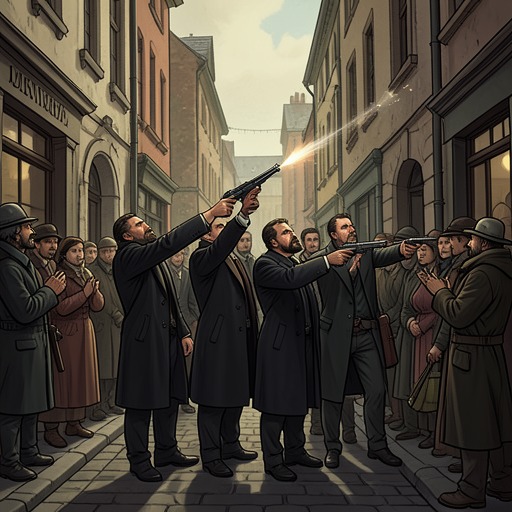
Fall of the Facta Government in 1922
M: Son of the CenturyThe Fall of the Facta Government in 1922 unfolded amid a spreading campaign of Fascist violence and a mounting crisis of state authority. It was not simply a change of ministry: attacks on local institutions exposed the weakness of the liberal state, while Benito Mussolini maneuvered between the armed movement and the prospect of entering government through legal channels.
Background: Organized Conflict and Political Opportunity
The crisis developed against a landscape of intense social conflict. In Emilia, socialist organizations held 223 of 280 municipalities, while peasant leagues had gained substantial influence over hiring, work schedules, threshing, seed supplies, and planting. Farmhands averaged only 120 days of work a year, making control of labor and wages a matter of survival for workers and a direct challenge to landowners. These organized rural movements formed part of the political terrain on which Fascist squads operated.
Fascism had also moved from street mobilization toward parliamentary participation. In 1921, Benito Mussolini accepted a place for Fascists within the national blocs, an alliance of traditional anti-Bolshevik parties. That parliamentary opening did not displace squad violence. Instead, legal participation and coercion developed side by side, leaving the government to confront a movement that claimed a place in parliament while maintaining armed formations beyond its control.
The Cremona Campaign and the Government’s Fall
With the arrival of fine weather, Roberto Farinacci’s squadristi launched a province-wide campaign against peasant leagues and municipal administrations, both socialist and Catholic. Within two months, thirty-five municipal administrations resigned, citing their inability to withstand the situation. The campaign showed how violence could empty local offices of authority without replacing them through ordinary political competition.
On June 16, blackshirts occupied the prefecture and set fire to the home of Deputy Miglioli, a Catholic representative who had led the white peasant leagues. On July 5, Roberto Farinacci entered Cremona’s town hall alone while its custodian slept in the entrance hall. From the mayor’s office, using paper bearing the municipality’s seal, he informed the prefect that he had appointed himself mayor. Ten days later, he returned with thousands of squadristi to besiege the city. Three days and nights of destruction, killings, and administrative paralysis followed; two days later, the government fell.
The episode made the contest over authority concrete. A Fascist leader could claim the mayoralty by using the town hall’s own official stationery, then return with a mass force to impose pressure on the city. The resignation of administrations, the occupation of the prefecture, and the siege of Cremona together showed how local government could be disabled while the institutions of the state remained nominally in place.
Mussolini’s Contradictory Maneuver
Publicly, Benito Mussolini defended the campaign. In Il Popolo d’Italia, he answered condemnations of Fascist violence with a promise to defeat opponents politically and through their unions. Behind the propaganda, however, he ordered Roberto Farinacci to demobilize from Cremona. Farinacci initially refused; Benito Mussolini ultimately had to threaten him in person. The contrast revealed a difference in the uses of violence: for the leader, it was a political instrument to be applied and restrained as circumstances required, while local squad leaders could treat it as an end in itself.
Since June, Benito Mussolini had been trying to end Fascism’s isolation. He approached the king, Francesco Saverio Nitti’s old liberals, Don Luigi Sturzo, and socialist reformists, but these efforts failed. On July 18, through the prefect of Milan, he reassured the state that he intended to contain the squadristi and enter government by legal means. His promise of restraint came alongside public support for conquest and a movement whose armed actions were undermining the government he hoped to join.
In parliament on July 19, Benito Mussolini renewed his threats and described a choice between a party of government and a party of insurrection. He then voted against Luigi Facta alongside Catholics and socialists who had lost faith in the government’s ability to protect them from squad attacks. The vote was a maneuver, not a break with Fascist violence: it positioned Benito Mussolini against a ministry already damaged by the movement’s actions and by its own failure to stop them.
Aftermath and Significance
The parliamentary debate drew unusually broad criticism of Fascist coercion. Claudio Treves attacked the ministers, and Filippo Turati warned that civilization was nearing collapse. Liberal newspapers also condemned the violence: the Corriere della Sera, the government-critical daily, deplored Fascist blackmail, while La Stampa, the anti-fascist daily, held right-wing ministers responsible for enabling inaction. Their criticism underscored that the crisis was no longer confined to socialist opponents or local officials; it had become a test of whether the state would defend its own authority.
The pattern recurred in the later October crisis. Facta’s government prepared a state of siege, sent defense orders to General Emanuele Pugliese, and dispatched arrest orders to prefects; a proclamation was posted in Rome. Those preparations belong to a distinct confrontation, but they echo the earlier collapse: formal state powers could still be drafted and announced, while their effectiveness depended on decisions at the highest level. By November, the Chamber of Deputies was packed for Benito Mussolini’s appearance, and the March on Rome was being publicly described as bloodless despite nineteen dead and twenty seriously injured in Rome during the preceding fifteen days. The fall of Facta’s government thus marks a stage in the erosion of liberal authority, as parliamentary procedure continued while political violence increasingly set its terms.