Fascist Political Religion
M: Son of the CenturyFascist Political Religion describes how political allegiance in the narrative acquires the forms and emotional force of religious faith. The dead become enduring presences, flags and memorials carry national meaning, and public ceremonies turn crowds into a disciplined community. This sacred language of sacrifice and rebirth does not displace political power: it helps authorize it, presenting violence, national unity, and obedience as parts of a single historical mission.
A faith formed by wartime rupture
The account begins from the devastation of the First World War and the sense that the old political world has exhausted itself. Europe is imagined as a stage emptied of its former leaders and orators, while five million returning veterans press toward Italy’s borders. The survivors, many of them former soldiers, are described as a new political public, bound by a common experience of war and by the belief that further conflict remains possible. In this atmosphere, the expectation of national renewal can promise a way out of disorder while also keeping the country oriented toward struggle.
The Unknown Soldier’s burial gives that collective loss a public focus. A fallen soldier, selected by lot because his identity cannot be established, represents the dead as a whole. His marble coffin becomes an altar for remembering a war in which death had become collective and impersonal. The ceremony makes private bereavement legible as national experience: people approach the grave as they might the resting place of their own loved ones. In this transformation, mourning is not merely an aftermath of politics. It becomes a source of political belonging.
The dead made present through ritual
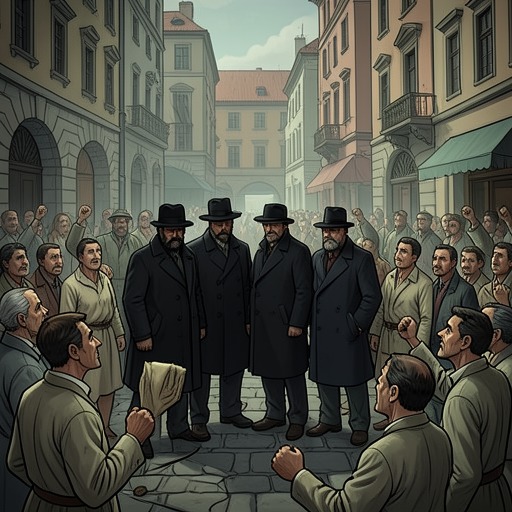
The founders of the National Fascist Party gather in prayer at the center of Rome around the Unknown Soldier’s memorial, while Fascist squads elsewhere in the city provoke fights. The juxtaposition matters. The political leadership performs solemn reverence for the nation’s dead at the same time that the movement’s militants enact conflict in the streets. The scene places public devotion and organized violence within the same political world rather than treating them as opposites. The narrative makes the implication explicit: politics is becoming a religion.
A later funeral for a fallen comrade shows how ritual can blur the boundary between burial and continuing presence. The procession moves toward the cemetery as the crowd kneels; the leaders and squads assemble in close formation, and a farewell address turns the dead man’s name into a rallying sign. The ceremony culminates in a collective response from a thousand surviving soldiers, who declare their comrade present. The dead are thus not only mourned: they are incorporated into the group’s living identity. The ritual teaches participants to regard loss as both sacred memory and an obligation that continues after burial.
Flags, places, and the promise of renewal
The political use of memory is also visible in Gabriele D’Annunzio’s presentation of Randaccio’s flag. On the Campidoglio, the poet displays the tricolor associated with the dead infantry captain and treats it as a national relic. He links its mourning significance to the demand that Fiume and Dalmatia be returned to Italy. A particular object therefore joins the memory of an individual soldier to a territorial claim: the flag makes sacrifice visible and gives it a continuing political purpose.
D’Annunzio’s account of 1919 intensifies the contrast between the failed or exhausted world of Versailles and the supposedly youthful, life-giving future represented by Fiume. The city becomes more than a place in a dispute; it signifies a new beginning sustained by heroic memory and faith in generations still to come. This pattern of decline followed by renewal also appears in Benito Mussolini’s later presentation of fascism. His program promises to make Italians into a single national people, advances an imperial vision beyond Italy’s borders, and places the Roman Church within that imperial conception. The state, in his account, is not a neutral arena outside the movement: it is something the movement claims to embody.
Leadership, violence, and discipline
The movement’s sacred political language gives a special role to its leader. Mussolini’s vision joins national unity to the idea of a decisive new age, while his public image is cast as the answer to an old order portrayed as exhausted. The narrative describes him as a figure of youth and rebirth, an arbiter expected to impose order on chaos. That image does not simply celebrate personal charisma; it presents political authority as the instrument through which the nation’s promised transformation will occur.
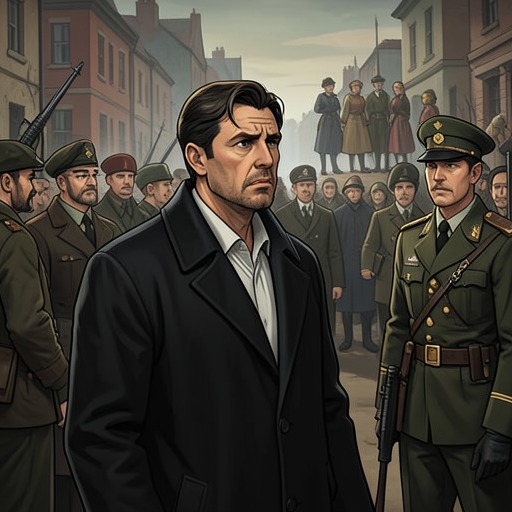
This promise is inseparable from the movement’s account of violence and discipline. Mussolini distinguishes between the disorder of Fascist militias serving private interests and violence directed toward the nation’s ends, comparing the latter to a surgeon’s intervention in diseased tissue. He also says that the new organization should learn to stand without depending on his personal direction. These claims place force within a larger language of national service and organizational self-command. The result is a political faith that can praise action while demanding discipline, and exalt a leader while presenting the movement as more durable than any one individual.
A contested inheritance
The narrative also shows that political ritual does not give one movement exclusive possession of grief or national memory. When Giacomo Matteotti is buried again in Fratta Polesine, his wife Velia chooses a regional funeral rather than the political burial in Rome urged by Turati. Peasants, workers, and railway workers gather along the route, mourning Matteotti and calling for justice and liberty. The funeral makes a public community out of bereavement, but its demands challenge rather than affirm Fascist authority.
That contrast clarifies the force and limits of Fascist Political Religion. The Fascist ceremonies described here convert the dead into symbols of unity, sacrifice, and militant continuity; the Matteotti funeral shows that public mourning can instead preserve a claim against power. Political ritual is therefore not sacred by nature or politically settled. Its meaning depends on who gathers, whose memory is honored, and what obligations the living are asked to accept.