Filippo Tommaso Marinetti
M: Son of the CenturyFilippo Tommaso Marinetti was a poet, the founder of Futurism, and an early participant in the political mobilization around Benito Mussolini. In the book, his public identity is inseparable from performance: he turned manifestos into street commands, war into an aesthetic and political ideal, and gatherings into stages. Yet his place in the movement was never secure. As Fascism moved toward a right-wing alliance and accommodation with the monarchy, Marinetti resisted the change and left its central committee, exposing a fracture between revolutionary rhetoric and political consolidation.
Identity and Futurist Formation
Marinetti founded the first historical avant-garde movement in twentieth-century Italy in 1909. Its manifesto travelled across Europe, from Paris to Moscow, advocating the destruction of museums, libraries, and academies. It celebrated speed, mass life, rebellion, patriotism, militarism, and war, which it treated as a source of renewal. The book presents this program not as a literary position kept apart from politics, but as a language Marinetti carried into public confrontations.
In 1915, he enlisted in the Alpines, leaving the neo-Egyptian furnishings of his home on Corso Venezia for military service. He fought, was wounded, returned to the front, experienced the defeat at Caporetto, and later celebrated victory at Vittorio Veneto while driving a Lancia 1Z armored car. The sequence matters to his later authority: his advocacy of war was backed by personal participation, and at the Milan demonstrations he stood among Arditi and veterans as a civilian who had himself entered combat.
Milan’s April 1919 Clashes
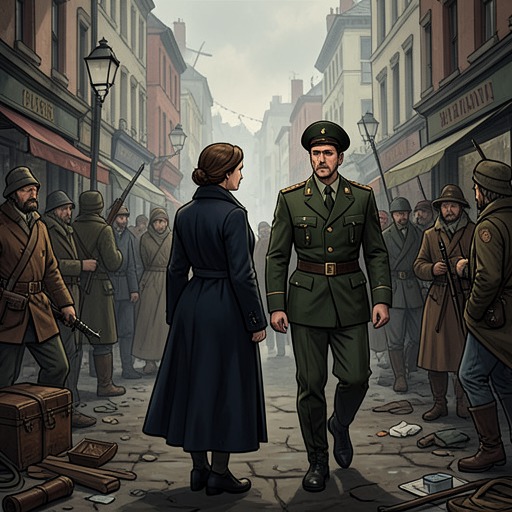
On April 15, 1919, thousands of workers gathered for a socialist rally at the Milan arena. In the early afternoon, several thousand demonstrators broke away from the procession and moved toward the city center. At Piazza del Duomo, Marinetti stood by the equestrian monument to Vittorio Emanuele II, addressing a mixed crowd of civilians, officers, students, Arditi, and Fascists. After descending from the monument, he urged bystanders to join the counter-demonstration and rejected the possibility of remaining a neutral spectator.
The two processions met across a Carabinieri cordon. At the head of the socialist march, women carried a portrait of Vladimir Lenin and a red flag; the opposing group was smaller and included men accustomed to wartime violence. When the cordon opened, stones and clubs came from the socialist side, while officers, Arditi, and Futurists fired first into the air and then toward the marchers. The confrontation quickly broke up the socialist column. Marinetti himself became involved in a scuffle with a worker and ended up in a porter’s lodge window. When two Arditi seized the worker, Marinetti intervened to prevent them from killing him. His conduct complicates any simple picture of him as merely an instigator: he helped summon the counter-demonstrators into the confrontation, but in this moment he also restrained an escalation against an opponent.
Three days later, Marinetti and Ferruccio Vecchi signed a proclamation posted around Milan. It described the counter-demonstration as spontaneous, denied an intention to provoke, and defended the intervention as a response to what it called a prior provocation. The text deplored the bloodshed while accusing Avanti! of encouraging civil conflict. The proclamation thus recast the violence as defensive and placed responsibility on the socialist press, even as the April 15 account had shown Marinetti actively calling neutral passersby into the opposing procession.
Electoral Politics and the Futurist Split
When the Fascists entered the Milan election under their own ticket, the selection of candidates took only minutes. Eighteen of the nineteen had served at the front; the list included Marinetti, the labor leader Lanzillo, and the conductor Arturo Toscanini. Marinetti persuaded Toscanini to accept candidacy, and Toscanini also contributed 30,000 lire to the list. Its platform retained proposals associated with the San Sepolcro program, including abolition of the Senate, tax reform, confiscation of ecclesiastical property, assistance for veterans and the disabled, and an armed nation. The electoral emblem was a French-made hand grenade issued to the Arditi, an unmistakable joining of ballot-box politics to the movement’s combatant identity.
The result was a severe defeat. In the Milan district, the Fascist ticket received 4,657 votes out of approximately 270,000; Mussolini received 2,427 preferential votes, and no candidate was elected. The book records Mussolini privately admitting the scale of the loss to his wife, while publicly making light of the poor result. A mock funeral procession by socialists passed the Mussolini home, with empty coffins symbolically assigned to Marinetti and Gabriele D’Annunzio as well as Mussolini. Marinetti’s presence on the ticket therefore tied him to a political venture that was, at this stage, electorally marginal and exposed to public ridicule.
At a later Fascist congress, Marinetti opposed the movement’s turn to the right. He attacked the monarchy as an obsolete burden, renewed his criticism of the Vatican, and argued that the veterans who had come from the Karst should not move toward reaction. The dispute was more than a personal quarrel: the congress was remaking the organization’s political direction, while Marinetti’s Futurist anti-monarchism remained resistant to compromise with established institutions. The following morning, only ten of the original nineteen central-committee members were reelected. Marinetti and Carli resigned the next day; all nine new members came from the provinces and were described as right-wing.
Public Persona and Narrative Significance
The book also stages Marinetti away from the monumental piazza, speaking in a working-class trattoria to truckers and printers at the end of their shifts. Standing on a chair, he denounced extravagant women’s clothing, arguing that frequent changes of dress turned the body into a display for male consumers and blaming male folly for the fashion. The scene extends his characteristic method: he brings the same shrill, absolute tone to a social argument that he brings to Futurist manifestos and political rallies. It also reveals the limits of his supposed revolt against convention, since his critique of consumer display rests on a restrictive account of women’s appeal and social role.
Marinetti’s narrative function lies in the friction between aesthetic insurgency and political organization. He gives Fascist street politics a Futurist vocabulary of speed, war, and rupture, and he acts directly within the violence of April 15 rather than remaining a distant intellectual. But when the movement seeks electoral standing and turns toward conservative allies, he resists its accommodation with monarchy and religion. His resignation marks the point at which the new political formation can proceed without one of its most visible cultural founders: the movement absorbs the spectacle and combatant language he helped supply, while leaving his anti-reactionary program behind.