Fum
M: Son of the CenturyFiume was a disputed Adriatic border city whose Italian-majority population made it central to postwar arguments over Italy’s promised territorial gains. Under Gabriele D’Annunzio’s occupation, it became more than a prize in a diplomatic dispute: it was presented as a beacon of liberty and a model for political renewal, while serving as a refuge for a striking mixture of movements and personalities. The city’s changing image—from contested territory to revolutionary laboratory and emblem of a new national future—gave it a significance far beyond its borders.
A disputed border city
The dispute over Fiume emerged from the unsettled terms of Italy’s victory in the First World War. The Treaty of London had promised Italy Dalmatia, but had not included Fiume, a small border city with a large Italian majority. Nationalists argued that the principle of self-determination promoted by Woodrow Wilson should nevertheless secure the city for Italy. Their claim joined the Treaty of London to Fiume as a single demand, even as Wilson appeared unwilling to concede either claim to Italy. On April 24, Vittorio Emanuele Orlando and his foreign minister, Sidney Sonnino, abruptly walked out of the Paris Peace Conference, turning the disagreement into a public rupture.
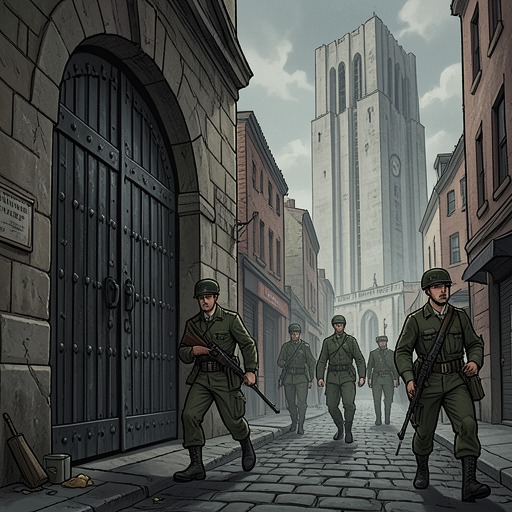
The city’s location and disputed allegiance made it a focus for forces beyond Italy’s official diplomacy. After Italian battalions had been expelled in late August, some grenadiers attempted to return on their own initiative. They concealed their guns and the insignia on their collars, defying the Italian high command’s opposition to a coup and challenging the inter-Allied command that controlled Fiume through French, British, American, and Croatian contingents. Their action also opposed Wilson’s intention to hand the city to the Yugoslavs and the Italian rulers’ apparent willingness to accept that outcome. The returning soldiers had the support of a volunteer legion drawn largely from Fiume’s civilian population. The contest was therefore at once local and international: a struggle over who could claim the city, and over whether official restraint would prevail against action taken outside government authority.
Occupation and popular welcome
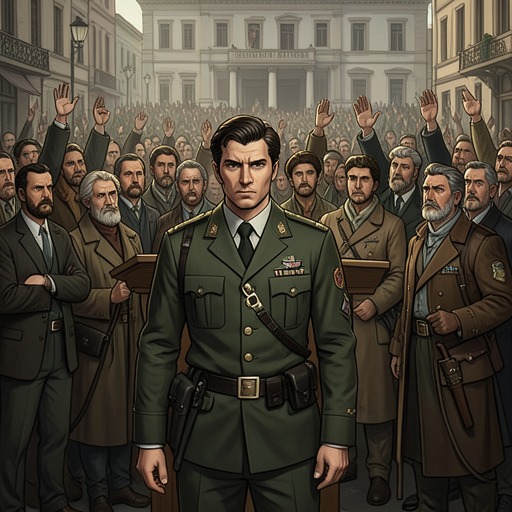
As Gabriele D’Annunzio approached, the city appeared to him as an object of desire and conquest. The account frames the poet’s arrival as a transformation: the man of letters discovers the appetite for siege associated with a military commander. Shortly after eleven in the morning, D’Annunzio’s troops entered Fiume. The population welcomed them jubilantly, women appeared in their finest clothing, and laurel leaves fell from the rooftops. The entrance was not merely a change of control; it was staged and received as a liberation, giving the occupation a public ceremony from its beginning.
D’Annunzio’s language enlarged that victory into a claim about the city’s meaning. In his address to the people of Fiume, he presented it as a rare source of liberty and truth in a corrupt world. In a later speech, he began with a detailed case for Fiume’s Italian identity, enumerating the proposed boundaries of a free nation, then turned from territorial argument to a universal promise: the city, he declared in effect, could kindle a new fire in the West. Its role shifted from that of a place marked by sacrifice to one imagined as a city of life. This rhetorical transformation allowed the occupation to speak simultaneously to Italian nationalism and to a broader desire for political and cultural renewal.
A political and cultural crossroads
Within little more than a month, Fiume had become a gathering place for sharply different political and social currents. Nationalists and internationalists, monarchists and republicans, conservatives and syndicalists, clerics and anarchists, imperialists and communists all appeared in its crowded political world. The account also describes artists, idealists, revolutionaries, adventurers, servicemen, writers, and people from widely differing social circumstances. The city’s appeal lay partly in this unlikely convergence: it offered a setting in which established political categories could be crossed, combined, or contested.
That mixture did not mean that the competing groups shared a settled program. Rather, Fiume’s importance rested in its capacity to gather people who wanted something different from the political order represented by the postwar settlement. Its variety made the city seem like a world in miniature, at once a nationalist project and a meeting ground for international dissent. The resulting spectacle reinforced D’Annunzio’s effort to make Fiume signify more than Italian possession: it could be portrayed as the site from which a new political age might begin.
The experiment acquired a constitutional dimension when D’Annunzio received a draft charter from Alceste De Ambris on March 18, 1920. De Ambris, a syndicalist of direct action whom D’Annunzio had called to serve as his cabinet head, had prepared a text inspired by radical socialist ideas and libertarian principles. The proposed constitution described a democracy grounded in the rights of workers and individuals. Its commitments placed Fiume’s political experiment in tension with any simple description of the occupation as a purely nationalist enterprise. The city’s claim to Italian belonging existed alongside an ambitious project to rethink political rights and social organization.
From local symbol to national project
Fiume also became a point of reference in Italian political struggles. Benito Mussolini arrived on October 7, 1919, when the city was already surrounded by legend and rumor. Reports circulated that D’Annunzio might use it as a base for further conquest eastward, toward Zadar, Dalmatia, and Split. Other accounts attributed to him a proposed march westward through Pula, Trieste, and Venice, then on to Rome, where the monarchy and the Albertine Statute would be overthrown in favor of military dictatorship. The narrative presents these as rumors and reported plans, not as an accomplished campaign. Their circulation nevertheless shows how Fiume came to be imagined as a possible launching point for a transformation of Italy itself.
At the end of 1919, D’Annunzio contrasted the city with the diplomatic proceedings at Versailles. In his account, Versailles represented an exhausted and fearful Europe, while Fiume represented youth, beauty, faith, song, and a future extending beyond the dead of the war. The contrast turned a dispute over borders into a contest between political times: a declining old order on one side, and a new community on the other. His appeal depended on a collective image of the city, where followers could understand themselves as carrying the dead behind them and the generations yet to come before them.
The same ambition shaped D’Annunzio’s later plans for intervention in Italy. He sent a proposal for organizing a revolutionary movement and argued that the country required a new order produced by bringing its healthy energies together around himself. He insisted that Fiume’s intervention should rest on its constitution and that the city could redeem Italy. The claim reveals the scale of the political role he assigned to Fiume: not simply a territory to be annexed, but a source of authority and a template for national renewal.
Fiume’s hold on political imagination endured beyond the first celebration of its occupation. When D’Annunzio awaited the result of a plebiscite on whether to accept the Nitti government’s proposed compromise, he wore the white uniform associated with the march from Ronchi; in his breast pocket was a silver cannula. The scene places the city between spectacle and decision, its leader awaiting a popular verdict on a practical settlement. Even later, a crowd in Milan could greet D’Annunzio’s arrival by shouting his name as in the days of Fiume. The city had become a portable political memory: a place invoked to summon the fervor, defiance, and promise that had gathered around the occupation.