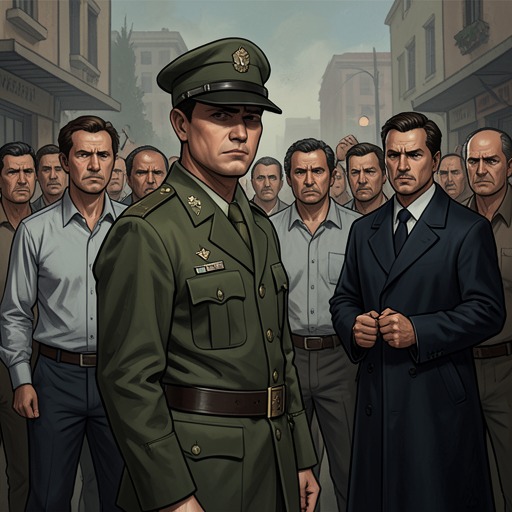
Giacomo and Girolamo Matteotti: father–son conflict over class loyalties
M: Son of the CenturyGiacomo and Girolamo Matteotti: father–son conflict over class loyalties is presented as a contest over where Giacomo belongs. Giacomo is the son of a major landowner, but he refuses the class position his inheritance implies and makes the impoverished peasants of Polesine his political community. His father sees that choice as a departure from the life assigned to him; the people Giacomo chooses see him as their advocate.
Family Background and Class Position
Giacomo’s paternal family is associated with wealth and commerce: his grandfather Matteo was an iron and copper merchant, and his father, Girolamo, was a large landowner suspected of lending money at exorbitant interest. This background sets the terms of the conflict. Giacomo’s opponents cast him as an agrarian who has repudiated his own class, a moralist descended from a usurer, and a “socialist in furs.” His father’s reproach is more intimate but no less stark: Giacomo, he says, has deserted the field assigned to him by fate.
The account does not give Girolamo a sustained speaking role or describe a reconciliation. Instead, the father’s accusation crystallizes the division between inherited position and chosen allegiance. Giacomo’s decision is not represented as a rejection of his family’s identity alone; it is a transfer of loyalty from landowner to laborer, made against the expectations attached to his birth.
The People Giacomo Chooses
The narrative answers the question of Giacomo’s belonging by turning from ancestry to the conditions of rural life. Polesine’s peasants endure chronic poverty, illness, overcrowded housing and exhausting work. The memory of a cow disinterred from the family estate comes back to Giacomo as he approaches a rally, though he is no longer sure whether the memory is false or whether the animal died of anthrax. What remains certain to him is the poverty of the land. The uncertainty of the childhood recollection contrasts with the certainty of his adult political choice.
Giacomo does not regard Polesine as merely a place of misery. He sees a region being remade through reclamation works, the organization of peasant leagues, treatment of disease and the affirmation of poor people’s rights. In the previous November’s election, Polesine sent him and five other Socialist deputies to Parliament, becoming, alongside Ferrara, one of Italy’s strongest Socialist provinces. Giacomo has thus chosen not only the people his father’s class regards as beneath it, but also their prospect of collective change.
That allegiance is not a claim that the peasants are free of violence. During the local elections, churches have been closed under pressure, people attending Mass have been attacked, and armed Communist squads patrol polling places and force voters to submit pre-completed ballots. When Catholic deputy Umberto Merlin, Giacomo’s former schoolmate, is beaten by his own farmers at a polling place in Lendinara, Giacomo intervenes to help him. The episode complicates any simple division between family class loyalties and political virtue: Giacomo remains committed to the poor while opposing coercion against a political opponent.
Rural Conflict and the Stakes of Allegiance
The wider agrarian conflict gives the father–son division its material stakes. In the Po Valley, peasant leagues seek control over hiring, work schedules, threshing, seed and planting. Their rules answer a precarious economy in which farmhands may find work for an average of only 120 days a year; seasonal wages and access to employment determine whether workers can survive the idle months. At the same time, the leagues enforce their system through fines, boycotts, social exclusion and pressure on those who accept lower wages or breach collective agreements. The conflict is therefore not simply an abstract clash of political labels: it concerns who controls land, labor and access to food.
The book also shows how those material demands become a field of political struggle. In Ferrara, where fifty thousand farm laborers face hunger during the spring idle season, Italo Balbo proposes a mass occupation of the city to compel the government to fund public works. On May 12, 1921, the city wakes to an immense procession of impoverished workers, carrying meager provisions and marching under fascist organization. Balbo uses the mobilization to demand work while promising that the fascists will maintain public order. The episode does not alter the account of Girolamo’s personal views, but it shows the turbulent political environment in which rural laborers’ needs could be both a basis for solidarity and an instrument in a struggle for power.
Meaning of the Father–Son Conflict
The relationship’s decisive asymmetry is that Girolamo’s judgment is reported as an accusation, whereas Giacomo’s choice is demonstrated through his political work and public interventions. The father measures the son against the place assigned by birth; the narrative measures him against the poverty he has witnessed and the people whose rights he seeks to affirm. Giacomo’s allegiance does not erase his origins. Rather, the force of the break depends on them: the landowner’s son becomes a Socialist representative of peasants, and the class boundary that might have secured his position becomes the line he chooses to cross.
The conflict also resists a tidy moral resolution. The peasants’ struggle is grounded in hunger and insecurity, yet the coercion surrounding elections and labor discipline remains visible. Giacomo’s intervention on Merlin’s behalf marks a limit to political loyalty when it becomes violence against an individual. Against that complicated landscape, his estrangement from his father stands not as a private quarrel alone but as a choice about whose hardship should command his allegiance.