Giovanni Randaccio
M: Son of the CenturyGiovanni Randaccio was an infantry captain and close friend of Gabriele D’Annunzio, killed in an assault during the tenth battle of the Isonzo. Though the narrative gives few details of his life beyond the battlefield, it makes his flag an enduring emblem: first a shroud associated with his death, then a relic used by D’Annunzio to turn a fallen friend’s memory into a public argument about Italy’s unfulfilled national claims.
Identity and Death
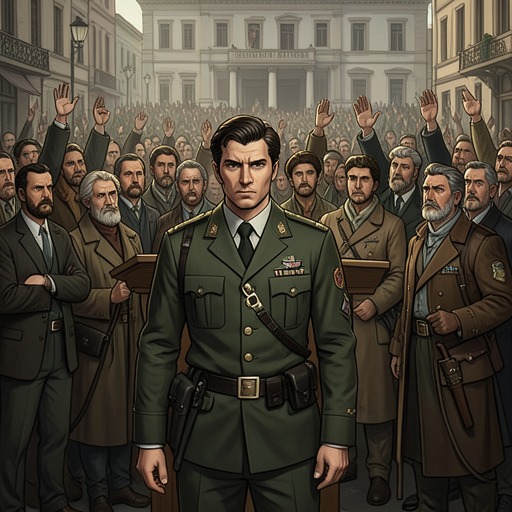
Randaccio served as an infantry captain and was close to D’Annunzio. At the poet’s instigation, he fell during the tenth battle of the Isonzo in an assault on a hill at the mouth of the Timavo River. The narrative presents his death as part of the war’s immense toll, but gives it particular weight through the bond between the two men and the objects left behind.
D’Annunzio’s subsequent exploits are linked to Randaccio’s death as acts undertaken, in the narrative’s formulation, as if to avenge his friend. These included an attack on the port of Kotor, a flight over Vienna to drop propaganda leaflets, and a raid in the Bay of Buccari that helped raise the morale of Italian troops after the defeat at Caporetto. Randaccio does not appear as an actor in these later episodes; his absence becomes one of the motives through which the poet’s continued pursuit of danger is understood.
The Flag as a Memorial
Randaccio’s tricolor flag becomes the chief material trace of him in the account. D’Annunzio displayed it at the Campidoglio with Randaccio’s body, treating the banner as both a shroud and a sign of Italy’s so-called mutilated victory. The soldiers gathered below looked at the flag and searched their own bodies for what the war had taken from them. Through this scene, Randaccio’s personal loss is placed beside the wider experience of veterans who returned from the front bearing the war’s consequences.
When D’Annunzio later described the flag to an audience in Rome, he recalled that it had been folded as a pillow for the dying Randaccio at Quota 12, the Stone Quarry. He presented it as a mourning banner, declaring that it should remain draped in black until Fiume and Dalmatia were returned to Italy. Randaccio’s memory thus became inseparable from the political demand attached to the flag: grief was made visible, and its duration was tied to a territorial outcome.
From Battlefield Relic to Public Spectacle
The flag continued to circulate after D’Annunzio’s departure from Rome. In Fiume, he took it from the infantry rucksack in which he kept it and removed its black mourning crepe. The gesture changed the relic’s public appearance while preserving its association with Randaccio. The banner was no longer only a sign of mourning; it also served as a stage prop in D’Annunzio’s performance of a continuing national struggle.
The narrative stresses the theatrical character of this use: the flag was already a relic, and Fiume provided a setting in which D’Annunzio could present himself at once as poet, hero, and performer. Yet the material object carried a real loss within that spectacle. Randaccio’s death remained the source of the flag’s commemorative force even as its meaning was redirected toward political mobilization.
Narrative Significance
Randaccio is a largely absent figure whose importance grows through remembrance. The account does not supply a fuller biography or a record of his own political views; instead, it follows how D’Annunzio’s attachment to him gives a human focus to the language of sacrifice and national grievance. The flag connects a specific dead soldier to the wider dead of the war, then carries that memory into D’Annunzio’s campaign over Fiume and Dalmatia.
That afterlife also sits beside the later rhetoric of national rebirth and expansion. In D’Annunzio’s address to his legionnaires, Fiume is contrasted with the exhausted postwar order and made to signify youth, life, and a future carried forward by the dead and the unborn. Randaccio’s memorial flag gives this political spectacle one of its intimate points of reference: the promise of renewal is voiced in the presence of a loss that cannot be undone.