Italy’s “Mutilated Victory” Sentiment
M: Son of the CenturyItaly’s “Mutilated Victory” Sentiment named the paradox that shaped the country’s postwar mood: Italy had emerged victorious, yet many Italians felt that the peace settlement had withheld what victory promised. Gabriele D’Annunzio gave that grievance its enduring image. The phrase made disappointment feel like a wound in the nation itself, binding diplomatic claims to the losses of war and furnishing a powerful language for mass politics.
Origins in victory and deprivation
The feeling took hold against the immense human cost of the war. The narrative evokes eleven million dead across Europe and five million Italian soldiers returning to a country whose old political order seemed exhausted. Italy’s victory did not erase the dead or guarantee that the peace would fulfill nationalist expectations. Instead, the scale of sacrifice made the question of what Italy had gained especially charged. The returning veterans appeared not simply as a demobilized population but as a force pressing against the boundaries of the existing political world.
The territorial dispute gave the grievance a specific form. The 1915 Treaty of London had promised Italy Dalmatia if it joined the war alongside Russia, France, and Great Britain. Italian nationalists also claimed Fiume, whose Italian majority, they argued, should be recognized under Woodrow Wilson’s principle of national self-determination, although the city had not been included in the treaty. The claim joined the two territories into a single demand: the London promises and Fiume together. For those who accepted this account, the peace negotiations were not an ordinary contest over borders; they tested whether Italy’s sacrifice would be honored.
That test acquired a humiliating public dimension when Wilson addressed the Italian people directly through a letter published in a French newspaper, bypassing Italy’s representatives while explaining why he would concede neither Dalmatia nor Fiume. The book emphasizes that the perceived injury lay not only in the refusal but in the paternal tone of the appeal. Italy appeared to be treated as a minor ally instructed by a superior power. In the same atmosphere, Georges Clemenceau was rumored to have disparaged Vittorio Emanuele Orlando as a “vegetarian tiger,” a phrase that sharpened the sense of national condescension.
The walkout and the making of a national grievance
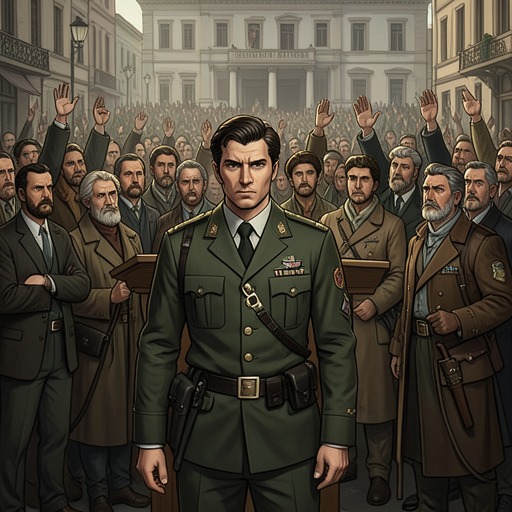
On April 24, 1919, Orlando and Sidney Sonnino abruptly left the Paris Peace Conference. Their departure was a proud and conspicuous protest, and it briefly seemed to unite Italians across political divisions. In the last week of April, piazzas around the country filled with demands for an Italian Fiume and Dalmatia. The book describes a common feeling of deprivation taking hold, intensified by the belief that yesterday’s allies were withholding what Italy had been promised at the cost of 600,000 deaths. Ivanoe Bonomi characterized the conference as seeming like an ambush.
The protest carried a danger that Filippo Turati identified in parliament. If the government had no certainty that an agreement was possible, Turati warned, the patriotic expectations it had encouraged would leave it trapped: retreat would now appear as humiliation. The warning proved apt. While Italy focused on the Adriatic claims, the other victorious powers continued negotiating without its delegates, dividing German colonies in Africa and the former Turkish Empire in the Near East. Fifteen days after the walkout, Orlando and Sonnino returned to Paris, eager not to miss the negotiations with the German delegation. Their return punctured the pose of defiance. The public that had imagined Italy standing alone against the victorious powers was left with disappointment, and the sacrifice of the war seemed to many to have brought no adequate return.
This sentiment had been gathering in a country already suspended between expectation and catastrophe. On April 15, tens of thousands assembled at a rally in Milan amid an atmosphere of revolutionary anticipation. Several thousand demonstrators broke away from the procession and moved toward the Duomo. There, socialist marchers led by women carrying a portrait of Vladimir Lenin and a red flag faced a smaller counter-procession of officers, Arditi, and Fascists. A brief clash followed. The episode does not reduce the grievance over the peace settlement to a single political faction; rather, it shows the unsettled public world in which rival movements sought to give the postwar crisis a meaning and direction.
D’Annunzio’s emblem and the politics of memory
On May 6, D’Annunzio addressed a vast crowd gathered at the Campidoglio in Rome. His metaphor of the “mutilated victory” made physically sound veterans feel symbolically maimed: they had prevailed in battle, yet were invited to understand the peace as a defeat. The image’s force lay in that reversal. A victory could be recast as an injury, and a diplomatic dispute over territory could become an intimate question of what the nation had lost.
The speech coincided with the return of Orlando and Sonnino to Paris, giving the public grievance an immediate political backdrop. D’Annunzio’s attendants spread a tricolor over the balcony rail, and the poet touched the flag wrapped around the remains of Giovanni Randaccio, a close friend killed in a wartime assault. The banner joined the national emblem to an individual death; below, the crowd searched its own bodies for the missing limb implied by the metaphor. The scene turned bereavement into public ritual and made the war dead witnesses to the claim that victory remained unfinished.
The image had appeared before the speech. In October 1918, before the armistice, D’Annunzio had warned that Italy’s victory would not be mutilated. It circulated among soldiers who had not yet been demobilized, then, within months, became a description of the postwar settlement. Its movement from warning to national diagnosis gave it the quality of a prophecy fulfilled. The phrase did not merely report disappointment; it organized that disappointment around the expectation that something owed to the dead had been taken away.
From grievance to political spectacle
The book repeatedly places the sentiment within scenes that make politics resemble a wartime ceremony. In Milan, a flare used to illuminate no man’s land streaked above a rally before Ferruccio Vecchi addressed the crowd in the language of combat. The sky’s brief transformation into a remembered war zone connected political mobilization to the veterans’ experience without resolving the conflicts dividing the crowd. Such scenes show how the memory of war could be brought into present-day politics as image, staging, and collective feeling.
D’Annunzio later set Fiume against Versailles in a speech to his legionnaires. He presented 1919 as the year of Fiume rather than the year of the peace negotiations, associating the city with youth, life, faith, and a future extending beyond the dead. He remained there despite the wishes of the Fiumani, but the narrative immediately qualifies the grand claim: Italians did not follow him, and his appeal had already begun to fade. The contrast matters. The rhetoric of national renewal could gather force around Fiume without representing a settled national consensus.
A related political language emerged in the Fascist program presented by Benito Mussolini. It promised to make Italians a single national people, to orient the country toward an imperial future, and to treat the state as the instrument of that transformation. Later, Mussolini portrayed the movement’s growth as a passage from a few small groups to legions, from a people to a nation and then a state pursuing expansion. These promises did not simply repeat D’Annunzio’s grievance, but they could redirect the emotional structure it had helped establish: a story of humiliation and decline could be answered by a story of rebirth, unity, and power.
War dead and the afterlife of the sentiment
The Unknown Soldier’s burial in 1921 gave collective loss a national focus. An unidentified fallen soldier, chosen by lot to represent the dead, was placed in a marble coffin in the most solemn ceremony yet held in unified Italy. The rite offered no individual biography to distinguish one loss from another; its force came from making the unknown soldier stand for them all. When Fascist leaders knelt before the tomb, the ceremony joined political authority to a public cult of wartime sacrifice.
The memory of Matteotti’s death produced a different but related funerary scene in August 1924. At Velia’s request, his remains were returned to Fratta Polesine rather than given the political burial in Rome proposed by Turati. Peasants, laborers, and railway workers gathered along the route and at Fratta, where mourners called for justice, retribution, and liberty. The episode is not presented as a continuation of the territorial dispute over Fiume. It does, however, show how the book returns to the political meaning of death, burial, and crowds: the memory of sacrifice could support competing claims about who represented the nation and what justice required.
Italy’s “Mutilated Victory” Sentiment therefore persists in the book less as a single policy demand than as a reusable structure of political feeling. It makes defeat imaginable inside victory, binds national status to the memory of the dead, and turns public gatherings into places where grievance can be performed and redirected. Its enduring significance lies in that double movement: it exposed a real postwar sense of loss while also giving politicians and movements a compelling language with which to claim the future.