The fascist new man
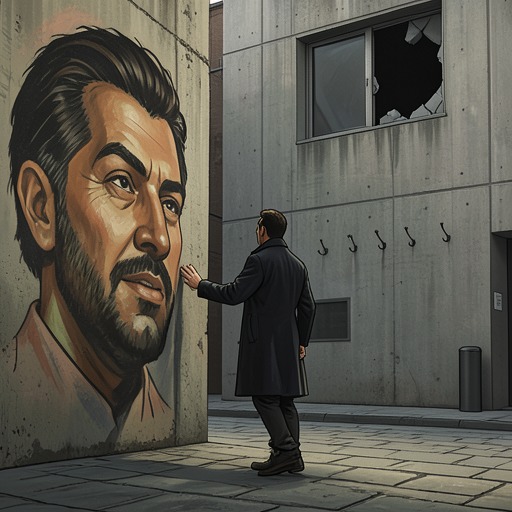
M: Son of the CenturyThe fascist new man is an ideal of national rebirth that joins youth, physical vigor, discipline, and political authority to a promise of overcoming postwar decline. In the book, the ideal takes shape through Benito Mussolini’s public ascent: the leader is presented as the answer to a discredited old order, while the mass audience is summoned to become a unified nation under his direction. Its promise of renewal is inseparable from force, hierarchy, and the exclusion of groups imagined as threats to national unity.
A generation formed by war
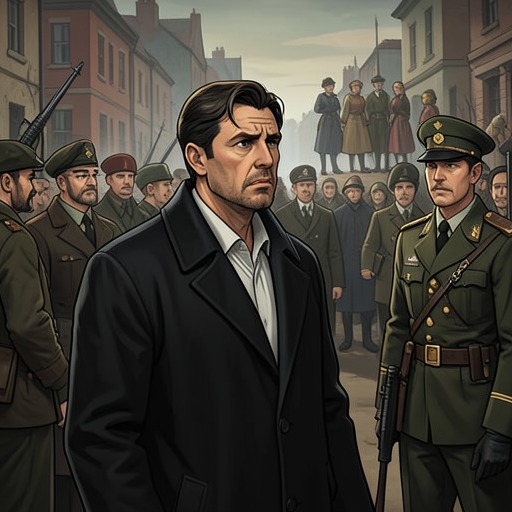
The ideal begins amid the devastation of the First World War. The narrator describes a Europe with no established figures left to command confidence: millions of dead lie beneath the war’s aftermath, while five million returning soldiers press toward the country’s borders. The veterans are not simply welcomed home. They appear as a new political mass before which the old politicians, liberals, and parliamentary orators seem exhausted. The future, in this account, belongs to those who were shaped by war and those who will inherit its consequences. The demand to move in lockstep makes collective discipline sound like the necessary response to an unstable world.
That crisis narrative gives violence a double meaning. It is both the inheritance of war and the force through which a new order is imagined to emerge. The returning soldier stands for survival and disillusionment, but also for the potential to overturn the authority of prewar political habits. The ideal therefore does not offer a return to peace as it was. It promises a new beginning built from the experience of rupture, with the combatant recast as the model for a renewed citizen.
Fiume and the promise of a new age
Gabriele D’Annunzio gives this language an early, theatrical form. Addressing his legionnaires, he contrasts the negotiations at Versailles with Fiume: Versailles represents an exhausted and hesitant Europe, while Fiume signifies youth, beauty, life, heroic action, and a future imagined as more populous than the dead of the war. The dead become a source of authority for the living, and the not-yet-born become the warrant for continuing the struggle. In this formulation, the new age is at once a rebirth and a continuation of wartime commitment.
The book also marks the limits of D’Annunzio’s appeal. He chooses to remain in Fiume, but the Italians do not follow him; the narrator depicts him as a poet whose claim to represent youth has already become outdated. His rhetoric nonetheless supplies an important contrast for Mussolini’s later performance: the language of a new beginning can be borrowed, but it must be attached to a political movement capable of claiming the people in the present. The brief report that D’Annunzio has been ordered to rest, while newspapers devote extensive attention to Mussolini’s triumph in Naples, further places the aging poet’s absence beside the emerging leader’s public momentum.
The leader as embodiment
In Naples on October 24, 1922, Mussolini appears before seven thousand people crowded into a theater with little more than a thousand seats. Five hundred pennants, a trumpet announcement, and the playing of Giovinezza turn his arrival into a mass spectacle. The staging makes the crowd itself visible as a protagonist of history, but it also organizes that crowd around the appearance of a single leader. Mussolini tells the city’s bourgeois audience that Fascism is an armed party, that force is decisive, and that it intends to become the state. He shelves the republican ideal and treats the king as an issue only if the king opposes the Fascists; the army, by contrast, is explicitly revered.
His appointment as prime minister completes the transformation from public image to state authority. At thirty-nine, with no government or public-administration experience and only sixteen months in the Chamber of Deputies, Mussolini reaches office wearing the black shirt of an armed political movement. The new man is thus not merely a private model of character. He is presented as a ruler whose apparent youth and force authorize a new political beginning, even as that beginning arrives through the established machinery of royal appointment.
In Rome, the image is reinforced by the contrast between Mussolini and the supposedly obsolete politicians of the old order. Crowds gather around him as he walks between his office and the Grand Hotel, responding to direct physical proximity and personal contact. The book describes his public persona through recurring figures of rebirth, virility, and command: he is cast as the initiator of an era and the tamer of disorder. Those images do not describe a retreat from violence so much as its promised containment by a stronger authority. The figure who has mastered force is offered as the one able to end conflict by making the competing fronts submit to a single order.
Unity, discipline, and exclusion
Mussolini’s program makes the political content of that unity explicit. He describes Fascism as a synthesis that can absorb liberalism after violence has buried earlier methods. Within Italy’s borders, regional identities are to give way to Italians alone; beyond them, national greatness is tied to an imperial ambition. The Roman Church is incorporated into this account of empire, while anticlericalism is dismissed. The state is presented as the Fascists’ own, and the masses are to be served and educated through an interpreter who may also punish them when he judges them mistaken. The promise of national unity therefore has a hierarchy built into it: the people are central to the spectacle, but political direction belongs to the leader and his movement.
The ideal also draws its boundaries by depicting opponents as degraded or alien. At a socialist procession in Milan, the armed observer sees a crowd celebrating Russia and interprets its disordered movement and international song as evidence that it is not a true Italian people. This is his judgment, not a neutral description of the demonstrators; its importance lies in the way it turns political opposition into a question of national belonging. A separate demonstration had placed women and children at the head of the march. The book explains that this unsettled authoritarian, patriarchal men because their anti-militarist presence seemed to announce a future without them. Their response—shutting windows, lowering shutters, and barring doors—figures the attempt to wall out a social change they cannot control.
Gendered discipline also appears in Filippo Tommaso Marinetti’s attack on women’s clothing. Speaking to workers and veterans, he argues that frequent changes of attire make women available to a market of male buyers and diminish their appeal. Margherita Sarfatti, the only woman at the table, observes the uproar with a benevolent smile. The scene places her presence beside an argument that reduces women’s social appearance to male judgment. The new political culture can celebrate a mass audience while continuing to define authority through a masculine ideal of command and control.
The book’s account of factory occupations complicates any claim that collective discipline belongs exclusively to the fascist project. For thirty days, workers run production without bank financing, raw materials, or the direction of engineers and technicians. They impose rules against drinking during shifts, organize watches against theft, and care for machinery and supplies. Their discipline demonstrates a capacity for collective self-organization and a desire for political transformation. Yet the socialist leadership defers the decision to carry the struggle beyond the factories, fearing that workers will be crushed in the streets. The contrast exposes a tension in the new-man ideal: disciplined collective action is celebrated when it consolidates national authority, but an independent workers’ project remains politically threatening.
From handfuls to legions
The ideal’s later public ritual makes its movement from minority to mass power visible. Returning to Piazza Belgioioso, where he had held an early Fascist rally before a few hundred people, Mussolini speaks to thousands. He recalls the former small group as a multitude and describes the volunteer army in religious terms, linking its readiness to sacrifice with the resurrection of the race and the transformation of a people into a nation and then a state. The progression turns numerical growth into a story of rebirth and national destiny.
The fascist new man is consequently both a promised identity and a political instrument. It offers veterans and an exhausted country an image of youth after decline, but binds that renewal to obedience, force, national uniformity, and a leader who claims to master the violence that his movement mobilizes. Its ceremonies make the crowd seem to rise into history; its hierarchy determines who may interpret that history and direct its course. The ideal’s central contradiction remains visible throughout: it celebrates a new people while narrowing the space for political difference and independent forms of collective power.