Venice Biennale
M: Son of the CenturyThe Venice Biennale’s 1924 exhibition was both an international art event and a test of how cultural authority might be joined to political power in Fascist Italy. Margherita Sarfatti presented the painters of Novecento in a gallery reserved for the group, advancing an art of modern order at a ceremony attended by the king and marked by the presence of Fascist officials. The exhibition proceeded smoothly, but its success could not erase the strain between Sarfatti’s ambitions, the artists’ independence, and the regime’s claims over culture.
The Exhibition and Its Setting
The XIV International Art Exhibition opened in Venice on April 1, 1924, the first Biennale of the Fascist era. The city’s customary pageantry remained in place: decorated gondolas moved across the water between San Giorgio and San Marco, artists gathered at Caffè Florian, and visitors received guests in palaces along the Grand Canal. But this familiar setting now included hierarchs in black shirts welcoming Vittorio Emanuele III to the garden of the exhibition pavilion beneath the Lion of St. Mark. The contrast made the Biennale a meeting point between Venice’s established cultural spectacle and the political order that claimed to represent a new era.
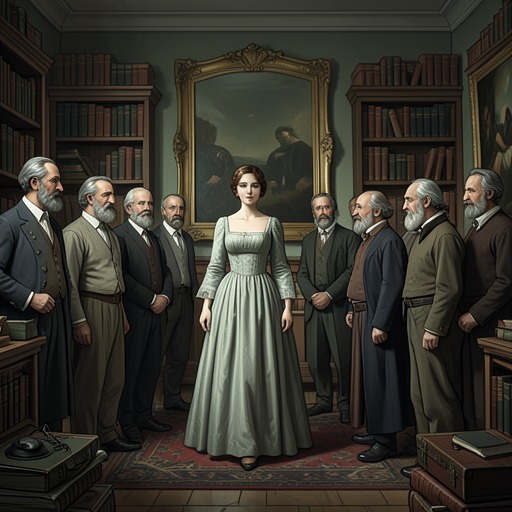
For Sarfatti, the exhibition was also a personal debut. Born in Venice, she had attended every Biennale since her father first took her there as a girl. In 1924 she exhibited Novecento for the first time, with a gallery of her own. Photographed among the painters, she appeared as the only woman among six men in a cultural world dominated by men. The arrangement gave her a visible position as organizer and advocate, while also making plain the gendered terms on which that authority had to be exercised.
Sarfatti’s Artistic Program
Sarfatti’s exhibition put forward a conception of artistic objectivity defined by a return to order: modern classicism, geometric composition, cohesive design, and harmony of color. One emblem of the program was Achilles Funi’s image of a young worker as a Renaissance Madonna. The work joined modern social identity to a classical and religious visual form, showing how the group’s idea of renewal could draw on inherited artistic language rather than simply reject it.
The display was arranged for an international audience. Delegations arriving by the Riva degli Schiavoni waterfront could encounter Novecento alongside the pavilions of Japan, Romania, and the United States, as well as those of European countries including Spain, Belgium, France, Holland, Hungary, Great Britain, Germany, and Russia. Sarfatti’s ambition extended beyond securing a place for individual painters: she sought to establish artistic power as equal in status to political power, speaking a language capable of forming a new cultural order with it. The exhibition thus tested both her aesthetic program and her claim to shape the regime’s cultural life.
Order, Disruption, and the Exhibition’s Success
The opening ceremony briefly recalled an older avant-garde disorder. In the king’s presence, Filippo Tommaso Marinetti interrupted Giovanni Gentile with a cry against backward-looking Venice. The book treats the outburst as diminished Futurist provocation: Marinetti was not invited to the exhibition, and the protest made him appear a caricature of his former disruptive role. The sovereign used the interruption as an occasion to leave the gallery early.
Despite the incident, the Novecento works were judged proficient, carefully selected, and well displayed. The exhibition’s smooth progress allowed Sarfatti’s new order, imposed in concert with Benito Mussolini, to triumph in public. Yet the result was not an unqualified victory for her. Ubaldo Oppi, described as perhaps the group’s most representative painter, accepted a separate room for his work after an invitation from Ugo Ojetti. Giovanni Papini attacked the group’s art, and Anselmo Bucci later withdrew. These defections and criticisms exposed limits to Sarfatti’s ability to consolidate the movement around her exhibition, even as its presentation succeeded.
Cultural Authority and Political Ceremony
The Biennale’s political atmosphere belongs to a wider pattern in the book, where public ceremonies and material objects make national memory available for political use. In Rome, Gabriele D’Annunzio displayed Giovanni Randaccio’s flag as a mourning emblem linked to claims over Fiume and Dalmatia. Later, the Unknown Soldier’s burial became an altar for collective memory, while Fascists knelt at the grave in a ceremony that joined politics to religious ritual. At a separate Fascist funeral, Michele Bianchi read Benito Mussolini’s farewell address before the martyr’s mother. These episodes are not events at the Biennale; their juxtaposition clarifies the broader political world in which its cultural pageantry took place.
The exhibition’s significance lies in this combination of aesthetic organization and political staging. Venice supplied an international setting and an established cultural prestige; Sarfatti supplied a coherent artistic program; the regime supplied the symbols and authority of its new order. The Biennale showed that cultural power could be presented as orderly and accomplished, while the defections and interruptions disclosed the frictions beneath that image.