Ana's pregnancy
MARRIED TO MY MASTER: A Bad Boy Hitman RomanceAna's pregnancy is not a single uncomplicated turn toward motherhood: it brings back a private history of loss, tests the possibility of a life with Grizzly, and is threatened by violence before ending in the birth of their child. The narrative follows Ana from the first sign that her period is late through fear, disclosure, medical reassurance, and delivery, setting her hopes for a family against the insecurity surrounding her and the Butchers.
Discovery and the Weight of the Past
Ana recognizes that her period is late and treats the change as alarming precisely because her cycle has always been regular. She has had unprotected sex with Grizzly, and the possibility of pregnancy arrives alongside her uncertainty about whether she can stay with him. Rather than take a test immediately, she avoids turning the possibility into a certainty while she is already struggling to keep other parts of her life in order.
When she does go for a test, Kid accompanies her to a convenience store. Ana tells him she needs medicine for a stomach bug, asks him to wait outside, and buys every brand of pregnancy test available. Each result is positive. Alone in the bathroom with the tests, she understands that she is pregnant and that Grizzly is going to be a father. Her reaction holds several feelings at once: the news is frightening and confusing, but also exciting. She wants Grizzly to want a family with her, even though she does not know whether he does.
That uncertainty is sharpened by an earlier pregnancy and loss. Ana later tells Grizzly that she had been pregnant before the raid and lost the baby after Rodent died. She had never told anyone about that experience; she had kept it as a private source of pain. The earlier loss also explains why the new possibility is not merely a joyful surprise. Ana had once imagined becoming a mother and had nearly done so, but that experience changed what she believed was possible for herself. The pregnancies therefore carry different outcomes but are connected by Ana's memory of loss and the fear of facing that possibility again.
Pregnancy Amid Conflict
The tests establish Ana's pregnancy, but they do not resolve the relationship questions surrounding it. She worries about becoming a single mother and about raising a child connected to a motorcycle club. Her wish for a family with Grizzly exists beside practical fears about the conditions in which she might have to raise a child. After crying, she washes her face and becomes resolved, but that resolve does not make the circumstances safe or simple.
Rodent's knowledge of a pregnancy becomes part of the danger surrounding Ana. He reveals that he saw the test and says he had been waiting for her to tell him. He assumes the child was Grizzly's and frames his own imagined claim to Ana's future as a reason he would have treated her better. Ana tells him that the baby was his and that she had not been with Grizzly while she was with him. The exchange exposes how pregnancy has become entangled with Rodent's possessiveness and with Ana's effort to keep control of what she discloses about her body and past.
During the confrontation, Rodent throws Ana against a dresser. She feels pain and sees blood, and fears the pregnancy has been lost. The episode makes the threat immediate: the pregnancy is vulnerable not only to Ana's memories and uncertainty, but also to physical violence. The narrative does not treat the bleeding as confirmation of a loss. Instead, medical examination supplies a crucial correction to Ana's fear.
Medical Reassurance and Birth
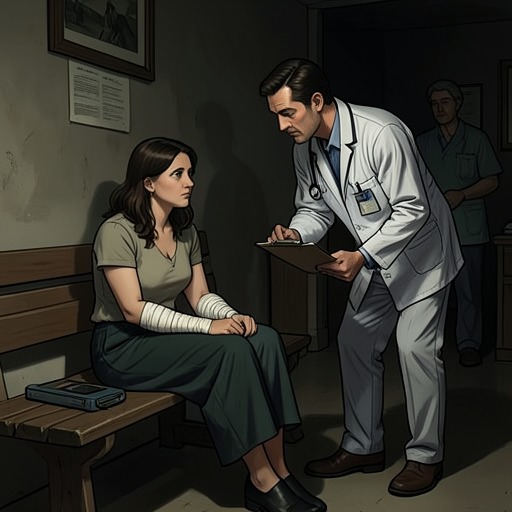
A doctor explains that Ana has mild abdominal bruising and that the trauma has caused pregnancy distress. After multiple tests, the doctor confirms that the baby is fine and says Ana should rest for the next few days before returning to her normal daily life. The reassurance is conditional rather than absolute: recovery requires rest, and the doctor emphasizes that the injury has affected the pregnancy even though the baby has survived it.
Grizzly learns the news from the doctor, who explains that Ana wanted him personally informed so he would not worry. The confirmation changes the meaning of the blood and pain he has seen: Ana is injured, but the pregnancy continues. The doctor bends the rules slightly by allowing Grizzly to see her, recognizing that they have both been through a great deal. The moment gives him the news directly while underscoring that Ana, rather than Rodent or the surrounding conflict, has chosen to tell him.
Months after Grizzly gets Ana back, the couple welcomes their child, whom he calls their little bear cub. The pregnancy itself is easy, to Grizzly's surprise and relief, but the delivery is not: it lasts almost three days. He stays beside Ana through hours of pain and uncertainty, worrying that she or the baby might not survive and that a cesarean might be necessary. The birth thus completes the movement from the positive tests and threatened pregnancy to a child arriving safely, without erasing the fear that accompanied the journey.
Significance
Ana's pregnancy brings reproductive choice into view as something shaped by more than desire. She wants Grizzly to want a family with her, but also anticipates the difficulties of single motherhood and life tied to an MC; her earlier loss makes the prospect of another pregnancy emotionally fraught. Her decision to delay testing, her private disclosure of the previous miscarriage, and her eventual sharing of pregnancy news with Grizzly each mark different limits on what she is ready to face or reveal.
The pregnancy also provides a sharp contrast between Rodent's attempt to claim authority over Ana and the later care surrounding the birth. Rodent uses the pregnancy to assert possession and is present when violence threatens it. By contrast, medical staff identify the injury, test the baby's condition, and prescribe rest, while Grizzly remains at Ana's side through the prolonged delivery. The ending offers a family after uncertainty and danger, but it does not recast the path to that family as easy: the earlier loss, the assault, and the three-day labor remain part of what the birth means.