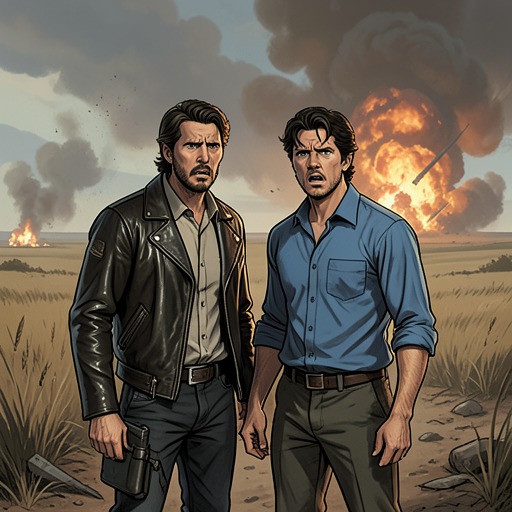
Cutter
MARRIED TO MY MASTER: A Bad Boy Hitman RomanceCutter is a rider traveling with the Butchers whose brief scenes place him at two very different points in the group’s life on the road. He first intrudes on Ana’s walk and is ordered away by Grizzly; later, an illness leaves him lagging behind as the others prepare to travel. Together, these moments establish both his subordinate place in the group and the practical, unglamorous disruptions of their journey.
Identity and Place in the Group
Cutter appears among riders wearing the same distinctive club branding Ana recognizes from the Butchers. His connection to the group is confirmed when Grizzly names him and tells him to leave, and when Kid later reports on Cutter’s condition while the others are getting ready. The scenes do not supply a wider personal history, but they place Cutter within the group’s travelling company rather than among passing strangers.
His relationship to Grizzly is visibly hierarchical. Cutter addresses him as boss, and when Grizzly intervenes in the roadside encounter, Cutter releases Ana immediately and rides on. The exchange establishes a practical chain of authority: Grizzly’s instruction is enough to stop Cutter’s conduct, without a prolonged argument or further confrontation. Cutter’s quick compliance is a concrete indication of his place in the group, though these episodes alone do not establish the broader terms of their relationship.
The Roadside Encounter
While Ana is walking beside the road, a Butcher slows his motorcycle and keeps pace beside her. He makes an unwelcome advance, first calling attention to her being alone and then catching a finger in her belt loop to tug her closer after stopping. Ana resists and tells him to let go. Grizzly’s intervention interrupts the encounter before it goes further.
The scene identifies the rider as Cutter only when Grizzly calls him by name. That moment changes the encounter from an unsettling approach by an unknown motorcyclist into a conflict within Grizzly’s own group. Cutter gives Grizzly an apologetic but not entirely earnest grin; Grizzly orders him to ride on, and he does. The other riders linger and watch, making the interruption visible to the group, while Ana turns her attention back to Grizzly. The evidence shows that Cutter’s conduct is checked by Grizzly’s authority, not that Cutter offers Ana an apology or that the encounter is otherwise resolved between them.
A Disruption to the Journey
Cutter’s later appearance is much less confrontational. As the group prepares to set out, Kid reports that Cutter is taking the longest and is still vomiting in the bathroom. Kid has brought him water, but Cutter remains ill. Grizzly asks whether he has water, a brief exchange that shifts the scene from the group’s preparations to the immediate question of Cutter’s condition.
The explanation given afterward is a combination of alcohol and food poisoning, with gas-station sushi identified as the likely culprit. The illness means the group must make another motel stop. The delay is not merely an aside about Cutter: it alters the pace of the journey and adds an unplanned overnight halt. When the riders get back on the road, Ana feels less apprehensive than before, describing the motorcycle ride and her growing openness around Grizzly as reasons for that change. Cutter’s illness thus forms part of the circumstances surrounding a shift in Ana’s mood, even though the narrative does not make him responsible for that emotional change.
Narrative Function and Limits
The contrast between the two episodes is central to Cutter’s brief portrayal. At the roadside, he is the source of an unwanted intrusion, and Grizzly’s intervention makes the group’s internal authority visible. During the later preparations, Cutter is instead the absent, incapacitated member whose illness holds up departure and requires a change of plan. The contrast gives him a small but concrete presence in the group’s life: he can affect Ana’s immediate sense of safety and, separately, the logistics of travel.
These scenes do not develop Cutter’s motives, history, or perspective. His actions and condition are presented through Ana’s first-person account and through what Kid and Grizzly say or do around him. As a result, Cutter remains defined by observable moments—the boundary-crossing roadside encounter, his immediate response to Grizzly, and the sickness that delays the ride—rather than by an independently narrated character arc.