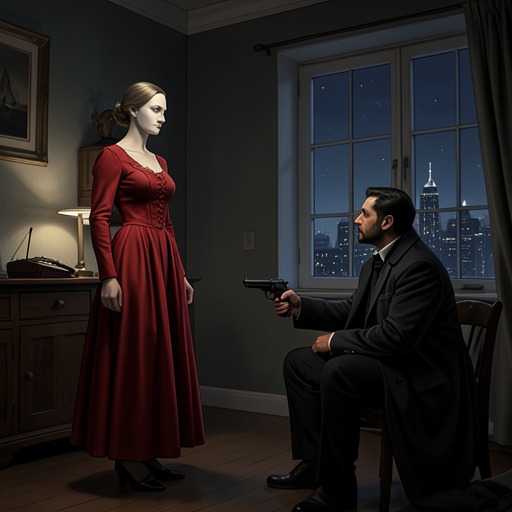
Derrick O’Bannon
MARRIED TO MY MASTER: A Bad Boy Hitman RomanceDerrick O’Bannon is a Federal Bureau of Investigation agent, the father of Scarlet O’Bannon, and a figure whose professional authority is inseparable from a painful family history. Scarlet remembers him both as a source of practical lessons about investigative work and as a father whose judgment has wounded her. When she suspects he may be tied to corruption, their strained relationship becomes part of the investigation; when the conspiracy is exposed, they work together, and he finally addresses the guilt and regret between them.
Identity and Professional Outlook
Derrick is known as a skilled Federal Bureau of Investigation agent. Scarlet recognizes that his reputation affects how others view her career: people assume that her place in the agency is due to her father, while she insists to herself that her own work and arrests matter. His professional standing thus provides her access to an institution but also shadows her independence. Their relationship is not simply one of mentorship. His influence can feel overbearing, particularly when he assumes authority over her decisions or speaks in a way she experiences as judgmental.
One of the clearest accounts of his working philosophy comes from advice he once gave Scarlet after drinking too much whisky. He told her to use the tools available in a case without letting shame, embarrassment, or social convention automatically rule out a tactic, while still recognizing limits. To make the point, he described using an investigator’s identity strategically: a Black agent might exploit the expectations of the Ku Klux Klan, or an agent might enter a gay club under false pretenses to gather information about a homosexual serial killer. Scarlet retains the lesson as a practical principle rather than a license without boundaries. During her flight with Cormac MacKay, she applies it to a dangerous situation in which she is in her underwear and a cocaine-using psychopath is in the passenger seat, signaling to Cormac that her behavior is a tactic and that he should play along. Derrick’s advice therefore persists in her work even when she is far from him.
Family Loss and Scarlet’s Suspicion
Derrick’s family history is marked by the drowning of his younger daughter, Tess O’Bannon. In Scarlet’s recollection, she pulls Tess from the water and reaches shore with her, only for the family’s efforts to save Tess to fail. Derrick tries to revive her while Scarlet and her mother wait in distress for an ambulance. In the immediate aftermath, the family travels dressed in black; Scarlet remembers her father staring ahead blankly. The loss remains present in later encounters: Scarlet imagines that he still expects Tess to appear, and his expression briefly changes as though he can see her before the imagined reunion disappears.
When Scarlet investigates Max Smithson and suspects that he may be working with corrupt agents, the family connection makes her inquiry especially difficult. She considers whether Derrick might be involved, speculating that cooperation with Max could help pay for her mother’s long-held wish to travel in Europe. She also recognizes how uncertain that suspicion is: she cannot imagine her father being pushed into corruption, but Tess’s death has altered how well she thinks she can read him. Scarlet believes Tess was their father’s favorite, and wonders whether grief could have changed his judgment. These are Scarlet’s fears, not established facts about Derrick.
The two meet over coffee in a small, busy shop. Derrick appears older than his age, with lined skin, heavy grey eyebrows, and hands that worry at his cup. Scarlet has to work against the childhood guilt that returns in his presence, even as she tries to approach him like any other suspect. She tells him she is investigating Max and two agents, Elijah Sullivan and Gertrude Fitzgerald. Derrick calls the accusations serious and asks what evidence she has. When she asks whether he is working with Max, he denies it and says he would never betray the Federal Bureau of Investigation. His denial does not erase Scarlet’s doubts at once, but the scene establishes that his loyalty is being questioned rather than proven compromised.
A Difficult Alliance
Scarlet explains that Max and his associates may be working for Mickey MacFarland, who has recently taken over the Irish mob. She wants Derrick to meet the two informants she has been working with, Cormac and Moira, both affiliates of the Irish mob who may help bring Mickey in. She feels guilty even describing them as informants, caught between competing loyalties, but Derrick accepts the proposed strategy as sound: catch the mob boss and identify the corrupt agents around him. His response marks a turn from the suspicion that has shadowed their coffee meeting to cooperation with Scarlet’s investigation.
That cooperation remains emotionally incomplete. As Derrick gets up to leave, Scarlet tells him she tried to save Tess. He pauses, his eyes filling, but asks whether they should get going rather than answer her confession. The moment shows the limits of their ability to speak directly about the loss: the shared grief is visible, yet neither can resolve it there. Their later work together will bring a more explicit acknowledgment of what has remained unspoken.
Derrick also appears at the compound where Scarlet and Moira are staying. He tries to enter, explaining to the guard that Scarlet is his daughter and is downstairs paying the cab driver, and identifies himself as a Federal Bureau of Investigation agent. When challenged about having a warrant, he steps back and agrees to wait. His willingness to defer to the guard’s boundary contrasts with his instinct to assert paternal and professional authority. Once Scarlet arrives, he objects when Moira speaks for him; Scarlet apologizes, and the group is left in an awkward silence. The brief exchange makes clear that father and daughter are still negotiating who gets to speak and act on whose behalf.
The Ballroom Bust and Reconciliation
During the operation that becomes known as the Ballroom Bust, Derrick takes an active role in the intervention. As Scarlet enters the ballroom with Cormac, Derrick arrives by elevator with other agents. He presses his Federal Bureau of Investigation-issued gun beneath one guard’s chin while the others secure a second guard. Scarlet is relieved to see her father. She cuts the music, and the sudden quiet gathers attention around Cormac and Mickey. Derrick’s presence is not only familial reassurance: he is one of the agents helping the operation gain control of a room divided between armed men and people being held under their power.
Afterward, Derrick and Scarlet share the substantial investigative work: completing paperwork, conducting interviews, and corroborating evidence. During a late stretch of work in Scarlet’s apartment, he tells her he is proud of her, regrets not saying so when she graduated from training or made her first arrest, and acknowledges that he should have spoken earlier. More significantly, he tells her he does not blame her and recognizes that he was wrong to imply otherwise. In the context of Tess’s drowning and Scarlet’s repeated insistence that she tried to save her sister, the admission directly addresses a burden that has accompanied their relationship. It does not undo the loss, but it changes the terms of their conversation about it.
The investigation’s outcome confirms the scale of the case they have pursued together. Mickey is sentenced to life for multiple murders; his men are imprisoned or tried, and the corrupt agents are gone. Scarlet learns that one of those agents was a serial rapist and killer. She later recalls the shared labor and Derrick’s apology while approaching The Leprechaun, where the new Irish mob compound is now a pub. His arc is therefore not a simple shift from suspect to ally: it moves from paternal authority and mutual hurt, through suspicion and operational partnership, toward an explicit acknowledgment of regret. Derrick’s most consequential change is not a new professional skill but his eventual willingness to tell Scarlet, plainly, that he is proud of her and does not blame her.