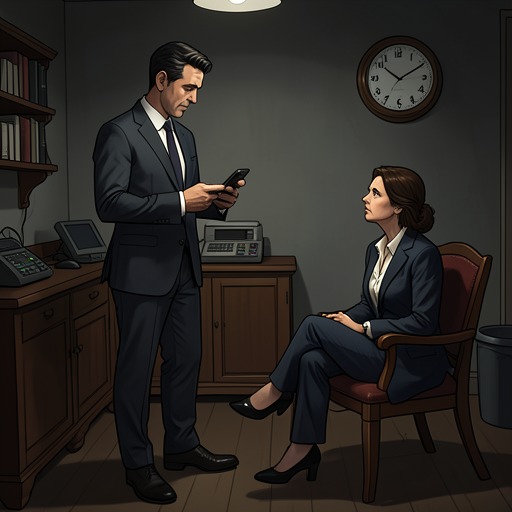
Emily's Confrontation with Edward Barker
MARRIED TO MY MASTER: A Bad Boy Hitman RomanceEmily West’s confrontation with Edward Barker turns her anger over Hymalete into a choice about how to resist BioSphere from within. She enters Barker’s office furious that he pushed an ineffective drug through approval, betraying first responders who trusted it, and that his actions drew her and Jas Robertson into the crisis surrounding Dane Bishop. Barker’s threats make clear that exposing the wrongdoing may place Emily herself in danger of becoming its public scapegoat. Rather than accept his framing of her choices as obedience or departure, she leaves with a third possibility in mind: staying in place and making room to act.
The accusation and the response
Emily storms into Barker’s office and slams the door behind her. Her anger is not presented as a private quarrel: she holds him responsible for forcing a drug on first responders despite knowing it did not work, and for the consequences that have entangled her and Jas in the wider conflict with Dane. The scene gives the accusation a personal cost as well as a public one. Emily believes Barker’s conduct has compromised the people who relied on Hymalete and put her own circle at risk.
Barker initially rises with his hands held out, presenting himself as peaceful and surprised. Emily refuses the performance and plants her fists on his desk. When he objects to the way she speaks to him, she turns that protest back on him, demanding an account of how he secured approval for a faulty drug. The physical arrangement sharpens the exchange: Emily stands over the desk, pressing the accusation, while Barker soon settles back into his chair as if the charge were ordinary business.
His answer is not a denial that he got Hymalete approved. He treats the achievement as part of the company’s work, describing drug sales and profit as the business’s purpose. Emily counters with the measure his account excludes: patients took Hymalete hoping to end their suffering, yet the drug offered no improvement over a sugar pill. Their disagreement is therefore about more than procedure. Barker frames the approval as commercial success; Emily insists that its failure matters because people trusted the treatment.
Institutional pressure
When Emily turns toward the board, Barker interrupts with laughter and asks whether she knows who helped him. His remark raises the possibility that responsibility reaches beyond the head of sales and marketing, but the scene does not establish exactly who participated or whether the board directed the fraud. Emily’s immediate reaction is to consider the scale of the implication: if others helped, the misconduct may be institutional rather than the act of one executive. She straightens and steps away, registering that the confrontation has widened beyond the man across the desk.
Barker then lays out the imbalance of power as he sees it. The company, he argues, is unlikely to sacrifice a sales-and-marketing chief who has made billions for it in order to protect an upstart CEO. He also warns that BioSphere’s quiet removal of Hymalete from the market has already hurt the company and suggests that Emily may be pressing too far. The withdrawal is thus presented not as a full reckoning but as a limited concession whose costs have sharpened the conflict.
Emily nearly breaks down, but the narration distinguishes her response from sadness or hurt: she is overwhelmed by anger at being painted into a corner. She clears her throat and moves toward the door. The movement is a pause in the confrontation, not a surrender to Barker’s argument; his attempt to define the available choices has not yet settled what she will do.
The threatened leak
As Emily is about to leave, Barker adds a more personal warning. Charlene Padilla of The New York Times is investigating, he says, and he could offer Emily to her as the story’s central scoop if Emily keeps causing trouble. Emily answers that he would not dare and insists she had nothing to do with the wrongdoing. Barker responds by dismissing the likelihood that the public will care about that distinction. He predicts that the press will seize on Emily’s looks and famous pedigree, then discard her once the story has consumed her.
The threat changes the confrontation’s stakes from internal accountability to public blame. Barker presents exposure as something he can direct toward Emily, not merely a consequence the company might face. His image of a public eager to see someone disgraced reinforces the threat: even if Emily is innocent of the scheme, innocence may not protect her from being made its most visible target. The scene leaves the truth of Barker’s leverage unresolved, but makes the danger of a managed leak explicit.
A third course
Watching Barker recline in his chair, Emily considers what remains possible. Staying at BioSphere could make her complicit now that she knows what happened; leaving could let the company pin the scandal on her without giving her a chance to see what was coming or collect evidence for her defense. Her thinking revises the choice Barker has imposed. Instead of accepting either complicity or disappearance, she recognizes a third way, though the scene does not yet specify every step it will require.
Emily tells Barker that he has won and that she probably cannot get rid of him, then turns, opens the door, and walks out. The concession sounds like capitulation, but her next actions make its strategic ambiguity apparent. She returns to an eerily silent office floor, where dozens of employees watch the Ice Queen and move aside as she crosses toward her office. Her heels strike the carpet like gavels. The image contrasts the apparent defeat of her words with the authority of her re-entry: she is back in her workplace for the first time in a week, and colleagues respond to her presence with fear.
Emily considers that fear a weapon and hopes it will give her room to do what she needs to do. Once inside her office, she shuts the door, hurries to her desk, and powers up her computer, drumming her fingers on the chair arms while it boots. The scene ends not with a public accusation or a resignation, but with Emily back at her own desk, preparing to act under pressure. Barker’s warning has made the risks of remaining unmistakable; her return suggests that she intends to use her position and access rather than simply surrender them.