Marianne Bishop
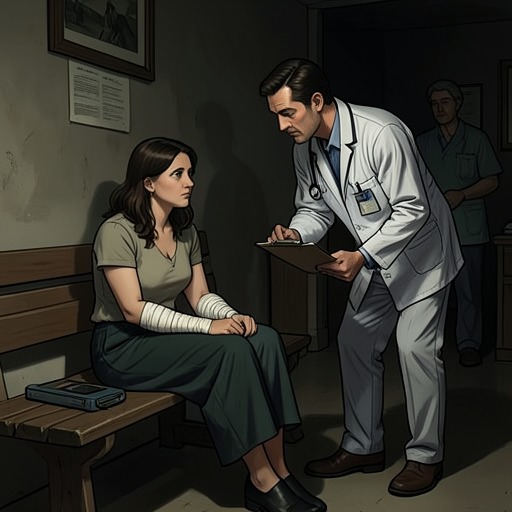
MARRIED TO MY MASTER: A Bad Boy Hitman RomanceMarianne Bishop is Benton Bishop’s wife and the mother of their children, whose murder by Benton turns her remembered family life into the measure of what was lost. The narrative gives her no independent point of view: readers encounter her through Dane Bishop’s recollections and grief. In those memories she is at once a specific person, the woman Dane describes as the best thing that ever happened to Benton, and an imagined voice confronting him with his failure to help his brother.
Identity and Family Life
Marianne is identified as Benton’s wife and as Dane’s sister-in-law. The family gathering Dane recalls took place at a birthday party for Landon Bishop, Benton and Marianne’s youngest son. The adults grilled in the backyard while the children ran through the sprinklers. Dane’s recollection holds the scene together through ordinary family activity: a birthday, a shared meal, and children playing within sight of their parents. It is a brief picture of the household before its destruction, rather than a detailed portrait of Marianne’s personality or daily life.
Dane’s other description of her is intimate but similarly limited. He remembers no more evenings having a beer with Benton on the back porch while his niece and nephew played, and no more laughter with Marianne, whom he regards as the best thing that had happened to Benton. That judgment places her importance within the family’s bonds: she is not just part of the home Dane has lost, but someone he believes made his brother’s life better. The text does not elaborate on how she and Benton met or on their marriage; its emphasis is on their shared family and the contrast between that remembered life and its violent end.
Murder and Its Aftermath
Benton is described as a decorated Iraq War veteran who murdered his family a little over a year before the conversation in which Emily West learns his identity. The account establishes Marianne as one of the members of that family. The same event that ended her life also left Dane fixated on proving Benton innocent, despite Benton’s conviction and death-row imprisonment. Marianne’s story is therefore joined to two consequences that remain active: the family’s absence and Dane’s effort to challenge the outcome of his brother’s case.
The memories return during a period when Dane is overwhelmed by that effort. He regrets not being present as Benton experienced symptoms of post-traumatic stress disorder and not recognizing the warning signs. In his account, Benton had returned from war profoundly changed; doctors and the United States Department of Veterans Affairs could not help him, and a pill made matters worse. Dane is also furious at the company he holds responsible and at a system he believes has placed the cost of its mistakes on Benton. These circumstances explain the context of Dane’s anguish, but they do not undo the family’s loss or establish Marianne’s own view of the events.
Marianne in Dane’s Memory
The birthday recollection is shaped by its distance from the present. Dane remembers the children as carefree, then sets that image against the knowledge that they are dead. He recalls the funerals, the reporters pursuing him, and news crews outside his home; the former family gathering sits among these later images as evidence of a life that cannot be recovered. Marianne’s absence is conveyed not through a separate account of her death, but through the domestic scenes Dane can no longer repeat: the family on the porch, the children playing, and the laughter he associates with her.
At one point, as Dane looks at family photographs, he imagines Marianne’s image questioning why he had not helped her family or freed Benton. This is a scene of grief rather than evidence that she literally speaks or appears to him. The imagined accusation gives personal form to the guilt already present in his memories: Dane believes he missed warning signs and failed to rescue his brother. Marianne’s place in this moment is especially consequential because his remembered admiration for her is joined to the charge he fears she would make against him.
Narrative Significance
Marianne is a central absence in Dane’s motivation. His campaign to prove Benton’s innocence is not presented as an abstract legal project; it is bound to the family he remembers and to his conviction that the tragedy followed failures by institutions as well as by himself. The remembered birthday and the imagined confrontation pull in opposite directions: one preserves a glimpse of family happiness, while the other makes that lost happiness a source of accusation. Together, they show how Dane’s pursuit of his brother’s exoneration is sustained by love and regret, even as Marianne and the children remain beyond the reach of anything he can repair.