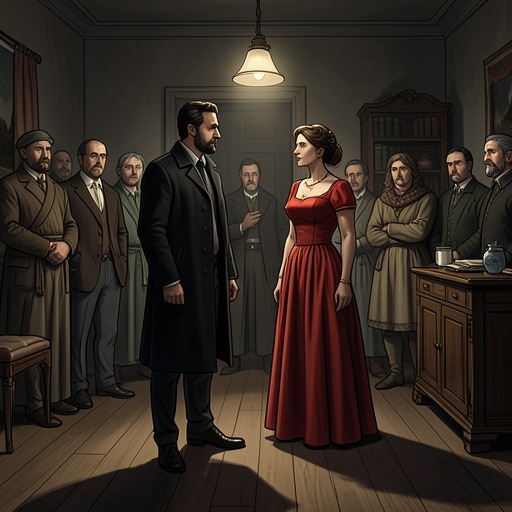
Mickey’s abduction of Scarlet and Moira
MARRIED TO MY MASTER: A Bad Boy Hitman RomanceMickey MacFarland’s abduction of Scarlet O’Bannon and Moira turns Moira’s captivity into leverage over Scarlet, forcing the FBI agent to submit rather than risk her cousin’s safety. The episode’s central reversal is that a plan involving Moira as bait is transformed into a real hostage crisis, with Mickey controlling both women and using photographs to intensify the pressure on their allies.
The threat that forces Scarlet’s choice
Mickey confronts Scarlet with proof that Moira is in his custody: a phone image shows her wearing a sparkling red dress and heels, squinting at the camera. He taunts Scarlet with the possibility that she has misremembered where Moira is, then makes clear that he can produce evidence. The image gives the threat a physical, immediate form; Scarlet is no longer dealing with a warning about what Mickey might do, but seeing Moira dressed and displayed under his control.
Mickey makes Scarlet’s choice explicit: she must go with him at once, or he will have sexual “fun” with Moira. Scarlet recognizes the threat as an attempt to exploit her protective instincts, and her anger at Mickey does not make the danger less real. She thinks of Moira as her cousin and of Tess O’Bannon’s drowning, connecting the present threat to an earlier death and to the fear of failing someone she was meant to protect. Rather than attack Mickey, Scarlet agrees to accompany him. Her surrender is not consent or trust; it is a decision made under coercion to keep Moira from being harmed.
The hostage spectacle and pressure on the rescue effort
Mickey’s control extends beyond the threat made directly to Scarlet. Cormac MacKay receives an anonymous message bearing a photograph of Scarlet and Moira in tightly fitting party dresses, both squinting into the flash. For a moment, Cormac imagines Scarlet has fought her way free and is waiting somewhere for him; the image abruptly replaces that hopeful fantasy with confirmation that both women are in Mickey’s hands. He has to set the phone on the dashboard to keep from crushing it, then tells Flint that Mickey has Scarlet and his sister. The hostage crisis reaches the people trying to intervene through images that turn the women’s captivity into a repeated, visible warning.
The first photograph is followed by a more degrading display. As Cormac and Flint prepare to retrieve weapons from a cache hidden inside an abandoned arcade, another image arrives: Scarlet and Moira kneel beneath Mickey, who rests his hands on their heads. The message makes Cormac’s quiet-entry plan seem naïve. He drops his weapon and turns toward the door, while the scene has already shown why a rescue cannot be treated as a straightforward assault: Cormac insists that the guns are a last resort and that neither woman can be put in the line of fire. Mickey’s photographs do more than locate the hostages; they force the rescuers to reckon with the risk that any move could make the captives less safe.
For Scarlet, the scene is especially painful because it resembles a plan only in its outward arrangement. She and her allies had intended to use Moira as bait, but Moira was meant to be safe and knowingly involved. Now Scarlet is kneeling beside her under the watch of armed men, unable to stop the man behind the camera from touching her head. Moira maintains a brave expression while Mickey is close; when he moves away, she releases a shaky breath. Scarlet helps her stand, a small act of care inside a situation in which neither woman controls what happens next.
The party also exposes the fractures beneath Mickey’s apparent command. Scarlet sees two groups in the ballroom: men associated with the previous Don, Cormac and Moira’s father, gathered apart and speaking quietly, and Mickey’s recruits, who drink loudly and congratulate one another. Mickey greets both sides with broad smiles, apparently failing to notice that the older group returns his welcome warily. The abduction therefore unfolds within a mob whose unity is more spectacle than settled allegiance: while Mickey uses the party to display his power over Scarlet and Moira, the room itself reveals that his authority has not erased the loyalties and divisions inherited from the former regime.
Control of the Evidence and the Communication
Mickey frames Moira’s whereabouts as something Scarlet cannot verify independently. He claims to have visited her on the top floor of an apartment building in Hell’s Kitchen and says that she is now in his care, then treats Scarlet’s demand for proof as an opportunity to show the photograph. His account makes the image more than a taunt: it is the evidence he chooses to provide, while the location and circumstances of Moira’s captivity remain under his control.
Scarlet tries to reach Cormac MacKay by phone, but Mickey takes the device before she can answer, hangs up, and puts it in his pocket. The interruption closes off an immediate line to help at the very moment she learns that Moira is being used to force her compliance. Her phone, like the photographs sent to Cormac, becomes part of Mickey’s machinery of control: he decides what can be seen, who can communicate, and when the message ends.
The reversal from bait to hostage crisis
The sequence is built around a plan changing meaning under force. Moira had been intended as bait, but only with her knowledge and safety secured; Mickey’s capture turns that controlled risk into genuine captivity. Scarlet’s decision to go with him and Cormac’s interrupted rescue preparations show the same reversal from opposite sides: she accepts immediate coercion to protect Moira, while he has to abandon the assumption that a quiet approach can reliably reach them. The photographs bind those perspectives together, making the women’s exposure visible to the rescuers without giving them control over the hostages’ location or safety. Mickey’s display at the party may project command, yet the wary response of the former Don’s men leaves that authority visibly unsettled. The abduction thus functions both as a personal hostage crisis and as a demonstration of power whose theatrical certainty is undercut by the divided loyalties in the room.