Police siege and lockdown at Emily West's home
MARRIED TO MY MASTER: A Bad Boy Hitman RomanceThe police siege and lockdown at Emily West’s home turns a hostage scenario intended to attract media attention into a public crisis whose scale Emily and Dane Bishop cannot control. Within hours of the story reaching television, helicopters, SWAT vehicles, and a broad police perimeter surround the neighborhood. The domestic setting becomes the center of a highly visible standoff, while the staged appearance inside the house must be maintained as the response outside grows more serious.
From media stunt to police response
Dane and Emily spend an hour pacing the house before his phone rings. Charlene Padilla is on the other end with a simple instruction: turn on the television. The resulting broadcast confirms that the hostage story has become national news. CNN identifies Emily as the chief executive of Pharma-Vitae and describes her as taken hostage at home by the distressed family of a customer on death row; its screen also reports a decline in the company’s share price. The coverage has given Dane the headlines he sought, and he immediately asks whether Pharma-Vitae has responded or agreed to release its papers. Charlene says there has been no response yet, but warns him that police are on their way.
That warning marks a change in the situation. The publicity is no longer only a tool Dane and Emily can use to pressure the company: police are mobilizing in response to the public account of a hostage crisis. The distinction between the deception they have devised and the danger authorities understand themselves to be confronting begins to matter less than the visible emergency surrounding the house. Their scheme has summoned consequences beyond the media attention they intended to attract.
The neighborhood under siege
By the time the next chapter opens, less than two hours have passed. News helicopters are overhead, SWAT trucks have arrived, and armed personnel have formed what Emily understands as a nearly impenetrable perimeter. Media vans and satellite uplinks fill the neighborhood, which has been placed under lockdown. The response is not confined to the house or to the people directly involved: an ordinary residential area has become a secured and televised crisis scene.
Emily registers the scale of the operation as evidence of her importance to the larger public and corporate story. Her reaction is not uniformly sympathetic to the people around her. She feels some concern for the neighbors but makes an exception for the Johnson family next door, whom she resents for letting their dog foul her yard and denying responsibility. That irreverent judgment sits beside the more consequential change in her circumstances: private domestic grievances now coexist with a police operation affecting the whole block.
Maintaining the hostage appearance
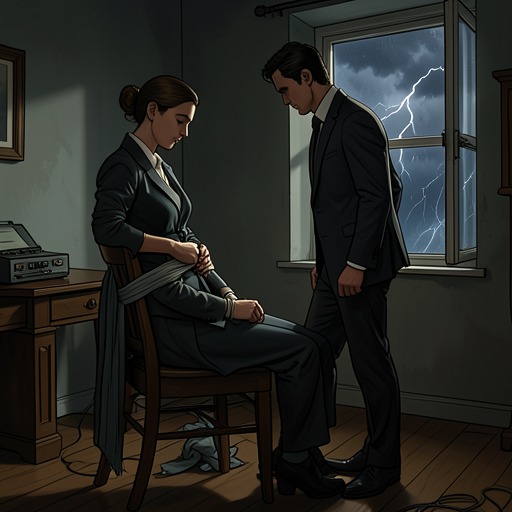
For appearances, Emily and Dane decide that she must be tied to her chair again, this time in the living room with the curtains drawn. The arrangement is meant to keep their account plausible to anyone watching from outside; the concealed windows and restraint preserve the visual logic of a hostage scene. Yet the performance has become difficult to revise. Emily doubts that anyone would believe them if they suddenly revealed that the crisis was a stunt, even if they could pull back the curtains and announce the deception.
The room’s presentation therefore becomes part of the siege. They are not simply waiting for coverage to have an effect on Pharma-Vitae; they must also sustain the appearance that prompted the authorities to surround the house. The closed curtains separate the staged interior from the public spectacle outside, while Emily’s chair makes her role in that spectacle physically legible. The plan depends on being believed, but the more convincing the crisis appears, the harder it is for its architects to call it off without being heard or trusted.
Emily’s changing assessment
Emily recognizes that events are no longer unfolding as she had hoped. She is increasingly worried that the situation is spinning out of control, and the arrival of SWAT and so many police officers is beyond what Dane had told her to expect. Her response distinguishes consent to an intended publicity strategy from confidence in every consequence that strategy produces: the operation has reached a new scale, and she did not anticipate this escalation.
While they wait for Charlene to arrive for an interview, Emily’s phone rings repeatedly. Dane ignores the calls and does not let Emily answer. She suspects that Jas Robertson is calling because she is worried about her. The unanswered calls make the cost of the lockdown personal as well as public: Emily cannot reassure someone close to her, while the house is sealed into a crisis narrative controlled by others. The siege thus ends this stage of the episode with the outside world pressing in and Emily’s own ability to communicate narrowed, even as she and Dane continue trying to manage the story they have set in motion.