Road Rage's drug-induced psychosis
MARRIED TO MY MASTER: A Bad Boy Hitman RomanceRoad Rage’s drug-induced psychosis is depicted as a state of escalating agitation, paranoid grievance, and threatened violence. Rather than calming him, drugs intensify his impulses and distort his understanding of Ana and Grizzly’s relationship with him. His fixation moves between memories of betrayal, possessive claims over Ana, and a desire for revenge against Grizzly; the result is a danger that reaches beyond his own mind into the people and clubhouses around him.
Identity and Background
Road Rage was formerly known as Rodent. His history with Ana and Grizzly supplies the emotional material around which his delusions gather: he remembers Ana as his partner and Grizzly as his friend, then recasts their closeness as a theft of the life he expected to have. He insists that he had imagined a family with Ana, including children, and treats that imagined future as something taken from him. The account establishes his sense of ownership, not a mutual agreement that Ana belonged to him.
His relationship with Grizzly had also been shaped by their shared past. Road Rage says he noticed Grizzly looking at Ana and observed her pulling away from him and becoming closer to Grizzly. He connects this remembered shift to the night Grizzly carried Ana away while injured. These memories are presented through Road Rage’s aggrieved perspective: they explain what he fixates on, but do not establish the accusations he builds upon them as fact.
Escalation and Visible Conduct
The narrative makes the effect of drugs explicit through Road Rage’s own recurring pattern. When he dopes, he does not become calm; he becomes more agitated and more inclined toward fighting and killing. By the time he is pacing in his office, revenge has displaced any possibility of satisfaction. Grizzly has escaped him, and Road Rage’s attacks on The Butchers MC and its clubhouses have not, in his view, gone far enough.
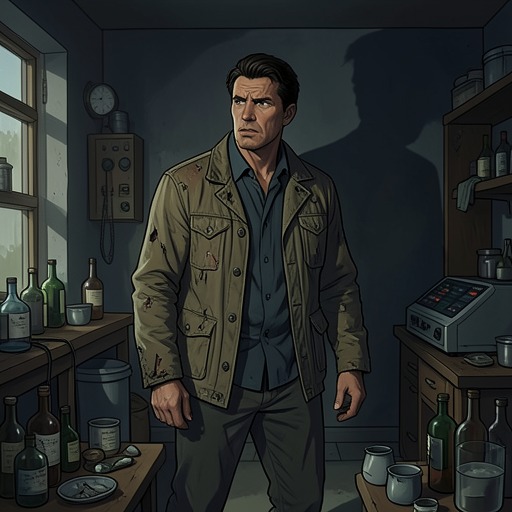
His agitation becomes physical. He overturns a table, scattering drugs and baggies, throws chairs, and damages a wall in a rage. The violence is not limited to objects: his followers can hear him, but stay away because they expect that his anger could fall on one of them and cost someone their life. Their avoidance shows how his condition affects the group around him. The scene presents his office as a place where the danger is already understood, even by people who do not intervene.
The Photograph and the Return of Grievance
A photograph gives Road Rage a new focus for his resentment. He recognizes Ana behind the bar at the clubhouse where The Butchers MC operates and sees Grizzly across from her. The image does not reveal a new betrayal; instead, it revives and intensifies the story Road Rage already tells himself about losing Ana, his club, and the future he had imagined.
He interprets their presence together as proof that Grizzly took everything from him. His thinking collapses several separate losses into one personal conspiracy: Ana’s choice to leave, Grizzly’s relationship with her, and Road Rage’s changed position become, in his mind, parts of the same theft. He paces and mutters threats against Grizzly and the others, insisting that he will get Ana back. The possessive language marks how completely his account excludes Ana’s independent wishes.
Encounter with Ana
When Ana next sees him, she identifies him as Rodent, but the man before her appears sick, haggard, and drugged. His changed appearance and behavior make him seem unfamiliar to her, and she recognizes that something is deeply wrong. He tells her that he is now Road Rage and says he has been looking for her. The change of name accompanies the change in how he presents himself: he approaches the reunion as a claim and a grievance, not as a conversation between former partners.
Ana challenges the premise of his account by recalling that he began using drugs. Road Rage rejects that explanation and blames her and Grizzly instead. He alleges that they planned to kill him so they could leave together, interpreting the earlier conflict as a deliberate plot against him. The text gives this accusation as his belief, not as an established event. His certainty turns disagreement into further evidence of betrayal, leaving little room for him to revise his suspicions.
Significance and Limits of the Depiction
Road Rage’s state is defined by the convergence of drug-fueled agitation and a possessive, increasingly paranoid reading of intimate history. The photograph, his memories of Ana and Grizzly, and their earlier conflict all become material for a single revenge narrative. The contrast between that narrative and Ana’s explanation makes clear that his accusations are not neutral accounts of what happened; they are part of the distortion through which he understands events.
The scenes also show consequences without presenting a recovery or resolution. His followers keep their distance, his threats name Grizzly and Ana as targets, and Ana recognizes his condition as alarming. The supplied evidence ends during their encounter, so it does not establish how long his psychosis continues or what ultimately happens to him. What it does establish is the immediate pattern: drugs intensify his agitation, grievance hardens into delusion, and his fixation turns an old relationship into a present threat.