Sleep deprivation
MARRIED TO MY MASTER: A Bad Boy Hitman RomanceSleep deprivation is a method of control used against Emily West during her captivity by Dane Bishop. Its force comes not from a stated schedule or a measured number of hours, but from the sustained obstruction of rest: Emily is restrained, deprived of sight and ordinary cues to time, subjected to loud music, and repeatedly prevented from settling into sleep. The episodes show how control over her body extends to the basic rhythms of wakefulness and rest.
Context and Method
Dane introduces the subject by asking Emily whether she has ever been sleep deprived. He refers to his own experience in the United States Air Force, where, he explains, personnel used pills to stay awake on long flights and combat sorties and took other pills afterward. His account establishes that he knows sleep deprivation as an organized practice, but the narrative does not equate his military experience with Emily’s captivity or provide medical detail about either.
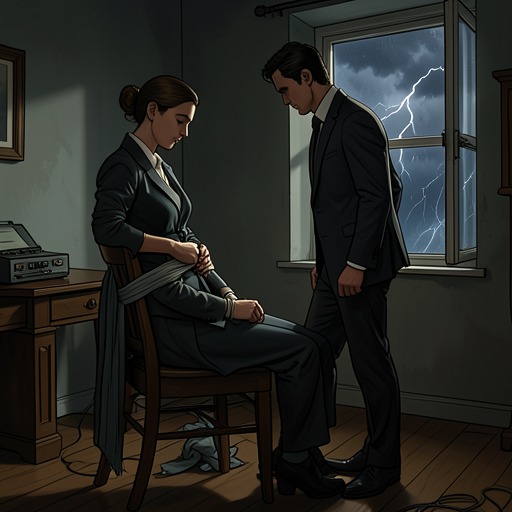
Dane then makes Emily sit in a chair and restrains her. He places headphones over her ears and plays heavy metal music at a volume that overwhelms her ability to hear herself. A tie over her eyes removes her vision as well. These choices leave her without the ordinary means of orienting herself in the room: she cannot see a clock, watch the light change, or track the sun across the sky. The environment is not merely uncomfortable; it is made difficult to interpret and difficult to escape.
The chair, headphones, and blindfold work together. Emily cannot readily change position, the music dominates her attention, and darkness prevents her from seeing whether time has passed. The narrative gives no exact duration for the first period of restraint. Instead, Emily experiences it as lasting for ages, an impression made more acute by the absence of clocks and daylight. The uncertainty is part of the condition as she lives it, not a reliable measurement of how long she has been kept awake.
Emily’s Experience of Time and Exhaustion
At first, Emily struggles against the restraints and searches for a way to sit comfortably. When she cannot continue resisting, she tries to slump, but that position is uncomfortable too, so she straightens again. The episode therefore makes rest difficult even before she manages to drift off: her body is confined to a chair and denied an easy posture, while the continuous music gives her little quiet in which to settle.
Eventually, exhaustion begins to overcome her. Emily’s head falls forward, but the sudden movement wakes her. She recognizes that her body may adapt to the position and tries to control the motion herself, letting her head hang forward so that the abrupt drop will not startle her awake. The adjustment gives her a possible way to catch a little sleep, but it is not the same as being allowed to rest normally. Her attention turns to managing the conditions Dane has imposed, finding a posture that might make a brief interval of sleep possible.
That adaptation does not end the deprivation. After the music has continued and she has begun to drift, Dane returns and resumes the noise. Emily wonders whether he will let her rest, but the text shows no dependable period of uninterrupted sleep. After a repeated interruption, she understands that he is not going to let her sleep for a long time. She also recognizes that the pattern withholds relief even as her body responds to the situation. The distinction matters: physical response does not mean that she has chosen the conditions or been given control over them.
Control and Coercion
Sleep deprivation takes place within a wider captivity in which Dane dictates Emily’s movement and conduct. He has forced her into his control after seizing her and requiring her to get into a car. Elsewhere, he sets rules that limit when she may speak and assigns her chores and service to him. The sleep episode belongs to this pattern of imposed authority: Emily cannot decide when the restraints come off, when the headphones stop, or when she is permitted to rest.
The episode also presents uncertainty and fear as part of the pressure. When Dane approaches with the tie, Emily cannot tell what he intends to do with it and fears that she is in danger. Once it covers her eyes, she cannot observe his movements or the passage of time. The combination narrows her ability to anticipate what will happen next. The narrative therefore connects deprivation not only to tiredness but to enforced dependence on the captor’s decisions.
Narrative Significance and Limits
The account makes the loss of time legible through concrete absences: no clock, no view of the sun, and no reliable distinction between an interval of wakefulness and a possible moment of sleep. Emily’s small attempt to adapt her posture marks the point at which endurance becomes practical problem-solving. Yet every possible adjustment remains within the arrangement Dane controls, and his repeated interruptions prevent adaptation from becoming genuine freedom to rest.
The text does not establish the total duration of the deprivation, diagnose a resulting condition, or describe its long-term medical effects. What it does establish is a recurring, deliberate obstruction of Emily’s sleep during captivity, and her growing realization that rest will not be granted on her terms. In that context, sleep deprivation functions as one element of coercive control: an intimate, ordinary need is turned into something the captor can withhold, interrupt, and use to keep Emily disoriented and subject to his authority.