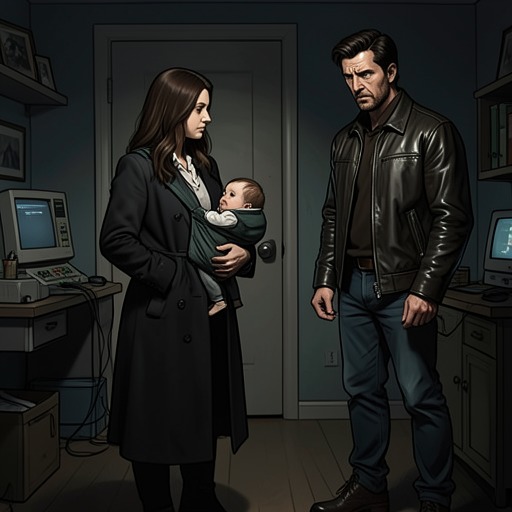
Ana’s post-traumatic nomadic life
MARRIED TO MY MASTER: A Bad Boy Hitman RomanceAna’s post-traumatic nomadic life is defined by motion as both practical survival and emotional self-protection. After the upheavals connected to Rodent and the war, she avoids staying anywhere long enough to become attached; even a brief reunion with Grizzly reveals how much that rule has cost her, and how difficult it is to keep obeying it.
From Duchess to Ana
Ana insists that her former identity cannot decide how she lives now. When Grizzly invokes Duchess as he remembers her, she answers that people change: she is Ana, and she needs to return to work if she wants a job the next day. Her request that Grizzly order a drink and act like an ordinary patron makes the distinction concrete. Whatever she once was to him, she is now trying to preserve an ordinary working life, and she cannot afford for his feelings or their shared history to disrupt it.
That effort is precarious. After her boss, Jeremy, threatens her and makes clear she will not be welcome back, Ana does not return to plead for her job. The decision is not presented as a fresh beginning or a chosen adventure; she sees no point in asking again when his words have already made the outcome clear. Losing work immediately narrows her options and sends her back into the unstable pattern she knows: use what little money remains, keep moving, and find another place to stop.
The mechanics of moving on
Ana has enough cash for one final night at the Motel, a gas-station sandwich, and a bottle of water. She has eaten the sandwich and tries to make the water last as she walks along the highway, looking toward a long stretch of road with little hope of finding anyone soon. The small, specific limits of her supplies give her movement its material cost. She is not traveling toward a stated destination; she is trying to get through the immediate day with what she has.
Her plan is already familiar. She expects to hitch a ride, get off somewhere decent enough to rest her feet, and then pack up and move again. She describes the pattern as continuing since Rodent and everything that happened back then. War nightmares remain, and staying in one place too long brings a particular fear: attachment might make another devastating loss possible. Moving on therefore protects her from the vulnerability of settling, but it also means she expects each temporary refuge to end in another departure. Her nomadism is at once a response to past harm and a routine that keeps the possibility of belonging at a distance.
The road also leaves her exposed to strangers. When motorcycles pass, Ana recognizes the bloody bear mark as the same kind worn by The Butchers MC. Later, faced with Grizzly’s offer, she weighs the danger of continuing to hitchhike against the protection his company might provide. Accepting does not mean she has found a permanent home or abandoned her habits. It gets her off the highway and offers a temporary interval of safety.
Grizzly and the pull of the past
Seeing Grizzly unsettles the self-sufficiency on which Ana’s plan depends. She had thought she was over him, but realizes that she wants him to hold her. She also recognizes the danger she associates with following that desire: acting from feeling instead of judgment could lead her to do something she would later consider a mistake. Even the possibility of a kiss attracts her, but attraction does not erase her caution.
Her decision to accept his offer comes after she looks at the road ahead and considers what refusal would mean. She may have to stay out there for a while, with no assurance of a better offer, whereas riding with Grizzly gives her protection from being picked up by an unknown person. For the first time, she admits to herself that she misses what she left behind. She tells herself that necessity, rather than the intensity of Grizzly’s gaze, is the reason to accept. The qualification matters: she makes room for return by treating it as temporary, something that need last only until she needs to leave again.
Intimacy without a settled ending
The return is emotionally powerful before it becomes secure. After sleeping and kissing beside Grizzly, Ana finds the closeness deeply right, though she knows it should not feel so simple after five years of heartbreak and change. She wakes during the night and remains alert to his arms around her, wondering whether he is holding on out of fear of letting go or because he is still protecting her. The sensation offers comfort, but her attention to its meaning shows that intimacy has not erased her uncertainty.
Her memories of Rodent sharpen the conflict. There had been a time when she welcomed sleeping in his bed and waking to his touch; later, Grizzly was the person she wanted. Yet she does not regard desire as the only obligation at stake. Ana says she is not the kind of woman to leave her baby’s father, especially not for that father’s best friend. She had hoped the baby she lost might somehow bring her and Rodent back together, but the relationship was already marked by Rodent’s decline and her growing feelings for Grizzly before everything fell apart.
The evidence of Ana’s nomadic life therefore ends not with a settled reconciliation, but with a charged pause. Grizzly’s embrace lets her experience a closeness she had trained herself to avoid, while her memories preserve the grief, loyalties, and consequences that make returning complicated. For now, she has allowed herself to miss her former life and to stay near it; she has not claimed that the old life can simply be restored.