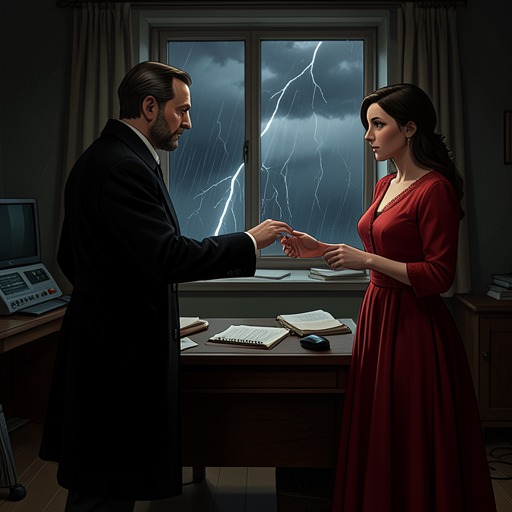
Cormac and Scarlet’s Intimacy Is Interrupted at the Motel
MARRIED TO MY MASTER: A Bad Boy Hitman RomanceThe motel encounter between Cormac MacKay and Scarlet O’Bannon turns an inconvenient shortage of rooms into a test of Scarlet’s professional identity and emotional boundaries. Their mutual attraction draws them toward intimacy, but Scarlet’s fear of crossing the line between FBI agent and criminal interrupts the encounter. Her decision to draw her sidearm stops what is happening; the silence that follows leaves her confronting not only what she feels for Cormac, but also the guilt and self-judgment that shape her resistance.
A Room Chosen Rather Than Checked
Cormac returns from the parking lot with the news that the Motel has only one room left. It contains two single beds, so sharing the room does not require sharing a bed. Scarlet doubts his account and considers checking for herself. Yet doing so might establish that another room is available, forcing her to take one alone—a prospect she does not want. She agrees to go with him without verifying the story. The choice is small and outwardly practical, but it places the two of them in close quarters while showing that Scarlet is already reluctant to create distance.
Several hours later, they watch television from separate beds as the sun sets. Takeout containers remain on the bedside table. Scarlet begins to undress and climbs onto the bed without getting under the covers, uncertain about what she intends. Cormac notices her and approaches. The separate beds have preserved the appearance of a boundary, but Scarlet’s actions have made that boundary unstable; the scene’s tension comes from the gap between her deliberate invitation and her uncertainty about how far she can accept it going.
Attraction Meets Professional Identity
As they kiss and become more intimate, Scarlet experiences desire alongside fear. Her attraction is not merely an abstract possibility: she recognizes it as stronger than what she has felt with previous partners. At the same time, she interprets continuing as a threat to the identity she associates with being Agent O’Bannon. Cormac’s status as a criminal makes the conflict concrete. The prospect of intimacy is also, in her mind, a crossing of the professional and moral line that defines her role.
Scarlet’s hesitation is therefore not presented as a simple absence of desire. She is drawn to Cormac even as she tries to preserve a version of herself organized around the badge, the holster, and the pursuit of offenders. The encounter exposes how difficult it is for her to separate attraction from the categories through which she understands herself and him. She can want him and still regard acting on that desire as a betrayal of her professional self.
The Interruption and Its Immediate Aftermath
When Cormac moves toward sex, Scarlet abruptly reaches for the gun in her handbag. She checks that its safety is on, points it toward him, and tells him to get off her. Cormac stops and objects that he is not trying to assault her. Scarlet insists that he stop, then points the weapon at his face. He backs away, laughing in disbelief and asking whether she is crazy. The encounter is interrupted by Scarlet’s armed intervention, not by an outside arrival or a change in the room’s circumstances.
Scarlet then sees Tess, muddy and standing with folded arms, accusing her in a vision of failing to save her and now choosing a bad man. Scarlet knows Tess is not actually present, but feels the judgment as real. That distinction matters: the vision does not change the physical situation, yet it gives form to Scarlet’s guilt and helps explain why desire has become entangled with self-reproach. Scarlet says she does not want to go further and describes the sexually open version of herself as unlike the suited, armed agent she considers real.
Neither speaks much afterward. They lie in the same room while television commercials give way to a game show and the night darkens; Cormac eventually snores. Scarlet reflects on having drawn her sidearm without reasonable cause and compares the incident with her experiences with other men, against whom she had never drawn her gun. Her response makes the encounter consequential beyond its immediate interruption: attraction has brought her to a point where the professional weapon she carries becomes part of a personal crisis.
What the Scene Reveals
In the quiet afterward, Scarlet distinguishes Cormac from her previous partners. She thinks of those men as ordinary in comparison and recognizes that Cormac seems able to see past the professional presentation she maintains. His response to her is unlike the clumsy or fearful reactions she associates with other men. The contrast helps explain the intensity of her attraction, but it does not settle what she should do with it; instead, it makes her feel more exposed.
Scarlet imagines a counterfactual version of their circumstances: Cormac as an FBI agent, sharing a room with her on a case, with his badge on the nightstand. In that imagined setting she is sure she would not have drawn her gun. She also recognizes that, if he belonged to her professional world, she would not be nearly as attracted to him. The imagined alternative clarifies the force of the actual one. Her desire is bound up with the very difference that makes the relationship feel impermissible, while her badge and weapon represent an identity she cannot simply set aside. The scene ends with that contradiction still active, held in place by separate beds, silence, and Scarlet’s unresolved attempt to decide which version of herself is real.