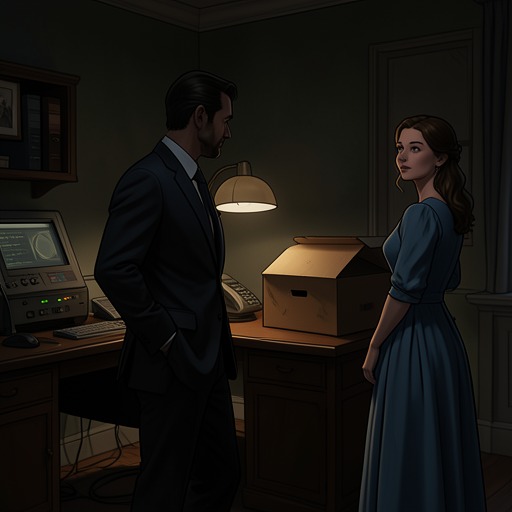
Dane Bishop
MARRIED TO MY MASTER: A Bad Boy Hitman RomanceDane Bishop is defined by two entangled struggles: his effort to challenge the account of his brother Benton Bishop’s crimes, and his volatile relationship with Emily West. He argues that Hymalete, a medication Benton had begun taking shortly before murdering his wife and children, may have caused or worsened Benton’s psychotic symptoms. When that claim meets institutional resistance, Dane takes it to the press and pursues a confession from Edward Barker. His public campaign gives way to a private ending with Emily, but the evidence of coercion within that relationship complicates the apparent resolution of his story.
Identity and Background
Dane is Benton’s brother, and his advocacy begins with a claim that others will not accept. Benton is on death row for murdering his wife and children during a psychotic break. Dane says that the United States Army service associated with Benton’s symptoms is not the whole explanation: Benton had recently started Hymalete, a medication manufactured by BioSphere, and Dane believes it failed to help and may have made the symptoms worse.
The distinction between what is publicly known and what remains undisclosed becomes central to Dane’s case. Benton’s conviction and the murders are matters of public record; Benton’s use of Hymalete, as Dane presents it, is not. Dane sees that missing information as essential to understanding what happened, rather than as a detail that can be set aside once a court has reached a verdict. His account does not erase Benton’s crimes, but presses the question of whether the medication and its effects were properly considered.
The Campaign Against BioSphere
Dane tries to defend Benton both in court and in the press. He also approaches BioSphere directly, but the company sends him to its public-relations department, where he receives what he experiences as a runaround rather than an answer. That response sharpens the conflict: his effort to investigate a possible drug-related cause encounters the manufacturer’s capacity to manage inquiries without addressing his underlying concern.
Dane makes the case publicly to Charlene Padilla, identifying himself and Benton and laying out the sequence he wants people to consider: Benton’s service in the United States Army, the psychotic break, the medication begun shortly before the murders, and BioSphere’s continued marketing of Hymalete. He points out that the drug is being promoted to first responders and service members with similar symptoms, with the promise of helping them return to normal mental health. In presenting the case this way, he connects Benton’s experience to the people the company is still addressing, turning a family tragedy into a question about the risks of a product offered to a broader group.
The public argument is also a campaign to make concealed information matter. Dane does not present Hymalete as a proven explanation that settles Benton’s responsibility; he argues that it may have contributed to the symptoms and that this possibility deserves scrutiny. His frustration with BioSphere’s response and his decision to make the medication’s role public reveal a persistent objective: to force attention onto evidence he believes was neglected, even when established legal and corporate channels have not given him the hearing he wants.
Evidence, Allies, and the Pursuit of a Confession
Dane’s campaign relies on other people as well as on his own persistence. He later recognizes that Charlene was present and was one of the few reasons he had been able to accomplish what he did. Her contribution is important enough that his reaction to being thanked is surprise: he had not expected gratitude from her, despite understanding her role in the effort. Their connection is shown through shared work on the case, not through an established personal relationship.
At another point, an unidentified caller urges Dane to go in and make a woman listen, comparing the proposed approach to the way he had managed to get her to hear him about the cover-up. The call ends before Dane can answer. The exchange presents persuasion as one of the tools associated with his campaign, while leaving both his response and the caller’s identity unstated. It also links his confrontation with the alleged cover-up to a later attempt to influence someone’s judgment; the evidence does not establish whether he follows the caller’s advice.
Dane’s pursuit of Edward Barker makes the demand for an answer concrete. Believing he has one final chance, Dane runs into a building intending to find Edward and make him confess. The moment shows that his inquiry is not limited to public argument or institutional complaint: he is also prepared to seek a direct admission from the person he wants to confront. The available account establishes that intention, but not the outcome of the encounter, so it cannot be treated as proof that Edward confesses.
Emily West and the Turn Toward Marriage
Dane’s relationship with Emily is presented through a sharp contrast between his declaration of love and evidence of his coercive treatment of her. When Emily ends her relationship with Ian, visible marks on her body lead her to button her shirt as she dresses. The scene associates those marks with Dane’s rough treatment, making clear that the private history between them is not simply a courtship unfolding alongside his public campaign.
Dane then tells Emily that he loves her and has loved her from the first moment he tried to break her. His description links his attachment to a history in which he attempted to dominate her and she resisted him, including by spitting in his face and taunting him as he tried to prove her weak. The declaration therefore does not cancel the coercion it names. Rather, it exposes the troubling terms through which Dane understands the relationship: he casts her resistance and his attempts to overcome it as part of the beginning of his love.
Dane asks Emily to marry him, and the story moves soon afterward to preparations for their wedding. Geraldine West remains in town for several days while Emily’s backyard is put in order, and Dane and Benton have their tuxedos fitted. Benton’s presence in this preparation places Dane’s family history inside the closing domestic scene: the brother whose case he has fought is no longer only the subject of legal proceedings and press statements, but participates in the events leading to Dane’s marriage.
Change and Narrative Significance
Dane’s trajectory moves from trying to secure recognition for an overlooked medical question to building a public case and seeking a direct confession. The methods differ, but each reflects his refusal to accept a closed account: BioSphere’s public-relations response does not satisfy him, and the public record surrounding Benton’s conviction does not, in his view, explain the possible role of Hymalete. His gratitude toward Charlene also marks a change in how he understands the campaign, as he acknowledges that its progress depended on someone else’s help.
The ending gives Dane a marriage and a family gathering, but it does not resolve the moral tension in his relationship with Emily. His declaration of love is closely bound to language about trying to break her, while the preceding scene has already shown evidence of rough treatment. The wedding preparations establish a concrete outcome, not a reconciliation that erases that history. Across both the public campaign and the private relationship, Dane’s pursuit of an outcome is persistent; the story’s final contrast is between the legitimacy of his demand for scrutiny of BioSphere and the coercive conduct through which he has pursued intimacy with Emily.