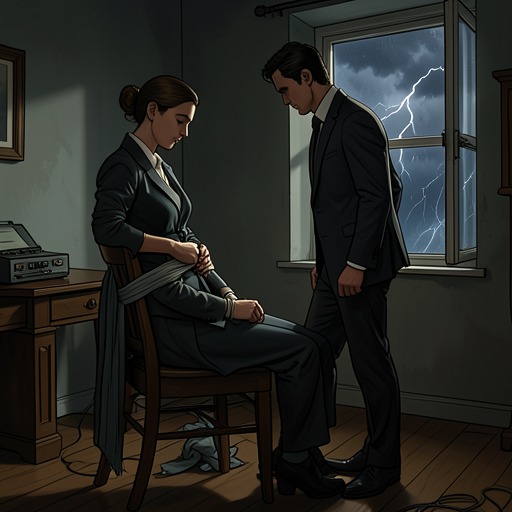
Dane Bishop kidnaps Emily West
MARRIED TO MY MASTER: A Bad Boy Hitman RomanceDane Bishop kidnaps Emily West after she refuses to acknowledge, without further proof and internal authorization, that BioSphere’s medication poses a problem for people with PTSD. The confrontation makes her professional caution the immediate trigger for violence: a request for institutional accountability becomes a demand enforced by force.
The demand and refusal
Emily West faces Dane while carrying the responsibilities of BioSphere’s chief executive. She knows the company may be partly responsible for his brother’s actions, but she insists that the issue must proceed through proper channels. Her concern is not only procedural: she feels accountable to shareholders and employees, and believes she was appointed to return value on their investment and keep staff employed. Those obligations pull against the human cost of Dane’s complaint, while she tries to keep her emotions from showing.
Dane asks her to admit that something is wrong with the medication when it is used by people with PTSD. Emily refuses to make that assertion without more evidence and direction from BioSphere’s legal team and researchers; she warns that continued pressure will lead her to call security. Her answer is measured, but the strain beneath it is growing, and she senses that her composed facade may crack if the encounter continues.
Dane’s expression shifts from sadness to neutrality. Before Emily can finish her warning, he grabs her by the throat. He tells her that she must get into the car, turning the disagreement into a physical seizure of control. When she swings her keys at him, he catches her wrist, twists it aside, and pushes her toward the passenger side. He opens the driver’s door, draws a large matte-black pistol from beneath his suit coat, and points it at her forehead. The demand is no longer for an admission: it is an order to comply at gunpoint.
Forced compliance and blackout
Dane Bishop’s command strips away the last possibility of negotiation. When he yells at Emily West to get into the car, she meekly takes the driver’s seat and buckles her seat belt on reflex. The automatic gesture is jarringly ordinary beside the gun at her forehead: even as her freedom is being taken, habit briefly supplies the shape of a normal journey.
Looking up at Dane Bishop, Emily measures her life against the danger in front of her. She has a college education and a master’s degree, and is one of the few women heading a pharmaceutical company, yet those achievements offer no comfort. She sees a life narrowed to work: no love life or companion to share her bed, no travel beyond business trips, and a career spent talking with people who might advance her business or prospects. The abduction thus interrupts more than her physical safety; it forces a sudden reckoning with how little of her life has existed outside work.
Emily’s fear gathers in her body, but she does not let herself cry. Thinking of her mother, she holds her gaze straight ahead and waits for whatever comes next. That fixed stare leaves her unable to see the pistol butt descending. The blow explodes in pain behind her eyes, and the world fades to black, ending the encounter with Emily unconscious and in Dane Bishop’s control.
The return to her house
Emily West regains consciousness sometime later, disoriented and with her head throbbing. The blackout has carried the abduction into a new setting: she realizes she is in her own garage, at her house, and checks the GPS in the center console. Dane Bishop has used the device’s HOME button to bring them there. The destination is familiar, but that familiarity offers no safety; Emily is now waking inside her own space under the control of the man who abducted her.
Her first response is to ask Dane what he is doing. He answers that they are at her house, his voice as devoid of emotion as hers had been earlier. The exchange establishes the immediate reality of her captivity: she has been brought home, but not returned to freedom.
Narrative significance
The abduction’s decisive shift is from a dispute over evidence to the immediate control of Emily West’s body and movement. Her insistence on institutional review cannot resolve Dane Bishop’s demand; once he turns to force, her professional authority and careful composure cease to protect her. The scene makes that reversal tangible through the changing function of ordinary objects: the keys become an attempted defense, the seat belt an automatic remnant of routine, and the GPS HOME button a means of carrying captivity into a place associated with safety. Emily’s loss of consciousness marks the limit of what she can perceive or resist, while waking in her own garage reveals that familiarity has not restored her freedom. The event therefore begins her captivity not with a remote destination, but with the conversion of home itself into its setting.