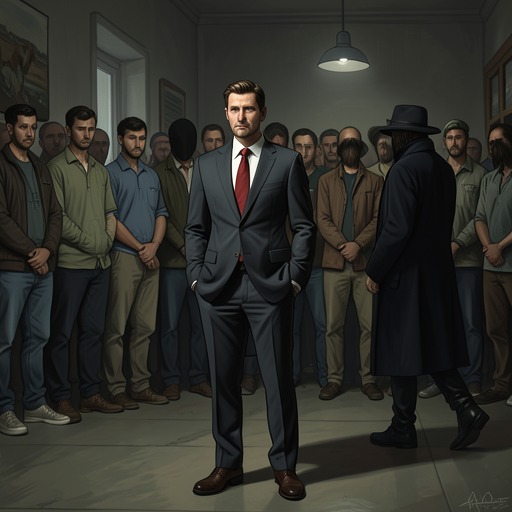
Dane Bishop's kidnapping of Emily West and family hostage crisis
MARRIED TO MY MASTER: A Bad Boy Hitman RomanceDane Bishop's kidnapping of Emily West and family hostage crisis is the point at which Dane recasts his campaign for his brother as a public spectacle. Seeking to expose BioSphere’s handling of Hymalete and raise support for Benton Bishop, he makes Emily—the company’s CEO—the apparent hostage in a crisis designed to draw national attention. The event’s defining tension is that the danger and coercion are real, but the public-facing emergency is also deliberately staged: Dane and Emily work to make the performance convincing enough that officials and reporters treat it as genuine.
Causes and Stakes
The crisis grows out of Dane’s demand that Emily obtain backup files and keep the police out of the matter. He gives her two hours and threatens Jas Robertson if she fails, making Jas a lever in his effort to control Emily. When Emily asks what would happen if an accident or a problem with the files intervened, Dane offers no extension or accommodation. The deadline establishes the immediate pressure under which the later hostage plan takes shape: Emily is not simply a public figure brought into a media strategy, but someone Dane has already threatened and physically restrained.
Dane’s stated cause is his brother’s case. Benton is on death row for killing his wife and children during a psychotic break associated with years of service in the United States Army. Dane also contends that Benton had taken Hymalete, a BioSphere medication that was being marketed to service members and first responders with similar symptoms. He alleges that the drug did not work and may have worsened Benton’s condition. The crisis therefore joins a family appeal for Benton’s defense to a broader accusation about a medicine intended for vulnerable groups.
From Private Pressure to Public Stunt
Over sandwiches, Dane tells Emily he has worked out how to make The New York Times run the story: a hostage situation. His proposal changes the method of his campaign. Rather than relying only on the files or on Emily’s position inside BioSphere, he plans to produce an emergency that the media cannot easily ignore. The hostage narrative makes Emily’s corporate identity central to the story and turns the threat against her into the means of generating coverage.
Dane presents the plan as a way to force BioSphere to respond and to advance Benton’s defense. He also brings out a dog collar and leash, placing them on the desk after telling Emily that, if she will not help, he will help himself. The gesture connects his demand for cooperation to the rules of captivity already imposed on her. He appeals to her stated feelings for him as another reason she should assist with the story and Benton’s legal fund. The plan’s emotional and political claims thus sit alongside a direct demonstration of his control.
The Recording and the Demands
Dane records a video addressed to Charlene Padilla. He identifies himself and Benton, outlines the public account of Benton’s crimes and mental state, and then sets out what he says has been kept from the public: Benton’s use of Hymalete, the possibility that it aggravated his symptoms, and BioSphere’s alleged possession of evidence that the medicine failed. He further claims that the company falsified data and pushed the drug through federal oversight. These are Dane’s allegations in the recording, not independently established findings within the event.
As the video continues, Dane holds a pistol against Emily’s head and turns the camera toward her. He identifies her as BioSphere’s CEO and threatens further harm if his demands are not met within twenty-four hours. The recorded threat is intended to make the crisis appear urgent and credible; it also raises the stakes beyond the earlier two-hour deadline concerning backup files and police involvement. The two deadlines serve different purposes: one pressures Emily in private, while the other gives the public hostage story its ultimatum.
In his call with Charlene, Dane specifies four demands: thirty million dollars for Benton’s defense fund, BioSphere’s admission that Hymalete has failed, publication of the true documentation on its experiments, and an exclusive interview with Charlene so he can present his account. Charlene questions how extreme the situation is, but Dane insists that the lives of Benton and Emily are at stake. His list makes the crisis both a ransom demand and an attempt to compel a corporate admission, disclose evidence, and secure a media platform.
Public Emergency and Staged Captivity
After Charlene calls back, Dane and Emily turn on CNN and see the hostage crisis reported on television. The broadcast describes BioSphere’s CEO as held at home by a distressed family member of a customer on death row. That framing compresses Dane’s claims into a dramatic public headline, linking Emily’s abduction to Benton’s case while making the alleged corporate misconduct secondary to the immediate emergency. The coverage confirms that the plan has reached the audience Dane wanted, though the visible headline does not show whether any of his demands have been met.
The response outside escalates quickly. Within less than two hours, news helicopters are overhead, media vans and satellite uplinks occupy the neighborhood, and SWAT vehicles form a heavily armed perimeter that effectively locks the area down. Emily recognizes from the scale of the response how much power her position as CEO gives the crisis to attract attention. Her brief thought about neighbors whose dog had repeatedly left waste in her yard gives the otherwise tense neighborhood scene a domestic, wry counterpoint.
For appearances, Dane and Emily decide that she should be tied to her chair again, this time in the living room with the curtains drawn. The detail clarifies the event’s double character: they are actively maintaining the hostage image even as the police perimeter and media presence make that image consequential beyond their control. Emily’s awareness that outsiders may no longer believe a sudden announcement that the crisis is a stunt underscores the risk of the performance. The episode ends with the neighborhood sealed off and the staged emergency operating as a real public crisis, its outcome and the fulfillment of Dane’s demands unresolved in this account.