Hymalete Evidence Files
MARRIED TO MY MASTER: A Bad Boy Hitman RomanceThe Hymalete Evidence Files are the digital records at the center of the Hymalete scandal: material Emily West found on BioSphere’s systems, showed to Jas Robertson and Dane Bishop, and later identified as surviving in her personal email. Their importance lies not in a single dramatic disclosure but in their repeated passage between different settings and forms of custody. At BioSphere, they are corporate records; in Emily’s hands, they become potential evidence; in public, they support allegations that the company concealed the drug’s failures. Their survival after a data purge helps make those allegations consequential beyond the hostage crisis that brought them to light.
Copies and Recovery
The files first emerge as a problem of recovery. After Emily has deleted material, she tells Dane that backups exist and locates them on her work computer at the BioSphere office. The disclosure changes the practical stakes of their alliance: deleted evidence has not necessarily vanished, but retrieving it requires Emily to return to a workplace where she fears the people around her. The files therefore connect the private conversation between Emily and Dane to the corporate systems where the underlying records remain accessible.
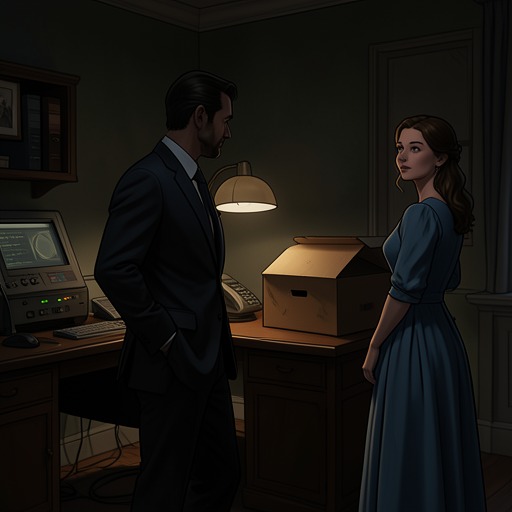
Emily later enters her office, logs in with her existing password, and opens files she had previously found with Dane. She hopes to act before Edward Barker discovers what she is attempting. The access itself depends on a small but significant circumstance: Edward has not changed her credentials. Emily is preparing to print the material when Edward enters without knocking, interrupting the effort. This moment establishes both the files’ vulnerability and the danger of handling them inside BioSphere; access is possible, but the person Emily suspects may be implicated is close enough to disrupt it.
From Company Records to Shared Evidence
The files also move from Emily’s individual knowledge into a shared view. She logs into her computer and invites Jas and Dane to look at the screen, explaining that the material was pulled from BioSphere’s servers. Jas reads it and reacts with shock, questioning whether the people involved had really done what the documents indicated. Dane already knows the files: he had seen them before, and their contents are the evidence on which he has staked his brother Benton Bishop’s future. The scene gives the files two distinct human stakes. For Jas, they make corporate misconduct newly legible; for Dane, they are tied to his effort to challenge the consequences of Benton’s case.
The display on Emily’s computer matters as more than a convenient summary. The files can be examined by more than one person, and their meaning is no longer confined to Emily’s own account. Yet the passage does not reproduce their contents in full or establish that every allegation has already been legally proven. Instead, it shows the records being read and interpreted by the characters, while later disclosures specify what they are said to demonstrate. That distinction keeps the documents’ evidentiary role separate from the public claims made on their behalf.
Public Disclosure and Allegations
Dane uses the files to make a public case to reporter Charlene Padilla. In a recorded video, he identifies Benton’s death-row conviction and states that Benton had taken Hymalete, manufactured by BioSphere. He alleges that the medication did not work and may have worsened Benton’s symptoms. He then presents the files as evidence that BioSphere knew its medicine was ineffective, had falsified data, and pushed the approval process through federal oversight. These are the claims Dane draws from the records; the video turns private corporate material into a direct public accusation.
Emily later tells Charlene that she has the files in her personal email. In the interview, she says she has no direct evidence that Edward or the board knew what was happening, while arguing that the evidence from the drug trials speaks for itself. The account therefore distinguishes the documents’ reported contents from the question of who within BioSphere knew of them. The files strengthen Emily’s ability to substantiate claims about Hymalete, but they do not, in the interview as presented, eliminate every uncertainty about responsibility at the executive level.
Survival and Consequence
A year later, the files in Emily’s personal email have acquired a further role. BioSphere has faced investigation, lawsuits, and penalties; Edward is on trial and faces the prospect of a substantial sentence. The narration attributes particular importance to the files that escaped the data purge because they were in Emily’s personal email account. Their survival provides material relevant to the case against Edward after an attempt to eliminate or clear company data has failed to remove every copy.
The files’ trajectory is thus defined by duplication and displacement: server records are recovered, opened on Emily’s work computer, viewed by her allies, invoked in Dane’s recording, identified in Emily’s email, and later connected to Edward’s trial. The text does not describe a complete chain of custody or specify the technical contents of each copy, so the precise path between those locations remains unstated. What it does establish is that the records outlast the corporate purge and continue to carry consequences after the immediate hostage crisis has passed.
Narrative Function
As an object, the Hymalete Evidence Files are neither a simple instrument nor a self-explanatory verdict. Their force depends on people accessing, interpreting, preserving, and publicizing them: Emily’s passwords and decisions, Dane’s disclosure, Jas’s reading, Charlene’s questions, and the later legal proceedings all shape what the records can do. Their movement turns an internal corporate archive into evidence that can cross the boundaries between office, personal account, news coverage, and trial.
That movement also creates a pointed contrast between institutional control and informational survival. BioSphere’s files are vulnerable to deletion and purging, yet copies remain outside the company’s immediate control. The records do not speak independently of the characters who present them, and the excerpt leaves some questions about executive knowledge unresolved. Even so, their persistence changes the story’s scale: what began as evidence tied to Emily and Dane’s discoveries becomes part of a public scandal and a continuing case against BioSphere’s leadership.