Irish Mob Ballroom
MARRIED TO MY MASTER: A Bad Boy Hitman RomanceThe Irish Mob Ballroom is an Irish mob venue whose earlier use as a rentable hall contrasts with its role in Mickey MacFarland’s violent seizure of control. When Cormac MacKay’s allies identify it as the place where Scarlet O’Bannon and Moira are being held, the ballroom becomes both a hostage site and the setting for a carefully staged reversal: Mickey’s show of dominance is disrupted, and Cormac publicly asserts his authority before the assembled men.
Background and Identification
Cormac’s father sometimes used the ballroom himself but mostly rented it out. That history gives the venue a practical, commercial life alongside its connection to the family’s criminal organization; it is not described solely as a private stronghold. Cormac recalls his father’s occasional use of the hall when Flint identifies the likely location of the captives. The clue comes from a photograph: Flint studies the reflections and angle in a mirror, recognizes two towers in the background, and concludes that the image was taken in the ballroom. His inference is presented as a strong bet rather than certainty, but it is enough to set the rescue attempt in motion.
The party setting complicates that effort. Cormac and his companions first plan to approach quietly, retrieve Scarlet and Moira, and use their guns only if necessary. They obtain weapons from a cache concealed inside an apparently abandoned arcade machine, at a location half a mile from the ballroom. Cormac stresses caution because a stray shot could hit either captive. The plan depends on entering without provoking the armed group, not on winning an open fight in the hall.
That calculation changes when Cormac receives another photograph. It shows Scarlet and Moira kneeling while Mickey stands behind them with his hands on their heads; an accompanying message makes light of their predicament. The image turns the ballroom from a target on a rescue map into the site of an immediate threat. Cormac drops his weapon and heads for the door, while Flint calls after him. His muttered return to the idea of sneaking in carries the gap between the plan’s careful logic and the pressure created by Mickey’s display.
A Room Divided by Force
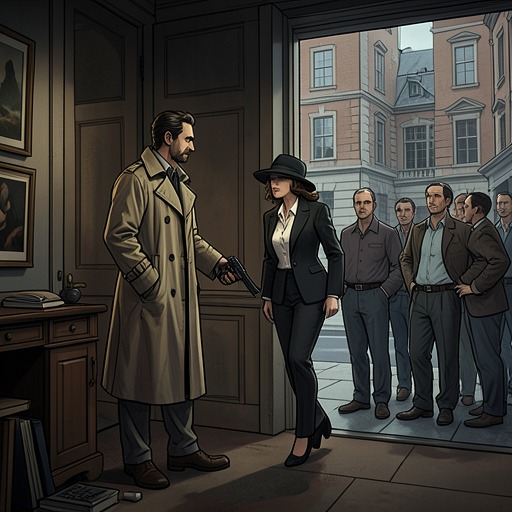
By the time Cormac and Scarlet are inside, the ballroom’s division is visible across the floor. Mickey’s armed men occupy one side with the prostitutes, dancing and shouting; the other side holds Cormac’s unarmed men, clustered together and watching the exit. The men’s slow drinking and prisoner-like attention to the way out make clear that they are present but not free to act. The contrast is not simply between two groups at a party: weapons determine who can move with confidence and who must wait.
The music helps Mickey impose the appearance of celebration. He replaces the light jazz with loud dubstep and orders the party to continue into the early morning. The change accompanies the room’s disorder: his men pull the prostitutes onto the dance floor, while Moira tries to keep as far from her assigned partner as she can. When Cormac moves as if to take her away, the man produces a gun and waves it toward him. Music, dancing, and command thus operate together as part of Mickey’s public performance, while the threat of a firearm enforces the limits of Cormac’s authority.
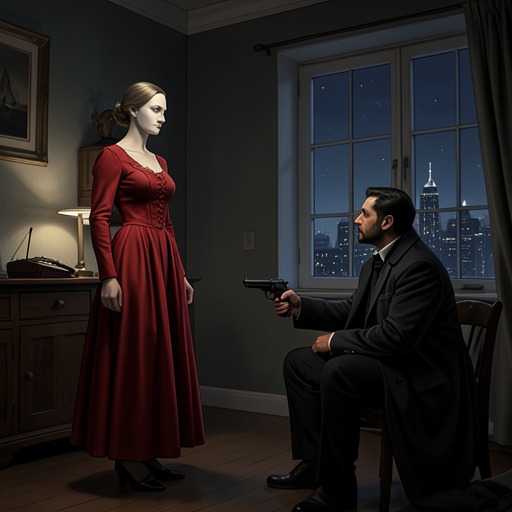
The ballroom also contains a smaller room where Mickey took the photograph of Scarlet and Moira. Cormac and Scarlet steal a moment there, separated from the main gathering by walls but not from its pressure: the music and Mickey’s shouts carry through. Scarlet challenges Cormac for coming into danger and doubts that his plan can save them. Cormac holds her hands and promises to find a chance to get all three of them out that night. The brief private exchange gives the ballroom a second function: it is not only the public stage of Mickey’s power, but also a place where Cormac and Scarlet can make a private commitment under that power’s immediate threat.
The Turn at the Elevator and Sound System
The route to changing control of the room depends on its layout. Cormac tells Scarlet to find a way to switch off the music, explaining that they need to demonstrate who is in control. The sound system is on the side occupied by Mickey’s armed guards, near an elevator watched by two men. The hall’s geography therefore puts the central task—silencing the party—within sight of the guards rather than safely beyond their reach.
The turning point comes when the elevator opens and three men emerge. The guards are caught by surprise: Scarlet’s father presses his Federal Bureau of Investigation-issued gun under one guard’s chin, while the other two men secure the second guard. Scarlet recognizes her father’s arrival with relief. She then cuts the sound system, and quiet spreads through the ballroom as the crowd gathers around Cormac and Mickey. The interruption strips away the music that had helped Mickey stage his authority and draws the divided room’s attention to the confrontation at its center.
The room’s occupants react to the shift before it is settled. One of Mickey’s men objects, and another announces that Mickey has been taken. Cormac, meanwhile, has Mickey in his grasp. The scene turns on the ballroom’s public character: because the armed factions and their followers are gathered together, a change in control cannot remain private. Cormac’s position must be made legible to the people in the room, just as Mickey’s had been established through weapons, guards, and spectacle.
A Change of Authority
Cormac strikes Mickey from behind and stands over him, addressing the assembled men. He names the harms that brought him there: Mickey took the woman Cormac loves, took his sister, and had a part in his father’s death. He also identifies the two FBI agents present and tells Mickey’s men that their freedom depends on what the agents decide. His words distinguish Cormac’s claim to leadership from Mickey’s coercive control: Cormac condemns the men’s actions but does not pretend that he alone can release them from legal custody.
The men begin chanting for Cormac as Don, and Scarlet smiles at him; he smiles back. The ballroom has not been shown changing physically, but its meaning has changed decisively. It first appears as a venue where Mickey can hold captives, disarm Cormac’s men, and compel a party. It ends as the room in which Mickey is subdued, the hostages’ rescuers gain the upper hand, and Cormac’s followers publicly acknowledge him. The building’s division, guarded access, music, and central gathering all serve the same narrative function: they make control visible, then provide the stage on which that control is reversed.