Max Smithson
MARRIED TO MY MASTER: A Bad Boy Hitman RomanceMax Smithson is a senior Federal Bureau of Investigation agent whose polished authority conceals a criminal alliance with Mickey MacFarland. Initially positioned as Scarlet O’Bannon’s powerful, insinuating supervisor, Smithson becomes a suspected conduit between the agency and the Irish mob. The investigation into him ultimately reaches beyond corruption and compromised intelligence: Cormac MacKay accuses him of participating in the abuse and killing of women, and Smithson is later given a mob funeral.
Position and Public Persona
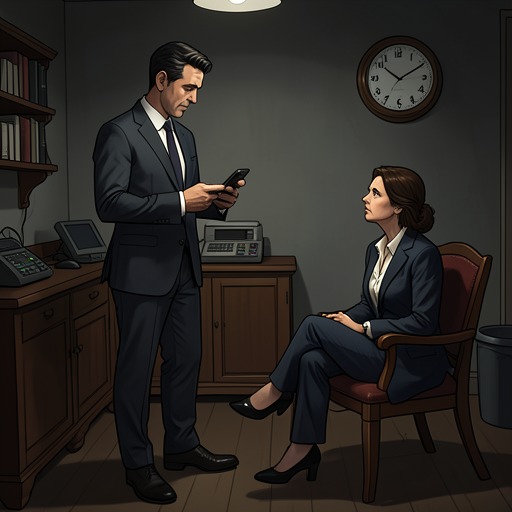
Smithson supervises Scarlet O’Bannon, an agent whose competence he persistently belittles while invoking the authority of her position. In his office, he is physically imposing: a large man with a jowly face and serious dark eyes, seated in an oversized chair. His visible manner combines office ritual and command. He drums his fingers, turns to the window overlooking New York Harbor before issuing instructions, and uses a familiar, paternal tone with Scarlet. She reads that tone as condescending and at times sexually suggestive, while his comments about her supposed attraction to Cormac MacKay turn their professional exchange into a personal provocation.
Smithson’s cultivated authority is reinforced by small signs of comfort and wealth. Scarlet notices his shiny cufflinks and, on another occasion, icing on his lapel. These details sit alongside her growing suspicion that his finances cannot be explained by his official work. His public identity as an experienced agent and manager thus contrasts with the private network and unexplained resources that Scarlet begins to investigate.
Relationship with Scarlet O’Bannon
Smithson exercises power over Scarlet through assignments, insinuation, and the expectation that she will return when called. When she discusses Cormac MacKay as a possible source of information, Smithson encourages a meeting, then frames her judgment as a possible crush. Scarlet rejects the characterization internally, but recognizes that his teasing presses on the very entanglement she is trying to assess: Cormac is a criminal informant whose information has helped direct law enforcement toward his rivals, while he has not turned in his own people.
His attitude shifts when Scarlet is in the field with Cormac during the crisis around Mickey’s move against the Irish mob. Smithson calls her and asks her to return to the office, first presenting the request as a friendly check-in and then making it an immediate command. He refers to Cormac as “Cor,” a small but striking lapse that intensifies Scarlet’s suspicions. When she asks whether the agency has heard that Cormac killed his father and taken over the mob, Smithson denies having heard it and says that Scarlet’s father wants her brought onto his team. Scarlet notices that he does not answer the underlying question plainly. Cormac then destroys her phone, cutting off the call; the interruption prevents the exchange from resolving her doubts.
Smithson’s supervisory behavior later becomes part of Scarlet’s effort to conceal her investigation. She and her father suspect that he is working for Mickey, based on witnesses who saw the two men together and suspicions among agents in California. They do not yet have enough evidence to arrest him, and exposing their suspicions could alert Mickey. Smithson permits Scarlet’s inquiry to continue, but she believes he is using it to report back to his own superior. During a later meeting, he challenges her for conducting the investigation since late summer without substantial leads or arrests. Scarlet maintains her professional composure rather than reveal what she knows.
Investigation and Criminal Connections
Scarlet’s inquiries give concrete shape to the suspicion around Smithson’s wealth and travel. He owns a yacht in California, as well as an apartment and a house there, despite having no offices in the state. His brother works in a low-ranking position in the Federal Bureau of Investigation, and Smithson has spent his holiday time in California over the previous year. Scarlet also discovers a string of local laundromats with no recorded purchase history. The unexplained acquisition of those businesses and his repeated California travel do not by themselves establish his crimes, but they add to the circumstantial pattern connecting him to Mickey’s operations and to the agents who had raised concerns about the state.
The larger investigation describes Mickey’s mob as operating in prostitution, hard drugs, and murder. In a later confrontation, Cormac’s associates hold Smithson in a makeshift alcove in a warehouse. Cormac accuses him of working with Mickey not to dismantle the mob but to assist its crimes, alleging that Mickey brought women to a remote room where Smithson abused and killed them. A video on a cellphone is presented as evidence of Smithson’s conduct. The account identifies this as part of Cormac’s accusation and the evidence shown during the confrontation, rather than as a public legal finding.
Smithson is questioned about Mickey’s location, which Cormac believes is one of his father’s former hideouts. Smithson refuses to give it up, saying he expects Mickey to kill him if he does. His response makes the alliance’s hierarchy plain: although he has had access to Mickey and information about the mob, fear of his criminal associate now constrains him more powerfully than his former position in law enforcement.
Exposure and Ending
Mickey later tells Scarlet that he had several contacts, including Smithson, and says Smithson will be dead. The account also establishes that Cormac will not let Smithson live. Three hours after the warehouse confrontation, Smithson has been given a mob funeral. The sequence closes his story without presenting a formal arrest or trial: the agent who had used institutional authority to control an investigation ends up subject to the mob’s own violent order.
Smithson’s narrative function lies in the reversal between office and allegiance. At first, the agency’s chain of command seems to place him above Scarlet and beyond her reach; his office, instructions, and familiarity with internal procedure make him a gatekeeper. As her investigation accumulates signs of concealed wealth, California connections, and suspicious communications, that authority becomes a liability rather than proof of integrity. His eventual exposure links corruption inside the Federal Bureau of Investigation to Mickey’s criminal network, while his death shows how little protection his official standing offers once that network turns against him.