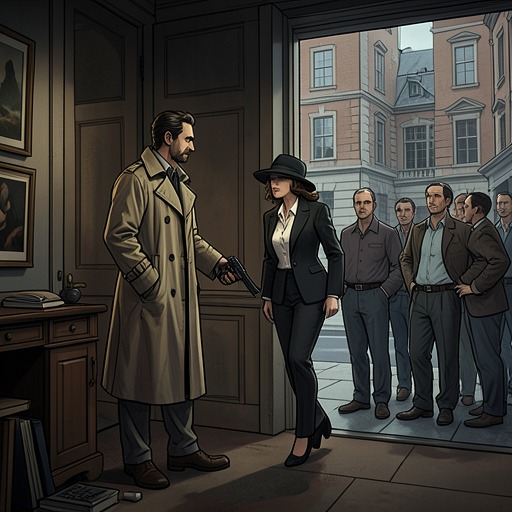
Patrick O’Hara
MARRIED TO MY MASTER: A Bad Boy Hitman RomancePatrick O’Hara is a longtime ally of Cormac MacKay’s father and one of the older figures in the Irish mob. When Cormac seeks him out after Mickey MacFarland has seized power and killed Cormac’s father, Patrick becomes an important source of information about the new balance of force. His meeting with Cormac also marks a limited but consequential shift: a man Cormac once feared might turn against him agrees to be ready to support him.
Identity and Background
Patrick is around fifty and has known Cormac since Cormac was a child. He was among Cormac’s father’s closest friends and allies, placing him within a network of older loyalties that predates Mickey’s takeover. Cormac remembers a small childhood kindness from him: Patrick once gave him a dollar for the arcade machines. That memory makes the encounter more than a negotiation between members of a criminal organization; it is also a meeting between people whose connection reaches back to Cormac’s youth and his father’s circle.
The history does not make Cormac entirely confident. Before Patrick arrives, Cormac hopes he has not gone over to Mickey, but cannot be certain. He is nervous about meeting a man he has known for years and worries that the encounter could end in violence. His anxiety reflects how thoroughly the takeover has unsettled relationships that might once have seemed dependable: even a father’s old friend must be approached as a possible threat until his position is clear.
The Meeting and Its Setting
Patrick meets Cormac at the docks. Cormac has recently returned to New York with Scarlet O’Bannon, and the pair have been staying at Moira MacKay’s place; after two days there, they have agreed to begin working rather than remain in hiding together. Cormac waits in the open before Patrick arrives, then greets him and accompanies him into a warehouse the family has used to store merchandise. His father’s last shipment of illegal cigarettes remains in a corner, a practical reminder of the older family operation amid the upheaval that followed his death.
The warehouse initially sharpens Cormac’s suspicion. Its isolation makes him consider that Patrick could have brought him there to kill him quietly, so he prepares for a fight. But the two men sit across from each other, and Cormac recognizes that Patrick looks tired rather than threatening. Patrick’s first response is to condemn the men who killed Cormac’s father. The meeting begins with shared grief and anger, yet Cormac does not accept expressions of sympathy as proof of allegiance; he presses Patrick to explain why Mickey remains in power if the family objects to the murder.
Patrick’s Account of Mickey’s Power
Patrick explains that the killing was not an isolated act followed by a simple succession. Mickey arrived with substantial backing, including men recruited from other states. Patrick describes this force as the product of years of preparation: Mickey had apparently been building support while positioning himself to claim the Don’s role. His followers came from varied circumstances, including homelessness, military service, and construction work. Whatever their backgrounds, their numbers had changed the practical cost of opposition.
That imbalance helps explain why anger has not become open resistance. Patrick says that many members have wives, children, and other family responsibilities, and do not want to enter a war without what they consider sufficient cause. Cormac rejects that calculation: to him, the murder of the Don and the seizure of the family should already constitute such cause. Patrick agrees that Cormac has a point and says many men may privately share it, but stresses that they are unlikely to say so openly.
Patrick’s description is not simply of a stronger faction facing a weaker one. Fear has also damaged the trust that would allow the family to act collectively. Members watch one another, unsure whom to trust, because they suspect that others may be working with Mickey or may choose to join him. In Patrick’s account, Mickey’s advantage rests both on the force he assembled and on the uncertainty that keeps potential opponents isolated. Cormac’s judgment that this no longer sounds like much of a family gives that fracture a name: inherited kinship and allegiance have not been enough to overcome suspicion.
Cormac’s Appeal and Patrick’s Pledge
After hearing the explanation, Cormac asks Patrick to be ready to back him when he makes his move. The terms are deliberately broad. Patrick might have to act against one of Mickey’s men, or his support might consist only of refusing to shoot Cormac if Mickey orders it. Cormac grounds the appeal in two relationships at once: Patrick’s love for Cormac’s father and Cormac’s own affection for Patrick. The request turns their shared past into a present obligation, while making clear that Cormac expects a choice rather than relying on old ties alone.
Patrick’s response completes the scene’s change in direction. He rises with a firmer expression than he had shown earlier and agrees to get on board, promising to wait for Cormac and be ready. The pledge does not establish that Patrick has already taken part in a confrontation or secured other members’ support. It does, however, give Cormac one specific ally in a group where open commitments have become dangerous, and it converts the meeting from a test of possible betrayal into the beginning of cooperation.
Narrative Role
Patrick functions as both a personal link to Cormac’s father and a witness to the political conditions created by Mickey’s takeover. His longstanding association with the former Don gives Cormac a reason to seek him out, but Patrick’s cautious explanation complicates any assumption that shared grief will automatically unite the family. He shows how Mickey’s years of recruitment have produced a numerical advantage and how fear prevents discontent from becoming coordinated action.
The scene’s movement is therefore from uncertainty to a limited commitment, not from defeat to victory. Cormac arrives unable to know whether Patrick is safe to trust; Patrick explains why even men who condemn the murder may remain silent; and Cormac answers that silence with a direct request for support. Patrick’s agreement offers a foothold for Cormac’s opposition, while the wider problem remains: a fractured family cannot be restored by loyalty to the past unless its members are willing to act in the present.