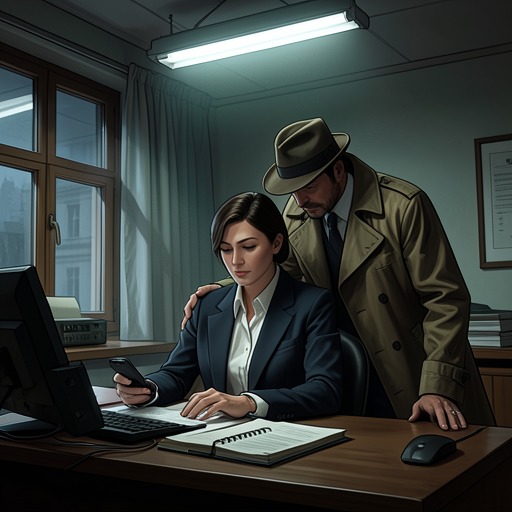
Scarlet Discovers the Kidnappers’ FBI Connection
MARRIED TO MY MASTER: A Bad Boy Hitman RomanceThe discovery that Scarlet O’Bannon’s kidnappers belong to a Federal Bureau of Investigation network transforms a suspicion into a tangible threat: the institution she serves may be compromised, and its resources may have helped place her and Cormac MacKay in danger. The turning point comes not through an explanation from the abductors but through the contents of their car: agency-issued jackets, trousers, holsters, and other equipment. For Scarlet, the evidence makes the betrayal physically undeniable, even as the extent of the corruption remains uncertain.
From suspicion to evidence
Before the discovery, Cormac had already argued that Mickey MacFarland could not have taken power without outside help. He contrasted Mickey’s perceived lack of judgment with the intelligence of Cormac’s father, and reasoned that the move against his father required assistance. In Cormac’s account, sending some of his men to California and creating an opportunity to attack his father pointed to a wider operation, with the Federal Bureau of Investigation as a possible ally. Scarlet resisted treating that theory as established fact. Her professional instinct was to insist on procedure and evidence, even as Cormac urged her to recognize the implications of what she already knew.
That gap between suspicion and proof gives the later discovery its force. Cormac’s theory had been rooted in his understanding of the criminal world and the unusual scale of Mickey’s success; Scarlet had reason to be wary of accepting it without confirmation. When they open the abductors’ car, however, the question is no longer whether the Federal Bureau of Investigation could be involved. The clothing and equipment make an institutional connection visible, while leaving unanswered how many people are involved or how far the network reaches.
The car’s contents
After dragging the men into a barn, Scarlet and Cormac handcuff them together around a weak bannister. They expect the captives to be able to free themselves eventually, but not before the pair can leave. Cormac then breaks open the car’s trunk with a shotgun to look for clothes. The jackets inside are blue, marked with yellow letters spelling out the agency’s initials; the trousers resemble those Scarlet has worn at crime scenes, and the holsters and other equipment are Federal Bureau of Investigation issue.
The contents overturn the distance Scarlet had tried to keep between her professional world and Cormac’s. These are not merely clothes that resemble an agent’s uniform: the cluster of jackets, trousers, holsters, and equipment identifies the abductors’ connection through objects she recognizes from her own work. She had considered Max Smithson as a possible source of the danger, but the evidence suggests to her that the problem extends deeper than one individual. It does not, by itself, establish the identities of the people who authorized the operation or prove that the entire agency is involved.
Scarlet’s reaction and the escape
Scarlet’s response is physical before she can master it: she drops to her knees and vomits into the dust. She repeats that the discovery cannot be true and cannot reconcile it with her sense of the Federal Bureau of Investigation as her own institution. Cormac kneels beside her and rubs her shoulder. His response acknowledges both the shock of the revelation and the fact that it confirms a danger he had already been trying to make her see.
She rises unsteadily but refuses to let the shock stop her. Scarlet explains that she had expected, at most, that Max Smithson might be implicated; the agency-issued gear makes the possibility of deeper involvement feel overwhelming. She also reasons that her firearm probably contains a tracker and that it may be how the kidnappers found them. This is her explanation, not a confirmed account of how they were located. She left the gun behind in the motel room, and the omission now reads as a possible safeguard rather than a simple inconvenience.
Cormac asks whether she can drive without shoes and wearing only her underwear. Scarlet forces a laugh and answers through the situation by invoking her professionalism. The detail brings the scene back from institutional betrayal to immediate survival: she and Cormac still have to get away, and she takes the driver’s seat despite her exposed, disordered circumstances.
Consequences and significance
The discovery sharpens the conflict from a struggle with individual abductors into a threat that may reach inside law enforcement. It also changes the meaning of Cormac’s earlier suspicion. His claim that Mickey’s takeover required help had sounded to Scarlet like a theory drawn from his own world; the Federal Bureau of Investigation equipment gives that theory a concrete basis, without resolving its full scope. The evidence therefore confirms a connection while preserving uncertainty about who within the institution is responsible.
For Scarlet, the reversal is especially severe because the evidence implicates the professional world she belongs to. Her recognition of the clothing and equipment makes the revelation intimate as well as political: the signs of an agency she knows are now attached to the people who took her. Her response—to absorb the shock, consider how they were tracked, and keep moving—carries the scene toward escape rather than resolution. The captives remain behind, temporarily restrained; the pair leave without knowing the full reach of the network or whether the suspected tracker explains their capture.