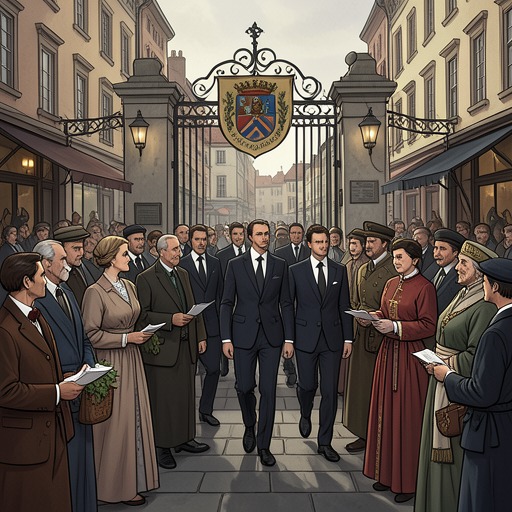
Sophia and Enrique’s Engagement Party
MY POSSESSIVE BILLIONAIRESophia and Enrique’s Engagement Party is the public turning point at which a family-arranged marriage is presented as a love match. Its apparent celebration rests on Enrique’s improvised claim that he and Sophia love each other and plan to marry soon, while Sophia privately recognizes that the announcement is false and resents him for making it. The event therefore joins spectacle and coercion: family honor, business interests, romantic reputation, and personal freedom are all placed on display at once.
Causes and Background
The party grows out of the long-standing alliance between the Montero and Castello families. When Joaquin Montero II and Fredo Castello were young, they defended one another, and Joaquin regarded his promise to Fredo as a matter of honor. Their business success and desire to preserve family wealth led them to treat the marriage of their children as the solution to a succession problem: Fredo and Marcella Castello had no son to inherit their wealth, while Sophia Castello was considered reckless and in need of a trustworthy husband capable of running the family business. Enrique, studying Business Administration at Harvard University when he first learned of the arrangement, rejected the idea that such a marriage should govern his life, even though he eventually agreed to obey his father.
Sophia’s resistance is shaped by both principle and evidence. She tells Beatriz that marriage should rest on love, trust, and respect rather than function as a joint venture protecting family assets. She also shows Beatriz photographs of Joaquin Enrique Lopez Montero III with different women, along with internet reports, blogs, and gossip portraying him as a playboy who changes lovers frequently. Those mediated images make Enrique’s reputation part of the conflict before the party begins: Sophia sees an arrogant womanizer, while Beatriz warns that much of the gossip is unreliable. The engagement must consequently repair not only a family arrangement but also a public image.
The immediate cause is Enrique’s attempt to prevent the arranged marriage from collapsing in front of both families. After Sophia challenges the logic of uniting their fortunes, Enrique gives her his calling card and says that he will leave for the United States shortly, offering her the choice of calling him if she changes her mind. Yet when the family gathering becomes emotionally volatile, Enrique abruptly tells Fredo and Marcella that he loves Sophia and that they are planning to marry as soon as possible, insisting that their decision comes from love rather than the arrangement. His statement surprises everyone, and Marcella’s distress turns into happiness; the parents immediately begin treating the engagement as genuine.
The Public Celebration
The celebration takes place in the function room of the hotel where Sophia is staying, with a guest list of one hundred people that includes relatives, friends, business colleagues, and family associates. Its size gives Enrique’s words institutional weight. What began as an improvised declaration becomes a social fact once guests gather to witness it, and the families’ happiness makes withdrawal increasingly difficult for Sophia.
Sophia prepares for the evening as though entering a contest of appearances. She wears a red off-shouldered mermaid gown, five-inch red stilettos, and red lipstick intended to create a more seductive image. Her aim is not simple enjoyment; she wants to provoke Enrique and punish him for announcing what she considers a fake engagement. The clothing turns her body into part of the party’s rhetoric, allowing her to answer his control through deliberate visual self-presentation.
Enrique is visibly affected when he arrives at her suite. Seeing Sophia fully dressed for the first time, he is stunned by her appearance and experiences a sudden physical response. Their encounter before the party therefore contains the contradiction that governs the whole event: attraction is present, but it does not erase anger or distrust. Enrique wants them to arrive together because guests will talk if they do not, while Sophia’s presence is required to make his public claim believable.
At the party, they behave like actors on a stage. Sophia remains at Enrique’s side and holds his arm; Enrique occasionally kisses her cheek or hand; and the guests, especially their parents, interpret these gestures as signs of a happy couple. The performance succeeds socially even though it fails privately. The party does not establish mutual trust so much as produce the appearance of it, turning physical proximity and controlled affection into evidence for an audience that cannot see the resentment beneath the display.
Surveillance, Reputation, and Control
The engagement is surrounded by systems that make private life visible and actionable. Sophia’s earlier understanding of Enrique comes through photographs and gossip, while Enrique responds to her movements through investigation and surveillance. When she hides from him in Brazil, he orders Greg to contact an investigation agency and demands a detailed report about where she is staying, who is with her, and whether she has a boyfriend. His need to know her location transforms courtship into monitoring and makes the engagement inseparable from control.
The same pattern appears when Enrique searches for Sophia after arriving in New York. He expects to dine with her at her suite, learns from the hotel manager David Parker that she has gone to a bar, and becomes agitated because he does not know whom she is meeting. He mobilizes Greg and his security personnel to search the city’s bars. When he finds Sophia with employees from the marketing department, including Chris Evans, his relief is mixed with anger and jealousy. The engagement’s public promise thus intensifies rather than resolves the question of who is entitled to access Sophia’s time, body, and movements.
Mobile images further reshape the relationship. Draco Valiente sends Enrique a multimedia message from Enrique’s office containing a stolen photograph of Sophia, while later an MMS photograph of Sophia exercising in a skin-toned top and skimpy black shorts provokes Enrique’s anger. These images do not merely record her; they become instruments through which men watch, interpret, and attempt to regulate her. Against that surveillance, Sophia’s red dress and deliberate seductiveness function as a limited form of agency, though the party ultimately places her back inside a public role defined by the engagement.
Consequences and Narrative Significance
The immediate consequence is that both families accept the engagement as real. Marcella begins planning the wedding, Joaquin Montero II responds with approval, and the party’s hundred guests celebrate the couple. Sophia, however, hopes that the marriage might somehow become real while also recognizing that Enrique created the crisis himself. Her uncertainty reveals the event’s central value shift: a relationship that began as an unwanted business arrangement is publicly elevated into romance, but the emotional reality remains unstable and contested.
The party also changes the stakes of every later decision. Once Enrique has declared love before the families and their wider social circle, the engagement carries the force of a promise even though it began as an expedient performance. His later formal proposal, made while kneeling before Sophia and presenting a twenty-four-carat diamond engagement ring, gives material form to the commitment first manufactured at the party. The sequence moves from family obligation, to public fiction, to a more direct claim of love, without erasing the coercive structures that made the first declaration necessary.
As a romance event, the engagement party occupies the story’s movement from resistance toward forced proximity and emotional entanglement. Sophia and Enrique are not yet a securely loving couple; they are adversaries required to perform intimacy, drawn together by attraction while divided over freedom, fidelity, and the meaning of marriage. The event’s lasting significance lies in that split between what the guests see and what Sophia knows. The party succeeds as a social ritual precisely because it conceals the conflict that gives the engagement its dramatic power.