Chicago
Ma Rainey's Black BottomChicago gives Ma Rainey’s Black Bottom its historical and social ground: in early March 1927, a recording session unfolds in a city where business carries on through winter chill while Black musicians contend for space, authority, and recognition. The city is more than a backdrop. Its South Side blues culture supplies the music’s lived roots, while the recording studio turns that music into a product whose performance and preservation are contested.
City and Historical Setting
The play opens in Chicago in early March, after winter has broken but with a cold wind still coming off the lake. The brisk routines of the city continue largely undisturbed. At one o’clock, secretaries return from lunch, worshippers leave Mass, cattle cars move through the stockyards, and workers clear tables at a restaurant. On the Chicago South Side, Black residents move toward cold-water flats and rented rooms, awaiting the night, when bars and juke joints fill with people whose relation to life is described as both dazed and dazzling.
This city portrait places ordinary schedules beside images of hardship and disorder. Chicago is presented as rough and bruising, a place of millionaires and derelicts, gangsters and sharply dressed men. Against that broad urban scene, the play focuses especially on Black residents, their values and attitudes, and their music. The city’s commercial routine proceeds, but the musicians at the center of the play face a different set of conditions within it.
The South Side and the Blues
The blues is described not simply as a musical style but as a way of being: music that breathes, touches, and connects. Although its roots may lie in Alabama, Mississippi, or elsewhere in the South, the play’s account emphasizes that the musicians have also learned it from places such as the streets of East St. Louis and Chicago’s South Side. Their northern surroundings have altered the music’s immediate cultural ground without severing its Southern origins.
In the play’s framing, the blues offers warmth and redress, bravado and poignant commentary, vision and prayer. It helps musicians reconnect and gather themselves for further struggle, even as it leaves them exposed to the burdens they face. Chicago is therefore both a place where the music is made and a setting in which its emotional and communal force becomes necessary.
The Recording Spaces
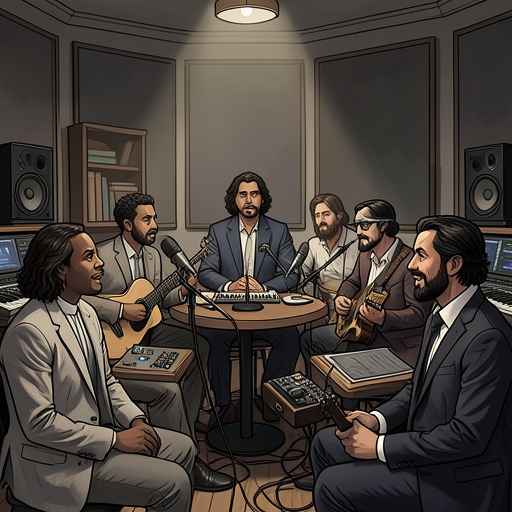
The stage divides the action between a basement band room at stage left and an upstairs recording studio at stage right. The band room has benches, chairs, a piano, lockers, a wall mirror, posters, and forgotten objects in a corner. Above it, the studio has a control booth reached by a spiral staircase, a line of chairs, and a horn through which the control room communicates with the performers; a rear door connects it to the band room. This arrangement gives the city’s recording work a precise theatrical geography: the musicians gather below, while the recording apparatus and its operators occupy a separate level.
At the opening, Irvin tests a microphone while Sturdyvant listens from the control booth. Later, Sturdyvant tries to direct the timing of Ma Rainey’s entrance, but she insists that he leave the singing to her and asks for her Coca-Cola. The exchange makes the studio a site of competing authority: the people above can listen and issue instructions, while Ma Rainey asserts control over how she performs. When the band’s recording fails, Irvin identifies a chewed microphone cord as the technical problem. The breakdown interrupts the session and helps expose how dependent the music’s capture is on equipment controlled within the studio.
The City in Performance
The session brings the larger setting into a concentrated encounter among performers, managers, and recording technology. Ma Rainey arrives with Dussie Mae, Sylvester Brown, and a policeman; she is dressed in a fur coat, matching hat, green dress, and pearls, and carries herself with a royal bearing. In the recording space, she coaches Sylvester Brown through the spoken introduction, reassuring him that a mistake can be done again. His hands clasp and pull against each other as he speaks, making the recording a bodily as well as vocal performance.
The band begins the song, and Ma Rainey sings after Sylvester Brown’s introduction. Yet the recording does not hold: Sturdyvant announces that the song has not been captured, and the damaged cord is identified as the cause. Elsewhere in the same divided setting, a dispute over God turns physical when Cutler punches Levee Green and jumps on him. These scenes do not make Chicago a single, unified community; instead, the city’s staged recording rooms bring distinct pressures into close quarters. The blues may offer connection and redress, but the people making it remain subject to unequal control, technical failure, and conflict.