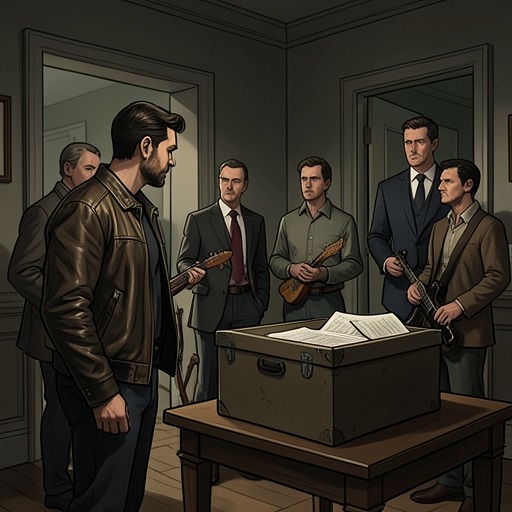
Levee and Cutler’s conflict over God
Ma Rainey's Black BottomLevee and Cutler’s conflict over God turns a story of racist violence into a direct test of religious belief: Levee demands to know why God did not protect the people who prayed to him, while Cutler answers the challenge with physical force. The scene moves from a minister’s forced dance to Levee’s memory of his mother’s plea for mercy, then ends with Levee stabbing at the air and declaring victory over a God he believes has turned away from Black people.
The Story That Prompts the Dispute
Cutler tells of Reverend Gates, a Black minister stranded in a strange town after his train leaves without him. As evening approaches, Gates sees white men gathering across the street from the station. He begins walking along the railroad tracks, but the men call after him, fire a gun into the air, and surround him. When they ask whether he can dance, he complies. One of the men tears the cross from his neck, accuses him of heresy for dancing with a cross and Bible, and rips up his Bible. The mob makes him dance until its members tire of watching. Cutler says Reverend Gates told him the story himself, while sitting in Cutler’s house, and that dancing was the only way he got out alive.
Toledo cuts into the account to say that he already knows its facts because he has heard the same story many times and experienced the same thing himself. His interruption makes the incident more than a distant report: the kind of racist coercion Cutler describes is familiar to the men in the room. Slow Drag adds that white people have never respected the Black minister. Cutler draws a further conclusion: if white people will humiliate a man of God, they will treat Ma Rainey as someone they can use to make money. Religious office offers no protection from racial contempt, and neither does musical fame.
Levee’s Challenge to God
Levee turns from the mob’s actions to the failure he sees behind them. If Reverend Gates is a man of God, he asks, where was God during the attack, and why did God not strike down the white men? Cutler warns that Levee will burn in hell, but this response does not address the injury Levee has named. Levee rejects the threat of damnation and insists that Cutler answer the question of why the minister was left to face violence alone.
His answer is an indictment: God is “a white man’s God.” Levee says God has never listened to Black people’s prayers, but has instead cast them aside, and he denies that Jesus loves Black people. His language makes the dispute inseparable from the power relations already present in Cutler’s story. Gates carries a cross and a Bible, yet the symbols do not stop the mob from tearing, mocking, and coercing him. For Levee, the scene exposes a gulf between religious promises and the protection actually afforded to those who pray.
The conflict also follows Levee’s defense of his own way of dealing with white men. He has said that his father was not frightened of them: his father could smile to a white man’s face and sell him land while privately planning what to do to him. Levee says that example taught him how to handle white people, and tells the others to leave him alone about it. That earlier account does not settle the argument over faith; it establishes Levee’s insistence on judging survival by what people do, not by appearances or assurances. Cutler’s tale and Levee’s question press that standard against the promise of divine care.
From Argument to Violence
Cutler’s answer to Levee’s blasphemy is bodily. Unable to bear the attack on his faith, he jumps up, punches Levee in the mouth, knocks him down, and gets on top of him, repeating that God is his God. Toledo and Slow Drag pull Cutler off. Levee is left bleeding from the nose and mouth, but tells them to let Cutler go and draws a knife. He circles Cutler with it while Cutler picks up a chair to shield himself. The argument about whether God protects the vulnerable has now produced an immediate threat between the men who were discussing it.
Levee calls on Cutler’s God to save Cutler, then invokes the memory at the center of his own accusation: his mother called out to God for mercy and help, and Levee says he heard her. He asks whether God turned his back on her. The plea gives his theological defiance a specific personal ground. His claim is not only that God failed Reverend Gates in a story told by Cutler; Levee connects that failure to his mother’s desperate prayer and to his own memory of hearing it.
As he continues addressing God, Levee becomes so absorbed in the challenge that he forgets Cutler is there. He stabs upward into the air, trying to reach God, and calls for God to turn his back on him as well. The knife’s direction shifts the scene from a confrontation with Cutler into a physicalized challenge to an unseen power. When Levee folds the knife and stands triumphantly, he declares that Cutler’s God is nothing. The gesture gives the exchange a momentary resolution, but not an answer to the suffering that provoked it.
Ending and Dramatic Significance
The lights fade to black after Levee’s declaration, and Ma Rainey sings, giving the scene a sharp transition from spoken religious argument back to music. Earlier, after Levee’s account of his father, Slow Drag begins playing bass and singing; the return of singing around the dispute places the argument within the band’s musical world without resolving it. The scene’s final movement is therefore not a reconciliation between Levee and Cutler, but a shift in stage sound and focus after the confrontation has reached its height.
The conflict brings together three linked failures of protection: Reverend Gates’s cross and Bible do not shield him from the mob; Cutler’s faith cannot persuade Levee that God answered his mother; and Levee’s knife, while it lets him stage a defiant challenge, cannot reach the God he accuses. Cutler treats Levee’s words as an assault on his faith, while Levee treats Cutler’s warning of hell as an evasion of the visible violence in the story. Their clash makes the question of belief concrete and urgent: whether religious language can account for the suffering described, or whether the experience of abandonment makes that language itself part of the dispute.