Levee—Cutler
Ma Rainey's Black BottomLevee Green—Cutler is a relationship defined by rival claims to authority that culminate in violence. What begins as a disagreement over which version of a song the band will rehearse becomes a struggle over who may direct the musicians, how a Black man should navigate white power, and whether faith can be separated from the suffering of Levee Green’s family.
Rehearsal and Authority
During rehearsal, Levee Green insists that the band should play his version of “Ma Rainey’s Black Bottom.” He says the version is on the list Irvin gave Cutler and urges Cutler to ask Toledo. Cutler refuses to let Levee dictate what is on the list, telling him to play the song Cutler names. The practical question of what to rehearse is already a contest over whose account and judgment will govern the room.
Slow Drag tries to return the musicians to the work, arguing that they should rehearse whichever version they are going to play. Levee Green says this is what he has been trying to tell Cutler, but Cutler answers that deciding what the group will play is not Levee’s business: Levee’s job is to play what Cutler says. Levee interprets the resistance as jealousy, accusing Cutler of resenting that Irvin is using his version and that he has demonstrated musical knowledge. Cutler rejects that explanation. The exchange reveals that the argument is not only about a song: Levee Green wants his contribution recognized as a basis for influence, while Cutler insists that musical ability does not confer authority over the rehearsal.
Cutler later makes the hierarchy explicit, saying Levee Green is confused about who is in charge because he does not understand that Ma Rainey is the boss. Levee counters that Ma Rainey is the boss on the road, whereas this is a recording session in Chicago, where Sturdyvant and Irvin decide what happens. Cutler then ends the immediate deadlock by proposing that they rehearse Levee’s version. His concession gets the band back to the song, but it does not settle their competing understandings of who has the right to make that decision.
Disagreement over White Authority
Their conflict also turns on how Levee Green handles white people. Cutler points to a white man who called Levee a boy and ordered him to rehearse; Levee answered only, “Yessir!” Cutler uses the incident to challenge Levee’s claim that he understands white men and is unafraid of them. Levee replies that he can say “yessir” to anyone he chooses and that doing so does not mean he is frightened. He says he has been handling white people for thirty-two years and insists that Cutler should let him handle the situation his own way.
The dispute is not simply about whether Levee Green feels fear. Levee presents his response as a deliberate choice and defends his own authority to judge when and how to answer white power. Cutler, by contrast, treats Levee’s deference in that encounter as evidence against his boast. Neither accepts the other’s interpretation, and the argument sharpens the earlier rehearsal dispute: each believes the other misunderstands who has the right to decide what a response means.
Faith, Violence, and Levee Green’s Mother
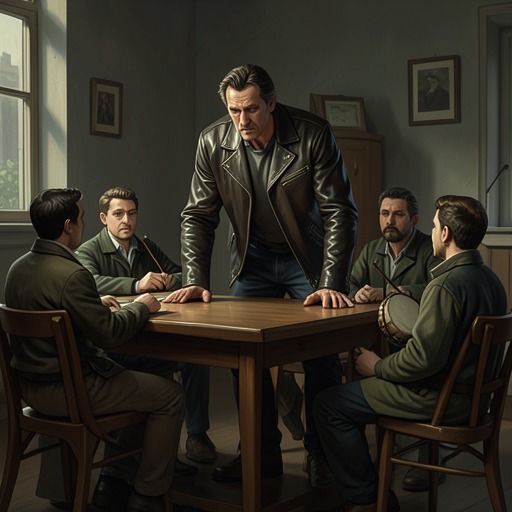
The breach becomes physical when Levee Green attacks Cutler’s faith. He denounces the white man’s God, arguing that God did not answer Black people’s prayers and did not save his mother. Cutler can no longer endure the blasphemy: he jumps up, punches Levee in the mouth, knocks him down, and pounds on him while insisting that the God Levee has insulted is his God. Toledo and Slow Drag pull Cutler away. Levee is bleeding from the nose and mouth, but tells them to let Cutler go and draws a knife.
With the knife out, Levee Green turns the confrontation into a challenge to Cutler’s God. He calls on God to save Cutler as God supposedly saved his mother, then recalls hearing his mother plead for mercy and help. He says that she called and God turned away. As he speaks, Levee becomes so absorbed in addressing God that he forgets Cutler and stabs upward into the air, trying to reach God. The remembered pleas give the quarrel its deepest personal stake: Levee’s attack on Cutler’s belief is inseparable from his accusation that divine protection failed his family.
What the Conflict Reveals
The relationship moves from a contest over a rehearsal decision to a fight in which each man’s convictions become intolerable to the other. Cutler’s insistence on discipline and faith meets Levee Green’s demand for recognition and his refusal to accept a God he associates with the abandonment of his mother. Their clash brings together the authority struggles of the recording room and the larger pressures of race and belief, without resolving either. The men are separated by Toledo and Slow Drag, but the scene leaves the underlying dispute exposed: Cutler defends a faith Levee indicts, while Levee insists that his own experience gives him grounds to reject Cutler’s judgment.