Ma Rainey’s Chicago recording session
Ma Rainey's Black BottomMa Rainey's Chicago recording session turns a commercial recording into a contest over artistic authority, performance, and the means by which music is captured. Ma insists on her version of Ma Rainey's Black Bottom, secures a place at the microphone for Sylvester Brown despite his stutter, and challenges the record company's attempts to direct the work. The take succeeds as a performance, but a chewed microphone cord leaves the song unrecorded; the session's later disputes over payment and paperwork show that control extends beyond the music itself.
Setting and Recording Process
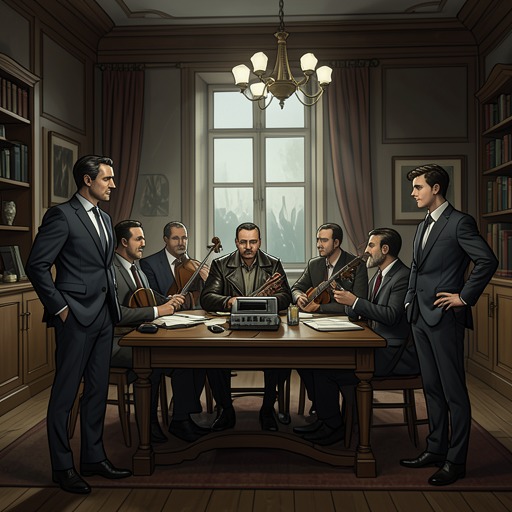
The play places the session in early March 1927, in a Chicago still caught in the chill after winter. Its two playing areas make the recording process visible as a division of space and authority. The band room lies in the building's basement, with benches, chairs, a piano, lockers, and forgotten equipment crowded around the musicians. Upstairs, the studio has a control booth at the rear, reached by a spiral staircase, a line of chairs, and a horn through which the control room communicates with the performers. A rear door connects it to the band room.
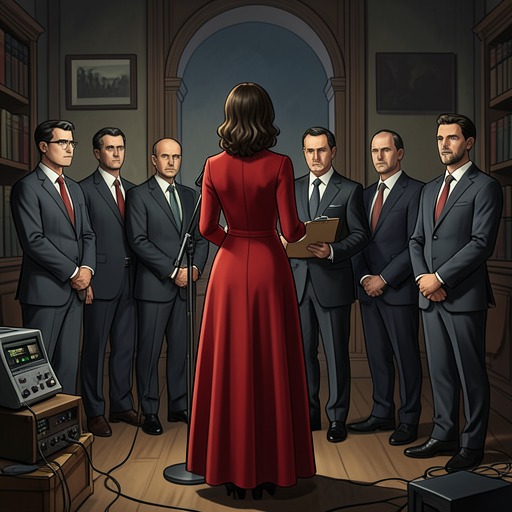
At the start of the play's recording action, Irvin tests a microphone while Sturdyvant listens from the control booth on earphones. The arrangement separates the people who perform from the people who monitor and manage the recording: Sturdyvant can speak to the room over a speaker, while Ma and the band work below him. The microphone and its cord are not incidental equipment. They determine whether a performance can pass from the room into a durable recording, and their failure ultimately defeats a successful take.
Ma's Version and Sylvester's Introduction
When Ma hears the band rehearsing Levee Green's version of the song, she rejects it. Irvin praises Levee's arrangement, particularly its horn introduction, but Ma says she will sing the song in the old way. She has brought her nephew to perform the spoken introduction, making the choice of arrangement and voice part of her authority over the session.
That choice meets resistance when the band objects that Sylvester stutters. Ma answers that the band works for her and that she decides what happens. She refuses to withdraw her promise to Sylvester, insists that he be given a microphone, and tells him to take his time when he falters through the introduction. Her encouragement is practical as well as personal: she keeps the performance moving without treating his stutter as grounds for replacing him.
Sturdyvant then tells Ma not to wait so long before entering and to shorten the introduction. Ma rejects his direction, drawing a boundary between his work in the control room and hers as the singer. She asks where her Coke is and prepares to record on her own terms. The exchange makes clear that the session is not simply a matter of getting a song onto record: Ma contests who gets to set its timing, arrangement, and performance.
A Successful Take, Then a Technical Failure
Irvin calls for take one, and Cutler counts the band in. After the performance, Irvin praises Ma and the musicians. Ma turns to Sylvester, tells him that he has done well, and says she knew he could manage the part. Cutler agrees that Sylvester did better than he expected. Within the room, then, the take confirms Ma's judgment: the introduction has been completed, and the band has delivered a performance the others praise.
The apparent success does not survive the recording apparatus. Sturdyvant interrupts to say that something is wrong and that the song has not been recorded. Irvin identifies the problem as a microphone cord that has been chewed up and says another cord is needed. The failure is not attributed to Ma's singing, Sylvester's stutter, or the band's playing; it is a material breakdown in the equipment. Ma calls the session disorganized and leaves to get her coat, with Dussie Mae accompanying her. The contrast between the praise for the take and the absence of a recording gives the technology a decisive role: a performance can happen successfully and still fail to become the record the session was meant to produce.
Musical Authority and the Band
The dispute over the song continues beyond the first take. Ma objects when Levee plays what she considers too many notes, while Levee defends his playing as improvisation on the theme. Ma insists that he play the song as she sings it, in keeping with how the others play, rather than going off on his own. Their disagreement sets her commitment to a shared, singer-led performance against Levee's claim to individual invention.
The conflict ends with Ma firing Levee and telling Cutler that he no longer plays in her band. Levee replies that being fired does not matter to him and presents it as a favor. The exchange makes the consequences of Ma's authority concrete: her control over the band's work is not only an argument about musical style but also a power to remove a musician from the session. Levee's later attempt to sell Sturdyvant his songs does not produce the recording opportunity he wants. Sturdyvant offers five dollars for each song, but Levee says he wants them recorded, and Sturdyvant again rejects them as unsuitable.
Payment, Forms, and the Session's Aftermath
Ma also intervenes when Irvin reports that Sturdyvant proposes taking twenty-five dollars from Ma's money and giving it to Sylvester. She refuses that arrangement: Sylvester, she says, should receive his own pay like everyone else. She directs Irvin to return to Sturdyvant and warns that he will not make another record of hers if he fails to pay the boy. In doing so, she uses her standing as a recording artist to press for compensation rather than accepting the company’s proposed substitution of her money for Sylvester's.
Sturdyvant eventually provides two hundred dollars for Ma and twenty-five for Sylvester. Ma then signs the forms, but the act does not amount to unqualified trust. As she leaves, she warns Sturdyvant that another mistake could lead her to make her records elsewhere. The session therefore closes its business on a conditional settlement: Sylvester receives the payment Ma demanded, and the forms are signed, while Ma preserves her stated willingness to take her recordings to another company. The performance has shown both the reach and the limits of her control: she can insist on the song's form, defend her nephew, and bargain over pay, but she cannot make a damaged cord preserve a take that the studio has failed to record.