Ma Rainey’s band
Ma Rainey's Black BottomMa Rainey’s band is the ensemble hired to accompany Ma Rainey in a Chicago recording studio in early March 1927. Led by Cutler, it brings distinct instrumental skills and temperaments to the session, but its members do not share equal control over what they play: the band is expected to perform Ma Rainey’s music, while Levee presses for room to shape it. The recording process makes that tension concrete, as a performance can be directed, interrupted, and ultimately lost through a damaged microphone cord.
Identity and Membership
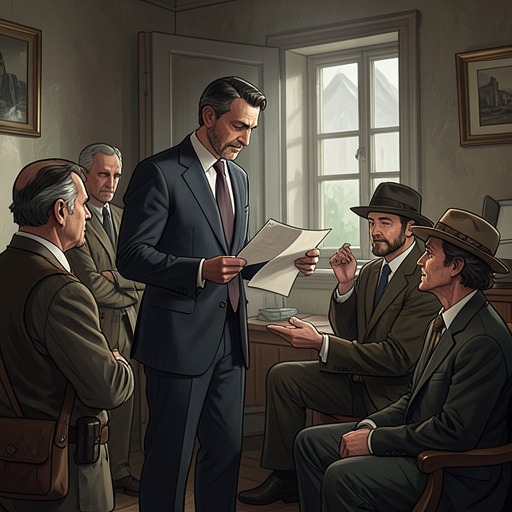
The band is presented as a group of seasoned musicians, most of them in their mid-fifties, dressed in the style of a successful ensemble of the era. Cutler plays guitar and trombone and leads the group, apparently because he is its most sensible member. His playing is solid and nearly unembellished; his understanding of the music stays close to the chord he is playing. He brings practical authority to rehearsals, insisting that the musicians follow the arrangement rather than turn the session into a forum for individual invention.
Slow Drag plays bass. Though he appears slow and is described as bored by life, he is deceptively intelligent; the African rhythms underlying his playing emerge with striking ease. Toledo, the pianist, is in command of his instrument and recognizes its limitations as an extension of himself. He is the only band member who can read, though his self-taught learning is sometimes misapplied. His quick perception of situations gives the group a thoughtful counterpoint to Cutler’s more immediate, practical leadership.
Levee is the band’s trumpet player and its most direct challenger to the group’s working arrangement. He believes his playing and ideas exceed the role assigned to him, and points to the possibility of having his own band as a measure of the independence he wants. The others’ positions differ: Cutler enforces the ensemble’s obligations, while Toledo answers Levee’s self-assertion with a defense of the group’s shared style. Their exchanges reveal a band held together by work, but not by agreement about what musical authority should mean.
Rooms and Recording Work
The band’s work moves between two sharply differentiated spaces. The band room is in the building’s basement, stage left: benches and chairs are scattered around a piano and a row of lockers, while forgotten miscellaneous items sit in a corner. A mirror and posters hang on the wall. It is the musicians’ gathering and rehearsal space, visibly separate from the equipment and oversight of the recording operation.
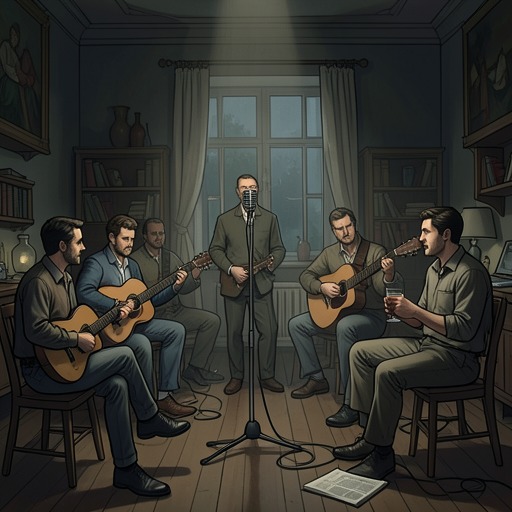
The studio is upstairs at stage right and is arranged like a late-1920s recording studio. Performers sit along one wall; a horn connects them with the control room at the rear, reached by a spiral staircase. A back door leads down to the band room. This layout lets the musicians perform in one space while Sturdyvant monitors from above and communicates through the speaker system. Irvin handles the microphone and the practical setup, while Sturdyvant’s position in the booth gives him a separate means of listening and intervening.
That division of space reflects the band’s position in the session. The musicians supply the performance, but the recording process is administered from the control booth, where Sturdyvant is preoccupied with money and is described as insensitive to Black performers, preferring to deal with them at arm’s length. The microphone and the speaker are not merely studio furnishings: they mediate who performs, who listens, and who can call for a change.
Musical Authority and Conflict
Cutler defines the ensemble as an accompaniment band, not one of the hot bands Levee wants to emulate. Until Levee has a band of his own, Cutler says, he is to play the piece and stop complaining. He insists that the musicians play Ma Rainey’s music and that Ma Rainey decides what is played. In his view, the band’s job is execution, not independent creation.
Levee rejects the limits of that role. He argues that listeners in the North will not want the introduction associated with a tent show and will want to hear music instead. His objection is both practical and artistic: he is concerned with how the arrangement will reach its audience, but he also resents being told that he is present only to play what someone else has chosen. Cutler answers by asserting the band’s place in the hierarchy and warning that Levee is not there to create. The disagreement exposes a divide between collective service to Ma Rainey’s performance and Levee’s desire for authorship and recognition.
The conflict is not simply between an established leader and a dissatisfied player. Toledo’s claim that style consists in keeping the same idea from beginning to end offers a different account of musical character, while Levee insists that individual ability distinguishes him from the rest. The band’s arguments therefore turn on competing definitions of style: continuity within a group, disciplined accompaniment, or the freedom to make a sound unmistakably one’s own.
Performance, Failure, and Dismissal
During the session for Ma Rainey’s Black Bottom, Ma Rainey prepares Sylvester Brown to deliver the spoken introduction. She instructs him to stand with his hands held as directed, remember the words, and take his time; if he makes a mistake, they can do it again. Cutler counts the band in, and Sylvester Brown clasps his hands in front of his chest, pulling them in opposite directions as he speaks. The band stops when the attempt ends, and Ma Rainey reassures him that he has done well and can get it right with time. Her attention to his performance places the introduction within the band’s work rather than treating it as an incidental addition.
Sturdyvant then tries to tell Ma Rainey not to wait so long before entering and to shorten the introduction. She refuses his direction, reserving control over how she sings while telling him to handle his side of the operation. When the band plays the number again, Sylvester Brown delivers the introduction and Ma Rainey sings. The session briefly brings the musicians’ accompaniment, the spoken opening, and her vocal performance together under her direction.
The take is not preserved. After the performance, Sturdyvant reports that something has gone wrong and that the song has not been recorded. Irvin identifies the problem: the microphone cord has been chewed up, and another cord is needed. The damaged equipment turns a completed performance into a lost recording and forces the session to stop; Ma Rainey declares the operation disorganized and leaves with Dussie Mae. The failure makes the technology part of the band’s working conditions: musical performance alone cannot secure a recording if the equipment that captures it fails.
Later, Ma Rainey fires Levee and tells Cutler that Levee is out and will no longer play in her band. Levee declares that the dismissal is no loss to him and exits to the band room. The decision gives explicit force to the hierarchy Cutler had defended: Ma Rainey controls the band’s membership as well as its music, and Levee’s demand for independence ends in his separation from the ensemble.
Significance
The band brings the play’s account of the Blues into the practical space of collective labor. Its musicians are not interchangeable accompanists: each has a distinct instrumental role, style, and understanding of the work. Yet their skill operates within a structure in which Ma Rainey determines the musical direction, Cutler maintains the band’s discipline, and Sturdyvant and Irvin manage the recording process from their own positions. The band’s internal dispute over invention thus unfolds alongside the external conditions of a commercial session.
The contrast between the downstairs band room and the upstairs studio gives that structure a physical form. In one room, the musicians wait, rehearse, and argue; in the other, their playing is transmitted to the control booth and made subject to recording decisions. The lost take shows how precarious that translation can be: the band performs, but a damaged cord prevents the performance from becoming a usable recording. Through its changing balance of accompaniment, individual ambition, artistic authority, and technical dependence, Ma Rainey’s band embodies both the creative force of its musicians and the limits placed on their control of the work.