The white man's God
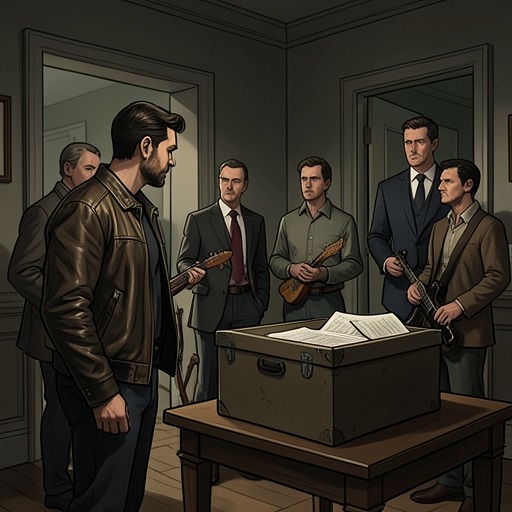
Ma Rainey's Black BottomThe white man's God is Levee Green's name for a deity whose protection and justice, as he sees them, have been withheld from Black people. The concept comes into focus when a story of racial violence prompts him to ask where God was, and why God did not intervene. His challenge is not abstract: it draws force from childhood trauma, and culminates in a physical, theatrical test of whether Cutler's God will answer.
Origins in Violence
Levee's distrust of divine protection is rooted in an assault he witnessed when he was eight. At his family's home in Jefferson County, about eighty miles outside Natchez, a gang of white men attacked his mother while she was frying chicken. Unable to understand what was happening but convinced that the men might as well harm him too, Levee fetched his father's hunting and work knife and tried to cut one man's throat. He struck the man's shoulder; the man seized the knife and slashed Levee across the chest, leaving the long scar Levee later displays. The memory makes the failure of divine intervention personal: Levee recalls hearing his mother plead for mercy and help, yet sees no sign that her prayer was answered.
The scene follows Cutler's account of Reverend Gates, a Black minister stranded in a strange town after his train left without him. White men surrounded Gates, tore the cross from his neck, ripped up his Bible, and forced him to dance; Cutler says dancing was the only way Gates got out alive. Toledo recognizes the account as one he has heard many times and says the same thing happened to him. Levee rejects Cutler's warning that he will burn in hell, arguing that a God who permits such violence is the white man's God, not a God who hears Black people's prayers. In that exchange, religious language becomes a dispute over whose suffering counts and whose appeals receive an answer.
The Challenge as Performance
Before the confrontation over Reverend Gates, Levee has already framed belief as a question of whether God can be encountered or relied upon. When Slow Drag tells of Eliza Cottor, a man from Tuscaloosa County, Alabama, who sold his soul to the devil, Levee says he wants to see the devil coming so he can sell the soul he has, adding that God has gone to sleep. The exchange does not resolve into a doctrine; it presents Levee’s spiritual language as a demand for evidence and response. A God who remains absent is no more useful to him than a devil whose arrival is only a story.
After Cutler punches him and knocks him down, Levee pulls a knife and asks whether Cutler’s God will save him. Cutler takes up a chair for protection as Levee circles him, but the challenge shifts away from the immediate threat: Levee invokes his mother’s pleas during the attack on her, then becomes so absorbed in addressing God that he forgets Cutler and stabs upward into the air. The gesture makes his accusation physical, directed at an unseen power rather than at the man before him. He finally folds the knife and stands triumphantly, declaring, “Your God ain’t shit, Cutler.” The apparent victory is a performed verdict, not evidence that God has answered; its force lies in Levee’s insistence that divine silence has already supplied the answer.
Theological Dispute and Historical Memory
The play sets Levee Green’s accusation beside Toledo’s account of Black people as “leftovers from history.” Toledo describes the making of history as a stew: people from different African tribes are mixed together, the meal is consumed, and remnants remain after the eater is full. He identifies Black people as those remnants, made into history and then treated as disposable by the white man who has consumed their labor and inheritance. The image does not explain Levee’s crisis away; it places his demand for divine justice within a history in which Black lives are used and then abandoned. Where Toledo offers a collective account of that abandonment, Levee’s question about God arises from a particular remembered assault and the unanswered pleas he heard.
The dispute also exposes a divide between explaining oppression and confronting its immediate force. Cutler tells Reverend Gates’s story to show that white people disregard even a Black minister, and connects that treatment to their capacity to use Ma Rainey to make money. Levee interrupts over the train route, then turns the account toward its religious implication: if Gates is a man of God, why did God not strike down the men who tormented him? Toledo recognizes the story as familiar and says it happened to him too, making the episode more than a distant illustration. Against Cutler’s warning of hell, Levee names the deity implicated by this recurring abandonment as the white man’s God. Religious belief becomes a measure of whose experience it can acknowledge, while the repeated stories expose a history that no assurance of future punishment can undo.
Prayer, Story, and Silence
Religious language in the band room does not carry one settled meaning. Toledo tells a comic story about a man who boasts of learning the Bible at church, then confuses the Lord’s Prayer with a bedtime prayer and loses a five-dollar bet. The joke turns religious knowledge into a performance that can be exposed by a listener; Levee, by contrast, demands an answer to suffering that no display of scriptural familiarity can supply. Set beside that joke, his accusation is not a test of whether people can repeat prayer, but whether prayer reaches anyone with power to act.
The play leaves Levee’s accusation hanging in a different register from the stories that provoke it. After he recounts his childhood assault and his father’s response, a long pause gives way to Slow Drag playing bass and singing the opening line, “If I had my way.” The song does not settle the dispute or explain the silence Levee confronts. Instead, it places music after testimony: a brief collective sound follows an account of violence, while Levee’s challenge to God remains unanswered. The contrast keeps the concept grounded in the play’s action, where prayer, remembered harm, argument, and music offer competing ways to voice what has not been repaired.