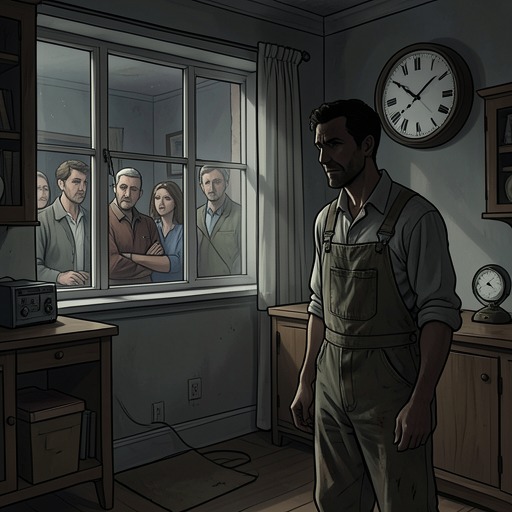
the leftovers from history
Ma Rainey's Black BottomToledo’s expression “the leftovers from history” names the position he believes Black people occupy in a history made and consumed by white people. Its central image is a stew: diverse peoples and materials are mixed into a shared past, but the past does not disappear when that history is declared over. What remains is treated as unwanted residue. As Toledo develops the metaphor for the band, its force lies both in the accusation it makes and in the argument over whether the others can recognize what it means.
The metaphor of the stew
Toledo begins by telling Levee Green that he and the others are leftovers from history. He explains that people came from different places in Africa, from different tribes, and compares their becoming one people to ingredients assembled in a pot. Carrots, peas, potatoes, meat, nuts, okra, and corn are mixed and cooked until their flavors flow together and form one stew. The image gives historical formation a physical process: distinct elements enter a mixture, are transformed by it, and contribute to something that can be consumed.
The metaphor then turns on what happens after the meal. A people makes its history as the stew is cooked and eaten, but the process does not use everything up. Carrots and potatoes remain; the stew is still present in fragments even after the meal has ended. For Toledo, those remnants are not simply the past preserved intact. They are what remains after a new history has been made and the people who made it have moved on to another meal. The leftovers cannot be incorporated into the completed meal again, yet they cannot be made to vanish either.
Toledo applies the image directly to the colored man. In his account, white people know that Black people have been made into history because they are the ones who have consumed them; the people being treated as leftovers, by contrast, have not yet recognized what has happened to them. He describes the white man as full and tired of what he has eaten, wanting Black people off the plate so he can eat something else. The metaphor therefore connects historical appropriation to present exclusion: the meal has supplied nourishment, while the remnants are now told to get out of the way.
Argument, interruption, and dismissal
The band does not receive Toledo’s explanation as a single, settled lesson. Slow Drag asks what eating has to do with the way white people treat Black people. Toledo clarifies that he has not claimed the act of eating explains every form of treatment; Cutler, meanwhile, urges Slow Drag to understand that Toledo is trying to tell him something. The exchange makes the metaphor’s interpretive demand part of the scene. Toledo is not merely describing an image; he is asking his listeners to see their place in history through it.
Levee Green responds by acknowledging the effort while rejecting the explanation. He says that he got lost trying to work out who puts nuts in a stew. The joke reduces Toledo’s historical analogy to a distracting detail about food, turning a claim about collective history into a dispute about the recipe. Slow Drag answers that his grandparents put nuts in their stew, treating the ingredient as familiar rather than puzzling. Toledo then draws a distinction the exchange has obscured: the stew eaten across Africa, the stew Slow Drag’s grandparents made, the stew the band members eat, and the stew Mr. Irvin eats are not the same stew. Shared ingredients, or a repeated name for a dish, do not make the histories identical.
Toledo closes the argument by saying he will not try to explain it again. Levee Green stretches out on a bench, calls himself nothing but a leftover, and tells the others to rehearse with Toledo, who can teach them how to make a stew. He says he knows his own part and that the others need rehearsal. This ending does not show Levee Green adopting Toledo’s account; he uses its defining word, but keeps his distance from the lesson and redirects attention to the band’s work.
Toledo’s stories and the expression’s context
The stew explanation belongs to a broader pattern in which Toledo uses stories and comparisons to make a point, while the listeners test, interrupt, or redirect his authority. Earlier, he tells a joke about two men debating whether one knows the Lord’s Prayer. The man who claims to have learned it at church recites a different prayer, and the other gives him the wagered five dollars. Toledo then uses the story to mock Levee Green’s argument that knowing how to spell music earns him a dollar. In both exchanges, the story makes an abstract dispute concrete through a reversal: the supposed proof of knowledge exposes a failure to understand what is being discussed.
Cutler’s account of Reverend Gates offers another pointed example of the racial history the band discusses. Reverend Gates, traveling to visit his sick sister, is left behind when his train departs. White men surround him, demand that he dance, tear the cross from his neck, destroy his Bible, and make him dance until they tire of watching. Cutler says the dancing is the only way Reverend Gates gets out alive, and reports that Reverend Gates told him the story himself. The episode is not an illustration Toledo supplies for the stew metaphor, but it places the band’s talk about Black life beside a specific instance of white coercion and humiliation.
Meaning and limits
Toledo’s metaphor is at once collective and contested. It describes a history made through mixing, consumption, and residue, but it does not make every stew—or every Black person’s experience—interchangeable. His insistence that the stews eaten by different people are not the same guards against precisely that flattening. The image can join a broad claim about exploitation to the differences among particular histories, even as the other musicians’ responses show how difficult it is to make that claim heard.
The phrase also sits in tension with Levee Green’s complaint about change. Earlier, when the band room has been moved downstairs, Levee Green insists on the visible change in the room, while Toledo answers that everything changes, down to the air and the skin. The two exchanges are not the same argument, but both stage a difference in scale: Levee Green fixes on an immediate, tangible circumstance, while Toledo expands it into a wider account of change or history. In the stew exchange, that gap leaves Toledo’s explanation hanging between a vivid image and the listener who refuses to follow it. The leftovers remain not only the metaphor’s subject, but also the unresolved question the band leaves behind.