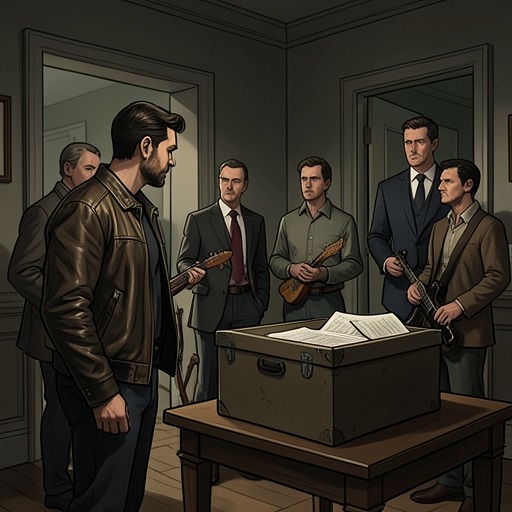
Black musicians under racial and economic oppression
Ma Rainey's Black BottomBlack musicians under racial and economic oppression occupy the play’s central tension: their Blues carry memory, connection, and a means of facing further struggle, yet the people and institutions that profit from Black music repeatedly try to control the musicians who make it. In Chicago in 1927, exclusion appears in ordinary encounters as well as in the recording studio. The musicians’ responses range from Toledo’s account of historical dispossession to Ma Rainey’s forceful bargaining and Levee’s demand to record his own songs.
Setting and Collective Experience
The play situates its concern on Chicago’s South Side, where Black residents return to cold-water flats and rented rooms before night brings them into crowded bars and juke joints. The opening frames their music as more than entertainment: the Blues connect people and offer warmth, redress, braggadocio, vision, and prayer. They help people gather themselves for the next struggle, even as those who make the music remain exposed to the conditions shaping that struggle.
This collective framing matters because the play’s examples of oppression are not confined to one kind of transaction. A Black musician can be refused passage in public, have his religious identity violated by a white mob, or find the value of his creative labor decided by a record-company executive. The studio does not stand apart from the city’s racial order; it gives that order a commercial setting, where voices and songs can be sought for profit while their makers’ needs and choices are discounted.
Exclusion and Historical Memory
Ma Rainey identifies racial exclusion in a practical, immediate form when she explains that a cab driver refused to carry Black passengers. The incident gives a concrete context to the recording session’s wider conflict: access and respect cannot be assumed, even for a celebrated performer. Her fame offers leverage, but it does not erase the racial boundary she encounters in the city.
Toledo gives that boundary a historical interpretation through his metaphor of a stew. He describes Black people as leftovers from a history made by others: the white man has consumed what Black people contributed, grown full, and now wants them moved aside. In Toledo’s account, the injustice includes not only exploitation but also the imposed failure to recognize what has been taken. His image connects the musicians’ present circumstances to a longer history of appropriation, while asking what Black people can do once they understand how that history has treated them.
Cutler’s story of Reverend Gates makes racial violence visible in a single episode. After being stranded on his way to visit his sick sister, Reverend Gates is surrounded by white men who demand that he dance. They tear the cross from his neck, destroy his Bible, and keep him dancing until they tire of watching; dancing is the only way he gets out alive. Cutler says he heard the story directly from Reverend Gates and connects it to Ma Rainey’s position: white people, he argues, can treat a Black person as someone to use for amusement or money rather than as a person deserving respect. Levee answers by asking where God was during the assault, turning the story into a direct conflict over whether faith can account for racial violence.
Music, Labor, and Commercial Power
The recording company’s interest in Black music is both aesthetic and commercial. Sturdyvant wants to hear more from Levee, the horn player who has brought him songs, because he thinks the sound is changing and should be made more rhythmic and unusual. His enthusiasm for a new sound coexists with a dismissive judgment of the company’s last release and anxiety about the business. He discusses poor sales in New York, where Harlem is located, while Irvin points to earnings in Memphis, Birmingham, and Atlanta. Sturdyvant says the business is bad for his nerves and imagines leaving it in two years for textiles, which he considers respectable.
Ma Rainey sees the unequal terms behind the company’s interest in her voice. She says she has performed since childhood and objects that the company wants to capture her voice on recording machines without treating her properly. She recalls that Irvin has managed her for six years but invited her to his house only to sing for his friends. She also argues that, if a Black performer can make the company money, the company accepts that performer; otherwise, the performer is treated as disposable. In her account, her records have earned the company more than all its other recording artists combined, yet it still complains about the cost of the session. Commercial value brings her bargaining power, but it does not make the relationship equal.
Levee’s exchange with Sturdyvant shows the same imbalance applied to songwriting. Levee asks about the songs he has supplied and says he has assembled a capable band, confident that listeners will buy the music if they hear it. He argues that audiences are tired of jug-band music and want excitement and fire. Sturdyvant refuses to record the songs, says they are not what the company is looking for, and offers five dollars apiece instead. Levee insists that Sturdyvant had told him he could record them and that the songs need to be heard with Levee playing them. Sturdyvant repeats the price and calls the purchase a favor. He finally shoves the money into Levee’s coat pocket and leaves; after the door slams, Levee balls up the money and throws it down. The rejection takes the form of a small payment, but what Levee resists is the conversion of a hoped-for recording into a cheap sale.
Bargaining, Recognition, and Resistance
Ma Rainey’s defense of Sylvester Brown makes payment another test of whether Black labor will be recognized. Irvin reports that Sturdyvant’s best offer is to take twenty-five dollars from Ma’s money and pass it to Sylvester. Ma rejects the arrangement: Sylvester should receive his own pay, like everyone else. She orders Irvin to return to Sturdyvant and warns that the company will not make another one of her records if it fails to pay the young man. When Sturdyvant comes to the studio, she repeats the demand directly. He produces two hundred dollars for her and twenty-five for Sylvester, which Irvin hands to them.
The exchange shows Ma using the commercial value she has accumulated to press for someone else’s compensation. Her authority is real but conditional: she invokes the possibility of taking her records elsewhere rather than assuming the company will act fairly. The same negotiation extends to the release forms. Irvin expects her to sign after arranging the payment; Ma first tells him to send the forms to her address, then asks for the pen and signs them. She warns Sturdyvant that another mistake could lead her to make records elsewhere. The sequence neither makes her powerless nor removes the company’s leverage. Instead, it shows her turning reputation, payment, and the timing of agreement into resources for demanding better treatment.
Levee’s story about his father offers a different language of resistance. He recalls his father smiling at a white land buyer while selling his land, even as he planned revenge. Levee says that example taught him how to deal with white people and insists that he can smile and say yes sir on his own terms. After a long pause, Slow Drag begins playing bass and singing. The transition from Levee’s account to music places performance beside speech as another response to the pressures being described, without suggesting that the underlying conflict has ended.
Significance
Across these scenes, the play links cultural value to the question of who controls its benefits. The Blues are presented as a sustaining way of life, yet recording turns the voice into something a company can capture, evaluate, and sell. Ma Rainey’s experience distinguishes being profitable from being respected; Sylvester’s disputed pay shows how even a modest sum can expose whose work counts; and Levee’s rejected songs dramatize the gap between a musician’s creative ambition and a company’s power to decide what reaches listeners.
The play also refuses a single response to oppression. Toledo explains dispossession through history; Cutler recounts the survival of Reverend Gates under racist violence; Levee challenges the place of God in a world where that violence goes unanswered; and Ma Rainey negotiates with the company using the leverage her success provides. Together, these differences make the musicians’ position neither an abstract theme nor a simple story of victimhood. Their music and arguments reveal people making claims on history, dignity, payment, and creative authority even when others continue to set the terms.