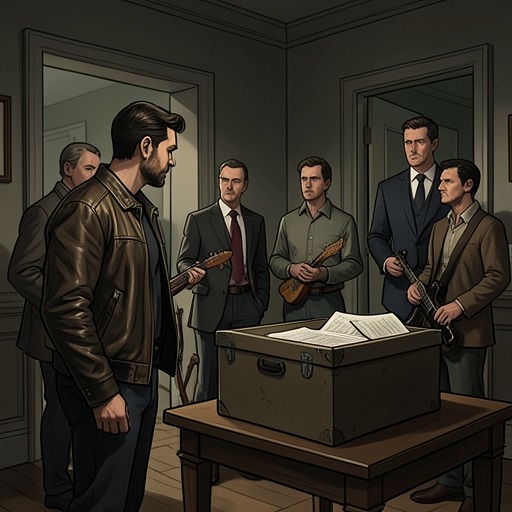
Memphis Lee Green
Ma Rainey's Black BottomMemphis Lee Green, known as Memphis, is Levee Green’s father, a farmer whose land, the white men’s attack on his family, and his subsequent revenge form the central story Levee tells about his childhood. He is remembered as both a man who achieved a measure of independence through saving and borrowing and a man who answered racial violence with lethal retaliation. His example helps explain the strategy Levee claims for himself: outward deference need not mean inward submission.
Identity and Background
Memphis lived with his family in Jefferson County, about eighty miles outside Natchez. He had nearly fifty acres of good farming land, which he bought from Mr. Hallie’s widow after working on shares. The account emphasizes the effort behind that purchase: he saved and borrowed until he could own land and live independently. People called him uppity for doing so, making his property more than a source of livelihood in Levee’s recollection. It represented a challenge to the racial order that expected Black people to remain dependent.
His farming connected the family to the seasonal work of the land. As planting time approached, Memphis went to Natchez to buy seed and fertilizer. Before leaving, he told eight-year-old Levee that he was now the man of the house and must look after his mother. That brief instruction places a child in a role shaped by the household’s vulnerability; while Memphis was away on an ordinary agricultural errand, the family faced an attack that would overturn their life.
The Attack and His Revenge
While Memphis was gone, eight or nine white men entered the house and assaulted Levee’s mother. Levee was present as a child. The violence becomes the turning point in his account of his father, but Memphis’s response begins with concealment rather than an immediate public confrontation. When he returned, he acted as though he had accepted what had happened. He obtained the men’s names from his wife, and the family announced that it was leaving the county.
Memphis sold the land to one of the men who had participated in the assault, smiling in his face as he did so. The gesture carried two purposes in Levee’s telling: it completed the family’s departure while hiding the revenge Memphis was planning. He moved his family to live with relatives in Caldwell and settled them there. Then, without telling them where he was going, he left one day. Levee says he never saw his father again. Memphis had secretly returned to the woods, where he waited for the men responsible.
He killed four of them before they tracked him down. They caught him in the woods, hanged him, and set him afire. The account gives no further detail about the other men or about the family’s life after his death. Its stark sequence—land sold, family relocated, father gone, four assailants killed, Memphis captured and burned—shows both the force and the cost of his retaliation. His revenge did not restore the family’s former security or return him to it; it ended with his death.
What Levee Learns from Him
Levee presents Memphis’s composure as part of his legacy. What taught him how to handle white people, he explains, was watching his father smile at one of the men who had assaulted his mother and sell him the family land while privately preparing to strike back. Levee insists that he can also smile and say yes, sir to a white person without surrendering his own judgment or timetable. He asks the other musicians to leave him alone about how he deals with white people, making the story not only a history of his father but also a defense of his own manner.
That lesson is deliberately double-edged. The smile can be read as accommodation, but Levee recounts it as a mask concealing a plan; apparent compliance and actual consent are not the same. Memphis’s example gives his son a language for surviving unequal power without mistaking good manners for trust. At the same time, the story’s ending places a limit on that strategy: Memphis’s secrecy enables his revenge, but his opponents ultimately find and kill him. The account does not present retaliation as a route to safety or repair.
Narrative and Thematic Significance
Memphis appears through Levee’s remembered story rather than through an independent account of his thoughts. The narrative therefore establishes what his son witnessed and what Levee believes the events taught him, without claiming access to every part of Memphis’s motive. In Levee’s telling, his father’s land ownership, the attackers’ violence, the hidden return to the woods, and the lynching belong to one history of racial domination and resistance.
The episode also gives a concrete family history to Levee’s distrust of white power. Memphis had attained economic independence by purchasing farmland, yet that achievement did not protect his household from assault, and leaving the county did not prevent his own death. The account’s connection between land, racial violence, and reprisal shows how narrowly independence could be defended and how devastating its cost could become. For Levee, the final inheritance is not simply his father’s revenge but the practice of reading the distance between a white person’s apparent welcome and the power that person holds.