Sylvester records the spoken introduction
Ma Rainey's Black BottomSylvester Brown’s spoken introduction to Ma Rainey's Black Bottom becomes a test of whether his stutter will be treated as a reason to remove him from the recording or as a difficulty he can work through with support. Ma Rainey insists that he perform the part, coaches him through repeated attempts, and celebrates when he delivers it clearly. The band completes the song, but a damaged microphone cord means the successful performance is not captured: the moment of artistic achievement ends in a failure of the recording process.
The recording room and the assignment
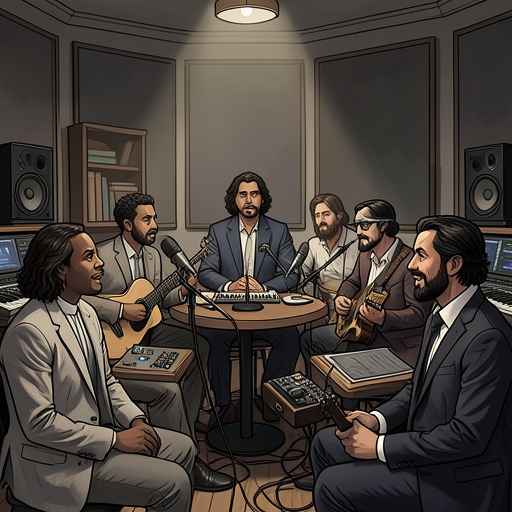
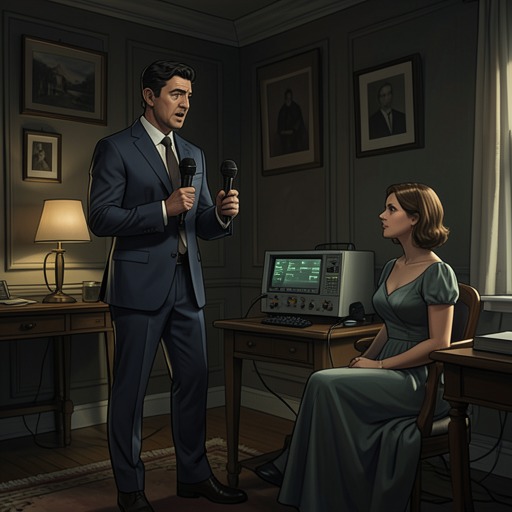
The recording takes place upstairs in the studio, separate from the basement band room. The studio’s control booth sits at the rear, reached by a spiral staircase; a horn lets those in the booth communicate with the performers. This arrangement divides the work between the musicians on the studio floor and the people monitoring the recording. Irvin handles the microphone and recording procedure, while Sturdyvant listens from the booth and can direct the session over the speaker. Sylvester’s introduction must therefore succeed not only as a live performance but as sound that the recording equipment can preserve.
Sylvester arrives with Ma and Dussie Mae. He is an Arkansas country boy, physically large and uncomfortable in his new suit and coat, and he stutters most of the time when speaking. Ma gives him a specific part: stand in position, hold his hands as she has shown him, remember the words, and say them. Her instruction makes the task manageable without pretending that he will never stumble; if he messes up, she tells him, they will do it again. She asks Cutler to play for him, placing the spoken lines within the band’s musical performance rather than treating them as a separate audition.
The first attempt and Ma’s insistence
As the band plays, Sylvester curls his fingers and clasps his hands in front of his chest, pulling them in opposite directions while he speaks. His first version is halting. He stammers through an introduction that presents Ma’s singing as the part still to come, and Levee Green stops playing; the rest of the band then stops as well. The interruption makes Sylvester’s speech a shared performance problem: the band cannot simply continue beneath him, and the recording cannot proceed as planned while the introduction falters.
Sturdyvant proposes taking the song without a spoken introduction, asking Ma to come in singing rather than wait through the opening. Ma refuses to drop Sylvester’s part. She argues that he does not stutter all the time, asks that he be given a chance, and coaches him again to hold his hands as instructed, relax, and concentrate. Her response determines the shape of the next attempt. The introduction is not discarded to make the session more efficient; the musicians and recording staff instead pause and give Sylvester another opportunity to deliver it.
The successful performance
On the next take, Sylvester’s wording reverses the emphasis of his first attempt. Instead of saying that listeners have seen the best and that Ma will show them the rest, he says they have seen the rest and that she will show them the best. He then announces Ma’s black bottom. This revised, clear delivery carries the introduction into the song rather than stopping it. Ma begins singing, and the band accompanies her through the performance.
When the song is completed, Irvin says that it sounded good and praises the band. Ma immediately turns the success into encouragement for Sylvester: she tells him he has done well, reminds him that she knew he could do it, and asks Cutler to confirm that he sounded good. Cutler agrees, adding that Sylvester did better than he expected. The praise marks a change from the first attempt, when Sylvester’s stammer brought the music to a halt. Here his introduction holds, the song follows, and the people around him acknowledge his performance rather than defining him by the difficulty of speaking.
A performance the equipment fails to preserve
The success is sharply undercut when Sturdyvant reports from the control booth that something is wrong and the song has not been recorded. Irvin identifies the problem as the microphone cord, which has been chewed up and must be replaced. The scene distinguishes what the performers have accomplished from what the recording system has retained: Sylvester has delivered the introduction, Ma has sung, and the band has played, yet the session has no recording of the song to show for it.
Ma calls the session disorganized and leaves with Dussie Mae, going offstage to get her coat. The technical failure thus interrupts the movement from performance to preservation and brings the session to a halt just after Sylvester’s success. His introduction matters both as a moment of personal affirmation and as part of Ma Rainey’s recording, but the damaged cord exposes how fragile that achievement is when it depends on equipment and on the people controlling it. The scene ends not by diminishing Sylvester’s successful delivery, but by separating the success heard in the room from the recording that the room was meant to produce.