Bionic Revolution
Made for LoveThe Bionic Revolution names the technological future Hazel is trying to leave behind: a world in which Byron and his colleagues treat increasing dependence on technology as progress, and even the defeat of death as a corporate advantage. Its name is therefore more than a slogan. In Hazel’s account, it marks a conflict between Byron’s ambition to make life technologically extensible and her effort to reclaim agency through ordinary, manual choices.
The Name and Its Double Edge
Hazel recalls that Byron and his colleagues call their project the Bionic Revolution, but sometimes say Byronic instead. She wonders whether the substitution is a slip. The novel leaves that uncertainty intact: the near-rhyme can be heard as an accidental entanglement of the movement with Byron himself, but Hazel does not establish that anyone intends the wordplay. What is clear is that, for her, the revolution is inseparable from the person whose future she is fleeing.
That association gives the grand language of revolution an intimate scale. Hazel is not describing a political uprising or a single technological breakthrough; she is naming the futureworld she experienced in her marriage to Byron. The term gathers a wider culture of technological faith into the pressure of a personal relationship. Its promise of transformation sounds expansive, while the life Hazel remembers within it feels increasingly difficult to escape.
Gogol’s Culture of Technological Dependence
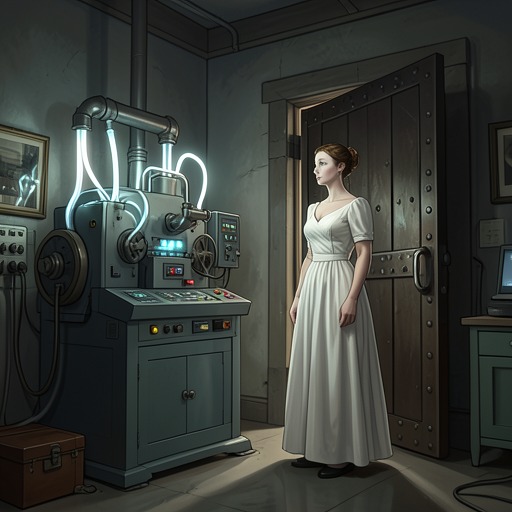
Hazel’s wish to turn away from the Bionic Revolution emerges through concrete contrasts in access and movement. At The Hub, the domestic compound Byron has named, entry depends on voice and retinal detection; some rooms require a fingerprint and keypad code, and the cars are controlled remotely. By comparison, the physical key to her father’s house presses its teeth into Hazel’s palm. Its small, bodily presence makes her feel as though she is going back in time, which she recognizes as exactly what she wants.
Her refusal extends beyond leaving a highly controlled home. While trying to find a bar near her father’s trailer, Hazel could use a Gogol search application, but decides that relying on it would be precisely what the enemy wants. She wants to form her own mental maps, accepting that they will be fallible and distractible. She calls this project deprogramming herself, while qualifying that Byron had not brainwashed her in any simple sense: she knows she would not have left him if he had. Her chosen alternative is not presented as effortless independence. It begins with navigating unfamiliar streets without a phone, internet device, or navigation system, while still not knowing what to do about the danger she believes she faces.
Hazel describes Gogol’s dependence on technology as cultish because reliance is treated as a personal strength and the degree of reliance as a measure of a person’s value. She tests that ethic with a deliberately extreme hypothetical: a worker has severed her brain from her human body and placed it in a robotic frame. The question makes visible the endpoint implicit in a culture that treats technological integration as proof of worth. Rather than rejecting the premise, Byron immediately embraces it.
Byron’s Ideal of Immortality
Byron says he would make the hypothetical worker do the same thing to him that day. If the results could not be replicated, he would give her the company and make her co-CEO until his retirement, after which she would run it forever. He calls an immortal CEO one of the greatest competitive advantages a technology corporation could possess. His answer turns the imagined conversion of a human brain into a robotic frame into both a personal aspiration and an organizational strategy: survival beyond a natural human lifespan would extend corporate leadership indefinitely.
When Hazel repeats her question about whether he wants to be immortal, Byron answers that technology is only getting better and credits himself, in large part, for that progress. His confidence joins technological optimism to his own importance. Immortality is not an abstract possibility in this exchange; it is a future he welcomes and believes technology can advance. The Bionic Revolution’s promise, as Byron expresses it, is thus not merely improved tools but the prospect of escaping bodily limits for as long as progress continues.
Hazel’s Counter-Project
Hazel’s response to Byron’s vision is bodily and immediate. His wink makes her feel as if her organs were a house of cards he had just blown down. At that time, welcoming death had been her only fantasy of escape from the marriage; Byron’s desire to stave death off for both of them makes their difference stark. He imagines technological continuity as a prize, while she has been imagining an end to the life she feels unable to leave.
Her rejection of the Bionic Revolution takes the form of withdrawing from its assumptions and practices. She wants no part of the futureworld she shared with Byron, or even of its technological present, and hopes that living in a manual, basic way will make her more distant from him. The physical key and the effort to build a mental map are modest countermeasures, not proof that she has become safe or self-sufficient. Their importance lies in the direction they give her: by choosing fallible forms of access and knowledge over automated convenience, Hazel begins to imagine reclaiming herself outside the future Byron considers inevitable.