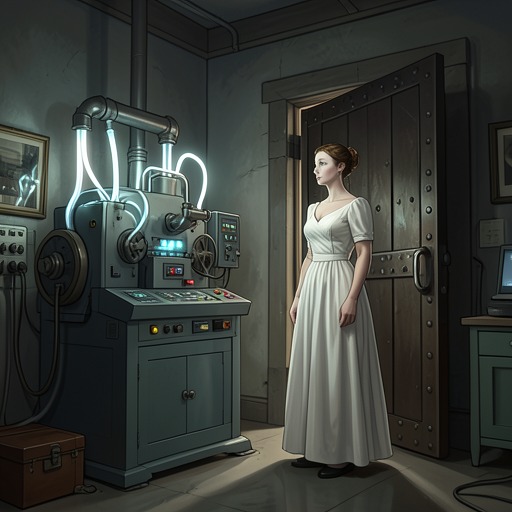
Fiffany
Made for LoveFiffany is Byron Gogol’s indispensable assistant at Gogol, but the novel introduces her chiefly through Hazel Green’s uneasy gaze. Her polished appearance, professional importance, and connection to Byron make her a measure against which Hazel questions her own place in their relationship. Later, Fiffany’s wedding turns a dress from Hazel’s humiliating shopping experience into a quiet instrument of recognition and possible complicity.
Identity and Position
Fiffany is Hazel’s age and has already made herself indispensable to Byron at Gogol. The account establishes her professional standing through Hazel’s assessment rather than through a separate explanation of her duties: Fiffany is the capable, established assistant against whom Hazel, newly attached to Byron’s world, measures her own uncertainty.
Her appearance is described in terms of deliberate polish. She is tall and toned, with glowing skin, highlighted hair, and a strikingly symmetrical face. Her laugh is confident and socially attractive. These details distinguish her from the shapeless, comfortable clothing Hazel has adopted as the standard Gogol worker uniform. Fiffany’s own outfits, Hazel notices, do not look as though they come from the company’s product line. Her presentation therefore marks her as both part of Byron’s professional environment and distinct from its apparent uniformity.
Hazel’s View of Fiffany
Fiffany’s significance is shaped by Hazel’s uncertainty about what Byron wants from her. After Hazel confesses insecurity about finding a wedding dress, Byron arranges for Fiffany to accompany her. Hazel experiences the choice as unsettling: Fiffany is her age, confident, attractive, and already secure in a role at Gogol. The shopping trip becomes more than practical help in Hazel’s eyes; it sharpens her sense of being inadequate beside someone who seems more at ease in the world Byron inhabits.
That comparison also leaves Hazel unsure how to understand Byron’s preferences. She has been wearing the comfortable, shapeless Gogol uniform, which she believes he prefers, while Fiffany dresses with a polish unlike the company’s standard clothing. Byron has told Hazel that he finds Fiffany too concerned with appearance, but Hazel still wonders whether he wishes she were more like her. The novel does not confirm that Fiffany is a rival or that Byron intends the shopping assignment as a comparison. Instead, it shows how Hazel’s insecurity turns Fiffany’s presence and appearance into evidence she tries, without certainty, to interpret.
The Wedding Dress and Its Afterlife
Hazel’s dress-shopping experience is distressing and physically uncomfortable. During the fittings, she has to stand in her underwear and be helped into gowns. One elaborate dress, with cutouts that appear to offer a way out but are blocked by translucent lace, leaves her unable to find an exit for her limbs; she eventually tears her way free. The episode makes clothing feel less like an expression of choice than a problem Hazel must escape. She even asks for pockets, thinking they could hold sedatives on her wedding day.
Six months later, Fiffany marries an EMT in the employee chapel at Gogol headquarters. She wears a smaller version of the dress Hazel had ripped her way out of. The garment’s return binds the two women’s separate wedding scenes together, but the text does not explain how Fiffany came to wear it. During the ceremony, Byron spends most of the time on his device, yet he attends and pauses to admire Fiffany as she walks down the aisle. He also comments on the dress while looking toward Hazel. The scene gives the dress a double meaning: it belongs to Fiffany’s appearance at her own wedding, but it also recalls Hazel’s earlier distress and Byron’s knowledge of it.
Knowledge, Interpretation, and Limited Evidence
Hazel concludes that Fiffany must have shown Byron a video of the dress-fitting episode. The novel presents this as Hazel’s inference, not as a confirmed account of what Fiffany did. What hurts Hazel, in her estimation, is the possibility that Byron and Fiffany shared amusement at her expense. She finds this imagined intimacy more exposing than the prospect of a conventional affair, because it would mean that a vulnerable moment had become material for their private understanding.
Hazel also wonders, while recognizing that the thought may be unreasonable, whether Fiffany’s wedding was staged so Byron could see her in the dress and imagine he should have married Fiffany instead. The narrative does not establish that this was Fiffany’s intention. Two weeks after the wedding, Fiffany is divorced; no reason for the divorce is given. Her marriage and its quick ending are facts, but the suspicions Hazel attaches to them remain suspicions.
Later Appearance and Narrative Role
In a later remote exchange, Hazel sees a brief outline of Fiffany’s head behind Byron in his office. The glimpse confirms only that Fiffany appears to be there; it provides no explanation of her purpose or of her relationship with Byron at that moment. Like the dress episode, the image reaches the reader through Hazel’s perception, where limited evidence and emotional vulnerability meet.
Fiffany consequently remains less a fully narrated counterpart to Hazel than a focal point for Hazel’s questions about belonging, femininity, professional competence, and trust. Her established place at Gogol contrasts with Hazel’s uncertainty, while the repeated dress links Fiffany to an incident Hazel experienced as humiliating and possibly exposed. The novel leaves Fiffany’s intentions largely unstated. That restraint matters: the anxiety surrounding her is clear, but it cannot be treated as proof that she deliberately set out to wound or displace Hazel.