Gogol Diagnostic Facility
Made for LoveGogol Diagnostic Facility is the remote, fortified site where Jasper Kesper exchanges anonymity and much of his remaining savings for access to Gogol’s diagnostic process. Its severe architecture and clockless medical procedures make his arrival a threshold into institutional control: he comes seeking a solution, but must first surrender ordinary measures of privacy, time, and bodily awareness.
Setting and Approach
The facility stands essentially in the middle of a field, guarded like a fort. Jasper’s journey there begins after he has secured the earliest appointment available for an additional fee; he drives all night, repeatedly unsure whether he has lost his way. At the gate, an eerie unmanned vehicle transports him to the actual building. The distance between entrance and destination is therefore not crossed on foot or by a human guide, but under the direction of the facility’s own technology.
The diagnostic wing’s appearance extends that atmosphere. Its building seems made of steel-colored ice, and its silver entrance doors are so thin that Jasper imagines them as two enormous razor blades. Walking through them, he cannot shake the feeling that he is about to be sliced in half. The image gives the threshold a bodily threat: before any procedure begins, the architecture has made entry feel like exposure to an impersonal instrument. The facility does not need to be described as overtly violent for Jasper to experience it as a place where the body may be acted upon.
Admission and the Cost of Entry
For Jasper, reaching Gogol Diagnostic Facility means accepting a lasting loss of anonymity. The intake process would ordinarily have driven him away, and simply entering the building compromises his ability to remain unknown for the rest of his life. Yet he arrives believing he has nothing left to lose and willing to spend his remaining life savings. The decision carries particular weight because the procedures are prohibitively expensive for an average person; the facility’s operator explains that people in ordinary income brackets often depend on fund-raising drives and charity walks to pay for them.
Jasper rejects the prospect of a public fund-raising campaign as a way to finance whatever he seeks. He assures the appointment operator that he will pay with his savings, although the initial survey shows no physical assets or employment record and makes her hesitant to schedule him. He persuades her by agreeing to pay the substantial consulting fee on arrival, then prepays for the procedure in cash. The arrangement gives him access, but only after he converts his private reserves into the price of entry.
The admission process also forces a return to a name he has avoided. A woman carrying a file folder addresses him as Mr. Kesper, his actual last name, which no one has used since high school. Hearing it forms a knot in his throat. Exhaustive identity confirmation is required before the appointment can be arranged, so he has had to be himself in order to enter a place where he hopes to find a solution. The episode makes identification both a practical requirement and an emotional cost of treatment.
Diagnostics and Bodily Control
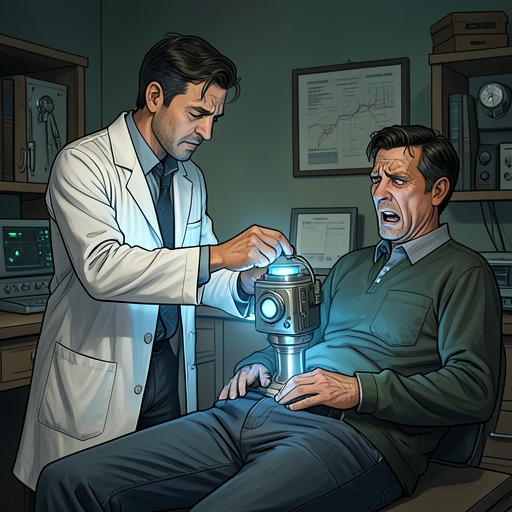
The diagnostics take hours, though Jasper feels as if an entire day has passed. The absence of clocks leaves him without a reliable sense of duration. Staff repeatedly usher him into machines that move around or above him; when one examination ends, another begins. He naps during the process, but cannot tell how much time the succession of tests occupies. Gogol Diagnostic Facility is thus presented not through a clear account of each test, but through Jasper’s diminishing ability to measure or organize his own experience.
His body, too, stops supplying its usual cues. Jasper notices that he has not become hungry and has not needed to use the bathroom. A woman explains that he has received injections, but he asks whether these were shots because he never felt them. The detail sharpens the contrast between the invasive-seeming machinery and the sensations that remain absent: interventions have taken place without his registering them as they happen. The account gives no technical explanation of the injections or individual diagnostic procedures, but it shows how the facility’s process unsettles his ordinary awareness of his body.
After the examinations, a group of scientists watches Jasper as he wakes. Several hold tablets and document him with fingers moving so quickly that they appear blurry. One older woman in a lab coat chain-smokes; though visibly shorter than the others, she seems to Jasper to dominate the room. The scientists behind her appear afraid of him, while Jasper imagines her as a protective mother duck. Their arrangement makes the room feel like both a medical workplace and an observation chamber: he has become the focus of a collective gaze, while one figure commands the group’s attention.
Voda’s Office and the Facility’s Role
Jasper is told that Voda wants to see him immediately. He is still aware of being unclothed and asks whether he should get dressed before being led onward. The brief transition from examinations to consultation preserves his exposure rather than marking a return to ordinary privacy. The facility’s process moves him from machine to observers to decision-maker, with staff directing each step.
In her office, Voda appears relaxed and pensive to Jasper. He notices her skin, which looks heavily processed to him, and compares her stillness to reptiles lying on electric rocks in pet stores. She lights another cigarette and says that she thinks she can help him, then qualifies the assurance with a maybe. Her office therefore offers neither a simple promise nor a complete explanation of what will follow. The cautious exchange leaves the desired solution unresolved while placing Voda, rather than the machines or the intake staff, at the center of Jasper’s next encounter with Gogol.
As a setting, Gogol Diagnostic Facility concentrates the uncertainty of Jasper’s decision. Its fortress-like approach, blade-thin doors, expensive procedures, identity checks, and clockless examinations turn hope into a passage through controlled space. Jasper has arrived prepared to spend his savings and surrender anonymity, but the facility first makes him wait, undergo tests he cannot fully track, and appear before an observing scientific group. Voda’s qualified offer of help closes the encounter without settling its outcome; the institution’s promise remains powerful precisely because Jasper has already paid so much to reach it.