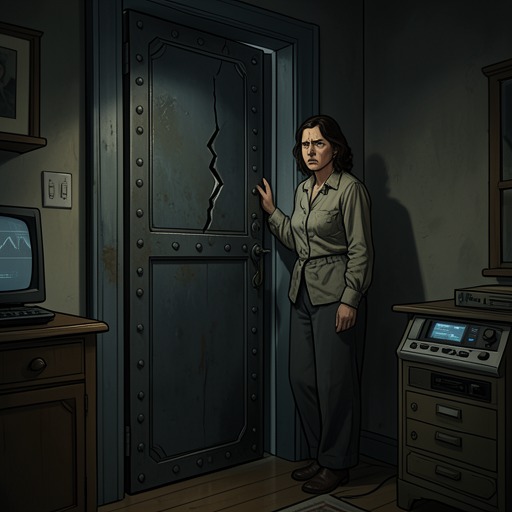
Hazel Tries to Evade the Download with the Sleep Helmet
Made for LoveHazel Tries to Evade the Download with the Sleep Helmet is Hazel’s attempt to interrupt the daily brain download by using a device Byron had placed in the safe. She turns a household box into a shelter, but the effort fails: the helmet can quiet her mind without stopping the images from arriving. The scene makes the gap between a technology’s soothing effects and its ability to protect her mental privacy physically immediate.
The Deadline and the Plan
The next morning, Hazel wakes without knowing what time it is; Liver does not know either. Her uncertainty has a hard limit: she needs to get home before the next download at noon. The deadline shapes the scene from its first practical decision, making time—not simply fear—the pressure behind her plan.
Hazel asks Liver to come to her house and help lift something. His glance at a shovel in the shed suggests that he takes the possibility of a body seriously. That macabre misunderstanding gives the request an edge of humor, but the object she needs moved is Diane’s box. Hazel is not seeking help to stop the download directly; she needs to get inside the box and wants someone present while it happens.
At the house, Hazel’s Father (Herbert) and Diane are playing cards in the kitchen breakfast nook. Hazel tells her father that a friend will help bring Diane’s box to the porch, asks him not to judge the friend by his appearance, and assures him that he poses no danger. The explanation keeps her immediate plan separate from the download she is trying to resist. Her father continues the card game with Diane, while Hazel turns to the helmet and the box.
Turning the Box into a Shelter
Hazel retrieves the Sleep Helmet Byron included in the safe. Its presence gives her reason to suspect that wearing it during a download will not prevent the process; she doubts Byron would have included it if it could block the downloads. Still, she considers the helmet worth trying. She wonders why the download comes at noon rather than midnight and whether sleep might make her memories harder to extract. Rather than trusting either possibility, she wants to try every obstacle available to her.
Hazel does not want to be alone when the download arrives, but she also does not want Liver to witness it. She tells him she will put on the helmet and climb into the box for a few minutes, without knowing exactly what will happen, and suggests that he wait in another room. After Liver asks whether she intends to shut the lid, Hazel asks him to help. He says he will make air holes for her health, an incongruous practical kindness that acknowledges the immediate danger of enclosing herself.
Inside the box, Hazel lies back wearing the helmet and activates its beta-wave sequence. The induction feels pleasurable, and the ease with which her mind clears frightens her. Her recurring image is not peaceful in any ordinary sense: she pictures a zookeeper pushing a large broom across the soapy cement floor of a cage. The rasp of its bristles recedes from the center toward the edge of the room; the disinfectant’s bubbly sheen becomes a thin consciousness that spreads until it disappears. The scene grants Hazel a brief experience of mental quiet, but it also situates that quiet in an image of cleaning a cage.
The Download Breaks Through
When Byron’s images begin, the calm is abruptly replaced by force. Hazel experiences them as impacts between her eyes, one after another: Byron accepting an award, delivering a speech, and standing among children in a rural African village. They rush toward her like billboards she is being flung against. The sequence brings Byron’s public image into the enclosed space where Hazel has tried to withdraw from him; the download does not arrive as an abstraction but as a barrage of particular pictures.
The images stop, but Hazel’s head continues to feel hammered. At first she cannot make sense of her attempts to sit up without opening the lid. Then she realizes that she is in the box with the helmet still on. That recognition restores the physical setting around an experience that has felt like an assault from within her own mind: she has not escaped the download, and she is also confined by the shelter she chose.
Hazel releases the helmet’s visor, turning its eyepiece transparent, presses against the box’s lid, and climbs out. The download has not been thwarted. She is shaking, though she sees no vomit; using the crate for support, she gets to her feet and teeters into the living room. The bodily aftermath makes the failure visible: the helmet’s quieting induction did not spare her the images or their effects.
Aftermath and Significance
Her Father and Liver are having a beer when Hazel appears. Her father asks Liver whether he is ex-military, and Liver replies that he is not keen on government. Hazel has lifted the visor but forgotten to remove the helmet. The exchange returns the scene to ordinary conversation without concealing her disorientation: the object she used in a private attempt to resist the download remains conspicuously on her head.
The attempt is significant because Hazel approaches the helmet neither as a guaranteed solution nor as something she trusts. She notices the suspicious circumstance of Byron’s having supplied it, forms a tentative theory about sleep and the timing of the download, and tests that theory under a deadline. The failure distinguishes a temporary clearing of consciousness from protection against the brain download. The box, helmet, and air holes can make a precarious place to endure the event, but they cannot keep Byron’s images out.