Hazel's Father Dies
Made for LoveHerbert’s death is the abrupt end of Hazel’s plan to delay medical care until her father could no longer refuse it. She had hoped to bring him to The Hub and return to Byron, but his decline outruns that arrangement. Instead of a hospital-room death, he dies at home, in a scene that leaves Hazel not with revelation or release but with a stunned sense of anticlimax, followed by a decision that puts her own life at risk.
Causes and Deferred Care
Herbert had been telling Hazel each day that he might have only a few weeks to live. She discounted the warning partly because his predictions had long been colored by extravagant pessimism. Before family vacations in their sedan, he would forecast ruined motels, infected bedsheets, overpriced tourist traps, and even bugs laying eggs in his imagined open sores. The trips never proved so disastrous; on the way home he would announce that they had dodged a bullet. That history gave Hazel reason to expect another false alarm, but this time the familiar gap between his dire forecasts and reality closed. His fever would not break, and he could not keep food down.
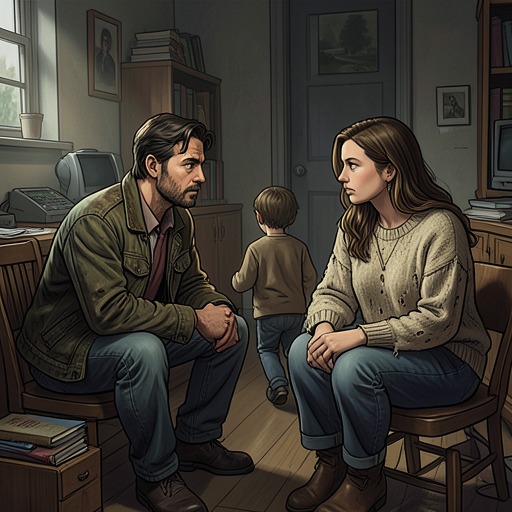
Hazel repeatedly begged him to go with her to the medical center. Herbert still had enough strength to spit on the floor and refuse, insisting that he was not leaving and that nobody was asking Hazel to stay. She wished he would ask her to remain, but recognized that his decline was not going to bring the emotional delicacy she wanted. He had asked her to put Diane and Roxy into bed with him. Hazel imagined that his periods of unconsciousness would soon grow deeper and farther apart; she planned to wait until he could no longer fight admission, then call Byron and tell him they were ready. There were bitter things she wanted to say before medical personnel arrived, but she did not want to provoke a final quarrel. Herbert had withdrawn into his own private space and wanted to approach death without an audience, at least not a living one.
The Death at Home
The immediate sign that something had changed is a low wail from Herbert’s bedroom. Hazel hears it as a raw accumulation of misery, then enters. Her father’s mouth is open as if he is about to speak or sound a note, but his lips remain parted and still. Hazel runs to his side and listens for a final word or even a small noise that might mark the departure of his soul. Instead, the image that presents itself to her is of death entering between his teeth. She calls to him, but there is no response.
Herbert has spent the preceding weeks in a bathrobe. Between the dolls, he looks to Hazel less like the patient in the hospital death she had imagined than like an elderly partygoer who has died in the middle of an incongruous gathering. Her expected version of his end involved a dim room, beeping machines, a hospital bed, and Herbert complaining to an orderly about the flavor of the turkey before collapsing mid-rant. The actual scene is both less dramatic and stranger: he has died at home, dressed only in his robe and surrounded by the dolls she had placed with him. Hazel tells him he went out on top, then qualifies the remark. The joke does not make the death triumphant; its hesitation registers the awkward mismatch between the line and what she is seeing.
After she leaves the bedroom, Hazel hears vague digestive noises and gurgles beneath the covers, compared to the staccato sounds of an engine cooling after a long drive. The bodily detail refuses a clean, ceremonious passage from life into death. It keeps the event close to the ordinary material world even as Hazel tries to make sense of what has happened.
Hazel’s Response and Immediate Consequences
In the living room, Hazel does not experience the grief she expects herself to feel. Her first response is closer to accepting an anticlimax: major events, she thinks, never seem to feel important enough. Her father has died, yet she feels neither transformed nor especially glum, and she tries to make herself upset about not being more upset. The reaction is not evidence that the relationship meant little to her; the account instead emphasizes the distance between an event’s magnitude and the feeling Hazel can access at that moment.
Practical danger quickly presses in. The clock shows just after four in the afternoon, and Hazel reckons that, at best, she has twenty hours before Byron learns her father is dead. She believes she must return to The Hub; otherwise, no one still living whom she might care about, even briefly, will be safe. The earlier plan—to wait for Herbert’s weakness, then call Byron and take her father for care—has become impossible. Her father’s death leaves her facing a decision about her own return while she is still unable to process the loss.
Instead of acting on that plan, Hazel walks down the hall to the bathroom with a disturbing sense of practiced ease. She swallows a full bottle of Herbert’s heavy opioids with tap water, then goes to the kitchen and drinks large gulps of his cheap whiskey. The sequence makes his death the immediate threshold to Hazel’s suicide attempt: the medicines and liquor are taken from the home and habits that defined his final days, and her deliberation gives way to action.
Thematic Significance
The death turns a familiar family pattern inside out. Herbert’s earlier forecasts of disaster had repeatedly exceeded what happened; now Hazel’s expectation that his condition might still allow time for a managed transition proves misplaced. The story’s recollection of her mother explaining that looking at what is not beautiful is looking at reality sharpens the contrast between imagined endings and the unadorned one Hazel witnesses. There is no hospital tableau, final speech, or sudden emotional insight to organize the loss for her.
The scene also makes the end of Herbert’s life a point of entanglement rather than closure. His refusal of care, Hazel’s delayed call to Byron, the presence of Diane and Roxy, and her urgent fear for the living converge in a cramped domestic aftermath. Herbert is dead, but Hazel cannot settle into mourning: the limited time she believes she has before Byron discovers the death and her sense that others may be endangered press her toward The Hub, while her immediate action moves in the opposite direction. The anticlimax of grief thus becomes the prelude to a crisis, not a resolution.