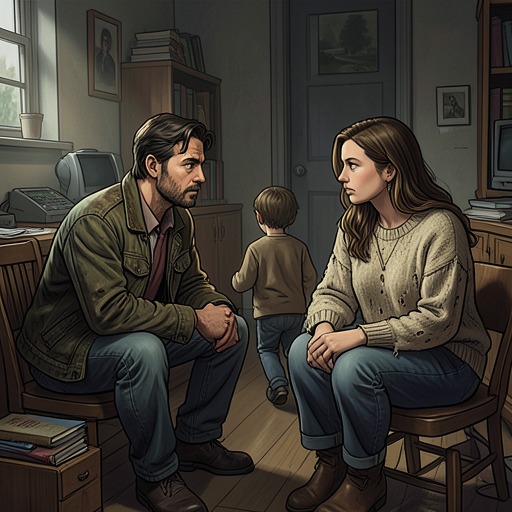
Hazel's Father (Herbert)
Made for LoveHazel's Father (Herbert) is both a host trying to establish a private life with Diane and the parent whose home gives Hazel shelter. The scenes present him through small negotiations rather than a broad biography: he asks Hazel to recognize Diane as a person, seeks privacy for the two of them, and ultimately becomes someone Hazel openly credits with giving her a roof. Hazel’s return to calling him her dad makes their bond feel newly affirmed, while her need for refuge gives that affirmation practical weight.
Identity and Household
Hazel's Father (Herbert) shares his home with Diane and describes their relationship in the language of a honeymoon. He says he will not need to leave the house much anymore, then calls the period ahead a honeymoon phase with her. The remark establishes Diane as the center of his anticipated domestic life, though the evidence does not explain what he has sold or why his plans involve staying home. Those details remain unstated; what is clear is that he imagines his household changing around this new partnership.
His choice of language also sets up a contrast between how he understands Diane and how Hazel might first perceive her. When Hazel is present, he insists Diane is not a doll and asks Hazel to acknowledge her personhood and greet her. The exchange makes recognition, not mere politeness, the issue he presses. He does not simply introduce Diane; he corrects the category Hazel is using and asks her to respond to Diane as someone deserving ordinary social acknowledgment.
Domestic Boundaries
The request for Hazel to greet Diane sits alongside a later request that Hazel leave the two of them alone. After Hazel comes down the ladder, a crushed beer can near her foot leaps into a coffin when she taps it. The accidental movement interrupts the evening, and her father says that this is not the honeymoon evening he had imagined. He asks whether he and Diane might have some privacy before they lose the opportunity, and suggests Hazel could walk to a neighborhood bar.
The scene gives his desire for intimacy a comic, practical shape: a disrupted evening, a household object behaving unpredictably, and a proposed destination for Hazel. His appeal is direct, but it is also framed as a request for time alone with Diane rather than a rejection of Hazel. That distinction matters beside the later evidence that his home provides her a roof. The household must accommodate both his new relationship and Hazel’s need to stay; the scenes show the friction without establishing a final arrangement or how long it lasts.
Hazel’s Refuge and Public Identity
Hazel later describes herself to a watching crowd as one of Herbert’s nieces. The account presents this as a public claim, not as a reliable statement of their actual relationship: Hazel is his daughter, as her later address to him as her dad makes clear. She considers the possibility that Byron has spy cameras on her and regards the many onlookers as witnesses. Bird-watchers with binoculars and nosy neighbors are part of the crowd she imagines as a safety net. The family connection therefore matters not only inside the home but also as a resource Hazel invokes before other people.
Her choice to present herself as a niece complicates the simpler language of shelter and kinship. In that moment, Hazel does not announce the closest available family label. Instead, she makes a more guarded public claim while calculating how the crowd might protect her from being watched or pursued by Byron. The evidence does not establish what the crowd actually does, or whether Byron is in fact monitoring her. It does show Hazel treating witnesses as potentially useful and her connection to Herbert as part of the setting in which she seeks safety.
Recognition and Significance
Hazel later tells her father that he is officially her dad again and that she would have no roof over her head without him. Her wording joins emotional recognition to material dependence: she affirms the relationship while naming the home he has provided. The word again suggests a renewed or restored status between them, though these scenes do not explain what preceded that change. Her gratitude is concrete, grounded in having somewhere to live rather than in a generalized declaration of affection.
Taken together, the scenes define Hazel's Father (Herbert) through a pair of domestic responsibilities that are not entirely in step. He asks Hazel to make room for Diane and for the privacy of their partnership; Hazel, meanwhile, needs the shelter of his home and at one point uses their family connection as a protective public identity. Neither role cancels the other. His request for an evening alone does not erase the roof he offers, and Hazel’s guarded presentation to the crowd does not prevent her later recognition of him as her dad. The character’s significance in this evidence lies in that overlap: the household is a place where new intimacy requires boundaries, but it is also the refuge that lets Hazel acknowledge dependence and belonging.