Jasper
Made for LoveJasper is a practiced con artist whose carefully timed romances make intimacy a means of extracting money, until a dolphin attack and its aftermath unsettle the routines that have governed his life. His movement from calculated deception toward remorse is neither immediate nor simple: bodily and emotional changes force him to confront what he has done, while his attempt to help Hazel gives that new conscience a concrete, dangerous purpose.
Identity and Method
Jasper approaches romance as a repeatable scheme. For several years, he generally kept to a six-month timetable, moving through courtship, a committed relationship, and the con in three evenly divided stages. The structure brought reliable financial returns, but it also made his work feel dull. Rather than abandon the formula, he began casting a wider net and considering whether he could deceive especially gullible partners more than once. His own account of the practice makes its underlying logic plain: people become steps in a process he can schedule and measure.
By the time Elizabeth gives him her 401(k), Jasper has been in the same large beach town for nearly a year, far past the period he considers prudent. She writes him a check for $38,000, her entire current retirement account, supposedly to support his first year of medical school. He reassures her that the investment is safe and frames repayment as a future matter between spouses; in reality, he waits until the check clears, sends a breakup text, destroys his phone, and buys another. Elizabeth nevertheless finds the motel where he is staying and reaches his room. Her persistent attempts to get his attention at the window make visible the risk his extended stay has created. Jasper recognizes that he has grown careless, yet also finds the danger exciting.
His self-deception reaches beyond the mechanics of fraud. Looking back on his relationship with Elizabeth, he treats a private, intimate detail as if it had foreshadowed the con, then imagines that she will have to adjust to a future unlike the one he promised. The retrospective cleverness is characteristic: he converts another person's loss into a story that flatters his own foresight, even though his exposure at the motel shows that he has misjudged the situation.
The Dolphin Attack and Loss of Control
After deciding to leave town, Jasper goes into the water. During the ensuing attack, he is pulled beneath the surface and struck repeatedly. Confused and short of oxygen, he first fears a human assailant or a dangerous sea creature, then recognizes that the attacker is a dolphin. Before that recognition, he calls out Elizabeth's private nickname by mistake, an absurd flash of the recently abandoned relationship amid a moment of mortal danger.
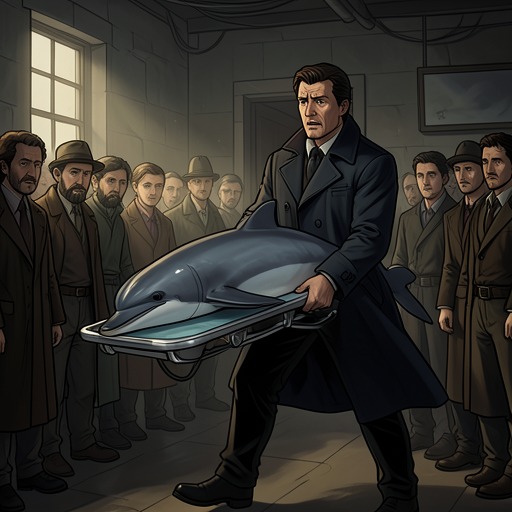
Jasper survives and brings the living dolphin onto the sand. The crowd gathers around the animal, giving him an opportunity to run before anyone follows him back to his motel. That night he sees himself on the local eleven o'clock news. An elderly witness presents his emergence from the water as a religious tableau, while an intoxicated tourist calls attention to being on television. Jasper curses at the broadcast, but he understands that he has escaped immediate pursuit. The same event thus turns him into a public figure, briefly, while he is trying to disappear.
The attack also alters his sexual response. When Jasper later tries to summon desire by recalling Elizabeth, the memory no longer works as it once did. Physical stimulation instead brings the dolphin's chatter to mind, and the sound produces an involuntary response that frightens him. This change strikes at a central source of his confidence: he has regarded the timing and control of his arousal as one area of life he could reliably command, even while manipulating other people and moving from place to place. Now his body seems to answer to something beyond his chosen script.
Treatment and Voda
Jasper eventually agrees to try a procedure associated with Voda's work. During the experience, his mind places him beside Bella's tank at the Oceanarium, imagining Bella rising from the water and approaching him. The apparent intimacy is part of the treatment's dolphin simulation, not a reunion with the animal. When the experience ends, the applause around him comes not from an audience at the Oceanarium but from the surgical crew. Voda dismounts, buttons her white coat, and tells him that the procedure worked; medical staff then free his restrained, numb limbs.
Jasper tries on the old smile he used to wear at the successful end of a con. It no longer feels familiar. The contrast marks a break between his former confidence in performance and the unfamiliar sensations that follow the treatment. In Voda's company he begins to experience reactions he has not known before, including discomfort when he recognizes that her interest in what he says is tied to her work.
He eventually tells Voda that he loves her, explaining that he thinks about her constantly and hates being apart from her. The admission surprises him because his former self would have experienced both the feeling and the honesty of confessing it as defeat. Voda does not return his love. She acknowledges that he is young and handsome but tells him plainly that she does not love him. Jasper asks whether she could ever grow to love him, his voice cracking; the vulnerability is new enough that he notices it, but he no longer reacts with the old shame. His emotional change has not made him invulnerable to rejection. It has made him more capable of naming what he feels and enduring an answer he cannot control.
From Remorse to Action
A rabbit-masked woman, who describes herself as Voda's close colleague and confidante, approaches Jasper as he is preparing to leave. She says Voda has described him as burdened by conscience and driven to do good. Her proposal is dangerous: someone has been subjected to brain manipulation much worse than Jasper's, and a syringe she holds can deactivate the chip in that person's head. The person is Hazel. The offer gives Jasper a way to put his remorse to practical use, but it requires him to risk his life rather than merely express regret.
Jasper leaves Voda a note saying that he loves her, while also acknowledging the role she has played in forcing this new condition upon him. He understands that he will probably never see her again and recognizes, with painful clarity, that this is how the people he conned must have felt when he left them—only they had also lost their money. The comparison turns his earlier victims from abstract marks in a profitable routine into people whose hurt he can imagine from the inside.
On the road, Jasper is no longer traveling to find a new city or another target. He intends to save Hazel, and he carries duffle bags of money that he plans to return to as many former victims as he can locate, leaving unmarked cash packages at their homes. He describes the undertaking to himself as a tour of goodwill, but the first stop remains uncertain: he has been told that a trailer's back sliding-glass door may be the best way in if nobody answers the front, and he hesitates when he sees several people in the bed inside. His change of purpose is real, but it does not make him instantly sure-footed or guarantee success.
Hazel and the Changed Jasper
Later, Jasper waits outside when Hazel finishes her shift. Instead of slipping away or concealing himself, he climbs onto the hood of his car, throws up his hands, and yells in celebration. Hazel glances back toward Ms. Cheese, who watches from behind the blinds, then invites Jasper to celebrate somewhere else, suggesting her home and the news. The reunion is brief, but its terms differ from his old romances: Jasper arrives openly, and Hazel chooses whether to go with him.
Jasper's arc does not erase the financial and emotional harm of his cons, nor does remorse by itself repair it. The planned returns of money and the attempt to deactivate Hazel's chip make his changed conscience consequential through action, while the dolphin-triggered loss of control has already exposed how fragile his carefully managed identity was. His old smile can still appear, but it no longer fits him as it once did. By the time he meets Hazel after her shift, the former trickster's exuberant public gesture is attached to an effort to help rather than to a successful deception.